
Skip to content Site Search

Menu

Home

We’re an independent, nonprofit newsroom reporting on gender, politics, policy and power. Read our story.

Topics

  • Politics
  • LGBTQ+
  • Health
  • Justice
  • Caregiving
  • Education
  • Abortion
View all topics

Daily Newsletter

Your trusted source for contextualizing the latest election news.

Look for a confirmation sent to

Did you mean

The email didn't go through.

or Contact us for support
  • Latest Stories
  • Our Mission
  • Our Team
  • Strategic Plan
  • Support the 19th
  • Search
  • Contact
Donate

Republish This Story

* Please read before republishing *

We’re happy to make this story available to republish for free under an Attribution-NonCommercial-NoDerivatives Creative Commons license as long as you follow our republishing guidelines, which require that you credit The 19th and retain our pixel. See our full guidelines for more information.

To republish, simply copy the HTML at right, which includes our tracking pixel, all paragraph styles and hyperlinks, the author byline and credit to The 19th. Have questions? Please email partnerships@19thnews.org.

— The Editors

Loading...

Modal Gallery

/
Home

We’re an independent, nonprofit newsroom reporting on gender, politics, policy and power. Read our story.

Daily Newsletter

Your trusted source for contextualizing the latest election news.

Look for a confirmation sent to

Did you mean

The email didn't go through.

or Contact us for support

Become a member

We’re an independent, nonprofit newsroom reporting on gender, politics, policy and power. Read our story.

Two speech bubbles, one with an outlined border and one with a lilac fill.

Make sense of the midterms

Get through election week with our daily newsletter covering the women and queer people still fighting to be seen and heard in our democracy.

Subscribe Now

The 19th thanks our sponsors. Become one.

Politics

Women of every race and ethnicity broke representation records in statehouses after the 2022 midterms

Women still lag in representation in elected office, but a number of new highs were hit, according to data compiled by the Center for American Women and Politics.

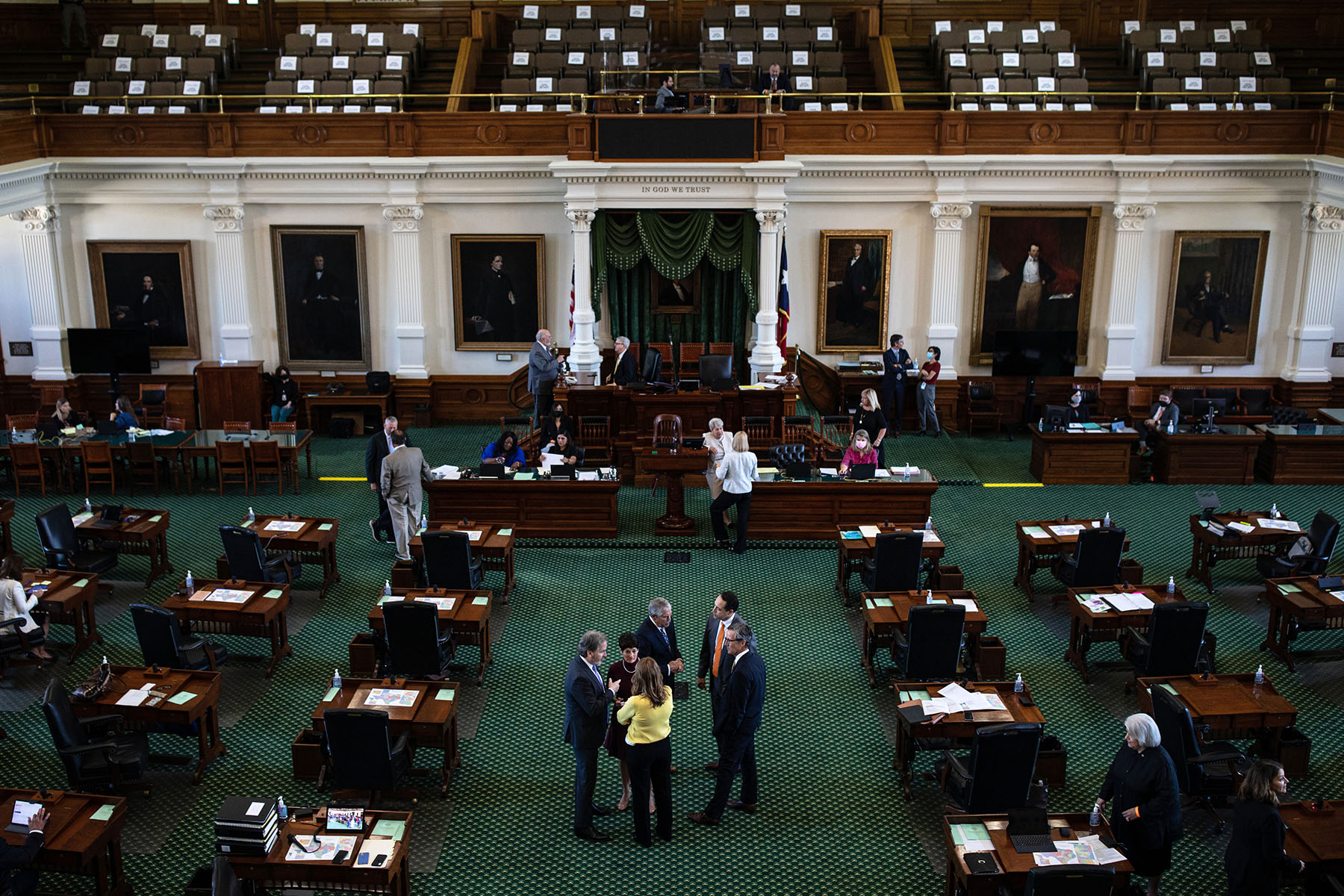
Texas state senators are gathered at the State Capitol in Austin, Texas.
Texas state senators are gathered at the State Capitol in Austin, Texas. (Tamir Kalifa/Getty Images)

Barbara Rodriguez

Health Reporter

Published

2023-06-14 05:00
5:00
June 14, 2023
am
America/Chicago

Share

  • Bluesky
  • Facebook
  • Reddit
  • Email

What do you want to know about politics? We want to hear from you, our readers, about what we should be reporting and how we can serve you. Get in touch here.

Women hit new levels of representation in statehouses after the 2022 midterms, with new records being set by Asian American/Pacific Islander, Black, Latina, Native American, Middle Eastern or North African, and White women, according to the Center for American Women and Politics (CAWP) at Rutgers University. 

Kelly Dittmar, director of research and a scholar at the center, said the gains in representation are spread out across states, and the reasons vary.

The 19th thanks our sponsors. Become one.

“There is no one ‘why’ on the record,” she said.

As the nation becomes more diverse, so does demand for that to be reflected in who holds elected office. That can manifest in more women of diverse backgrounds running for office, or party leaders, funders and other recruitment groups being more supportive of those bids.

More like this

  • More AAPI women are becoming federal judges, but barriers remain in the rise to the bench
    Judges Neomi Rao (left) and Florence Pan at their respective appears before the Senate Judiciary Committee confirmation in 2019 and 2022.
  • Just 37 members of Congress are mothers with minor children
  • Why the 2022 election was historic for Muslim women’s representation

“Some of it may be self-selection, and some of it is recruitment and targeted efforts to encourage these women to run,” Dittmar said. “Some of it is a combination of both.”

Dittmar also noted that 2022 was the first election after a redistricting period that in some states meant new district lines and fewer incumbents. Women still lag in representation in statehouses overall. Currently, there are 2,412 women state legislators, which represents 32.7 percent of 7,383 seats

“Redistricting often creates opportunities, especially for those who have been previously kind of marginalized in these systems, because otherwise incumbency is a really strong force,” Dittmar said.

Here’s what CAWP’s data on women serving in state legislatures by race and ethnicity show for representation. Some lawmakers identify as more than one race and are counted more than once in this list:

  • 98 Asian American/Pacific Islander women; 91 are Democrats, six are Republicans and one identifies as nonpartisan. The previous record was 78, set in 2022, before the election. 
  • 372 Black women; 367 are Democrats, three are Republicans and two are independents. The previous record was 368, set in 2022, before the election. 
  • 190 Latinas; 166 are Democrats and 24 are Republicans. The previous record was 156, set in 2021. 
  • 36 Native American women; 30 are Democrats and six are Republicans. The previous record was 32, set in 2022, before the election
  • 13 Middle Eastern or North African women; all are Democrats. The previous record was 11, set in 2021.
  • 1,728 White women; 945 are Democrats, 759 are Republicans, four are independents and 20 identify as nonpartisan. 
  • Two women, both Democrats, identified as multiracial alone. 

CAWP contacted women officeholders directly to confirm how they identify and used public records where they have self-identified. The center could not confirm racial and ethnic identification for 25 women state legislators.

Latinas gained in Florida and Arizona, which both have substantial Latinx populations. In Florida, the net gain was one, but party composition changed, from an even split to seven Republicans and two Democrats. In Arizona, meanwhile, Democratic Latinas gained several seats, from seven to 14. 

While Black women’s representation continues to increase in statehouses, the growth is not as large as some other groups. In South Carolina, the number of  Black women state legislators dropped, from 13 (all Democrats) to seven (six Democrats, one Independent).

“There is more work to do across all groups, but some of the momentum we’re seeing in these gains are coming from the groups where we’re also seeing the greatest demographic change,” Dittmar said.


Share

  • Bluesky
  • Facebook
  • Reddit
  • Email

Recommended for you

  • Sarah Trone Garriott smiles with both arms raised behind a podium on election night. American and Iowa state flags hang behind them as supporters hold campaign signs in the foreground.
    A seismic shift in Iowa: No Republican women will serve in Congress next year
  • Lahn receives an ear of corn from children.
    Two millennial dads are making MAHA moms’ priorities a campaign strategy
  • Cynthia Villarreal, wearing a white blouse, stands outdoors among flowering bushes and trees, looking off to the side in the sunlight.
    The power of Latinas’ Trump regret could swing this election
  • Rep. Maria Elvira Salazar speaks with reporters as she departs a House Republican Conference meeting at the Capitol.
    ‘Back stabber’: Trump lashes out at Latina congresswoman who criticized his immigration crackdown

Daily Newsletter

Your trusted source for contextualizing the latest election news.

Look for a confirmation sent to

Did you mean

The email didn't go through.

or Contact us for support

Become a member

Explore more coverage from The 19th

  • Politics
  • LGBTQ+
  • Health
  • Justice
  • Caregiving
View all topics

Site Footer

Support representative journalism today.

Learn more about membership.

  • Give $19
  • Give $50
  • Give $100
  • Any amount

Transparency

  • About
  • Team
  • Contact
  • Privacy Policy
  • Community Guidelines
  • Gift Acceptance Policy
  • Financials

Newsroom

  • Latest Stories
  • Strategic Plan
  • 19th News Network
  • Events
  • Careers
  • Fellowships

Newsletters

  • Daily
  • The Amendment
  • Menopause
  • The Mom Guilt Economy
  • View all

Support

  • Ways to Give
  • Sponsorship
  • Republishing
  • Volunteer
  • Merch

The 19th is a reader-supported nonprofit news organization. Our stories are free to republish with these guidelines.