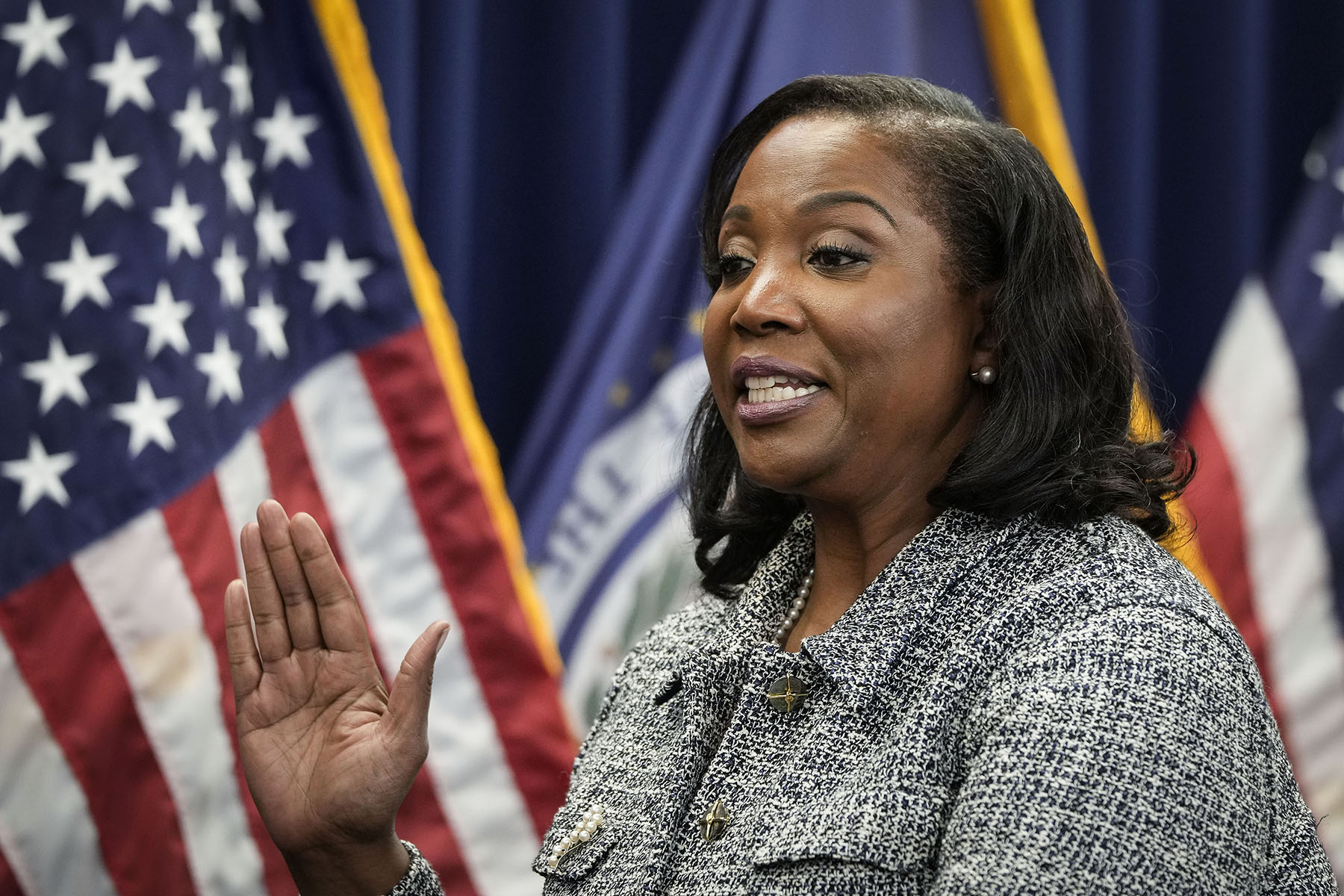

The Supreme Court on Monday ruled that President Donald Trump could not fire Federal Reserve Board Governor Lisa Cook — at least for now.
Cook, who has published research centering on race and inequality and advocated for other Black women in economics, in 2022 was confirmed as the first Black woman to serve on the independent Federal Reserve Board, which sets U.S. monetary policy and regulates financial markets.
In August, Trump said he intended to fire her, a dramatic escalation in his attempts to pressure the Federal Reserve to lower interest rates.
In his letter dismissing Cook, Trump cited allegations that Cook engaged in “deceitful and potentially criminal conduct” of mortgage fraud by listing two residencies as her primary residence on loan applications. Cook has not been charged or convicted with any wrongdoing in connection to the allegations, which relate to applications she submitted before her service on the Federal Reserve. Trump’s allies have levied similar accusations against other perceived political opponents, including New York Attorney General Letitia James and Sen. Adam Schiff of California.
A president can only fire a member of the Board of Governors for “cause,” which has been interpreted to refer to gross misconduct in office. In an August statement, Cook said she would not step down and there was “no cause” for Trump to try to fire her.
“I will not resign,” she said. “I will continue to carry out my duties to help the American economy as I have been doing since 2022.”
The Supreme Court on Monday ruled that Cook had the right to appeal her dismissal and could stay in the position on the independent board during that process.
Much of Cook’s economic research has centered on international economics, particularly the post-Soviet Russian and Nigerian economies, and on race in America, including the impacts of lynchings and segregation and the history of Black innovation.
One of her best-known papers found that violent lynchings of Black Americans between 1870 and 1940 reduced the number of patents awarded to Black inventors. Cook has written and co-authored other research papers and articles on the links between segregation and lynchings, the mortality consequences of distinctively Black names, and causes and ramifications of current gender and racial disparities in innovation and patent filings.
Before then-President Joe Biden appointed her to the Federal Reserve, Cook was a professor of economics and international relations at Michigan State University. She served on the Council of Economic Advisors in the Obama administration and in the Treasury Department’s Office of International Affairs from 2000 to 2001. She attended Spelman College, a historically Black women’s college, and Oxford University as a Marshall scholar, later earning her Ph.D. in economics from the University of California, Berkeley.
“I spent my childhood in Milledgeville, Georgia, in the midst of the rural, desegregating South,” she said in her 2023 congressional nomination hearing for a full term on the Board of Governors. “My dedication to public service was invigorated by observing the courage and resolve of my late parents and other members of my family. We stood alongside friends and neighbors whose names were never recorded, and others, like the Rev. Dr. Martin Luther King, Jr, whose memories are engraved in our nation’s history.”
Cook has also advocated for women and people of color in economics, including in her role directing the American Economic Association’s Summer Training Program from 2018 to 2021. Black women are heavily underrepresented in the White and man-dominated profession of economics, which in turn has led to underrepresentation on decision-making bodies like the Federal Reserve.

Support The 19th’s ambitious plans
As part of our three-year strategic plan, we’ll keep showing up in the way you’ve told us you need us to: as your relatable guide to an unequal nation. Your support will help drive our plan forward.
The Supreme Court on Monday ruled that Cook had the right to appeal her dismissal and could stay in the position on the independent board during that process.
In 2019, Cook and Anna Gifty Opoku-Agyeman, then a pre-doctoral student, published a New York Times op-ed highlighting the barriers facing Black women in economics, which include discrimination, harassment and inequality in publication citations. Opoku-Agyeman, a doctoral student at Harvard Kennedy School, later co-founded the Sadie Collective, an organization focused on growing the pipeline for Black women in economics and related fields. It’s named for Dr. Sadie T.M. Alexander, who in 1921 became the first Black woman to earn a Ph.D. in economics.
Alexander, they wrote in the op-ed, “switched to law because of the racism and sexism she encountered. A century later the experience of black female economists is disturbingly similar.”
Fatima Goss Graves, president and CEO of the National Women’s Law Center, said in August that Trump’s attempt to fire Cook was “further evidence of his strategy to illegally dismantle a politically independent body he cannot control.”
“Time and time again, the president has targeted Black women leaders and has tried to push them out of positions of power,” she said. “As prices continue to rise and his public approval falls, Trump is trying to distract the nation from his failures by removing the experts and replacing them with political loyalists who will blindly carry out his destructive agenda, whatever the cost to our nation and to working families.”