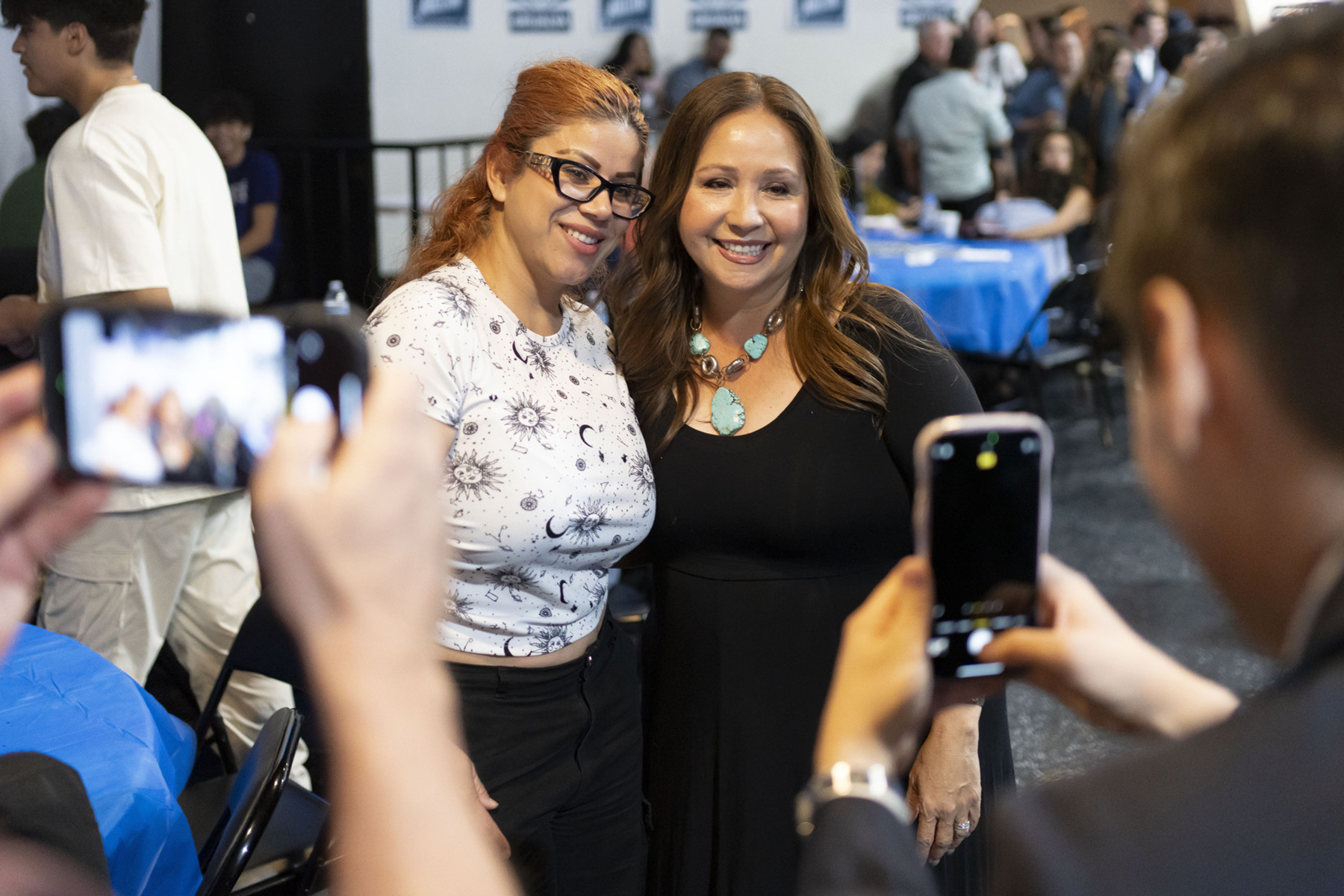
TUCSON, ARIZONA — On a recent Saturday morning at Adelita Grijalva’s campaign headquarters, the mood was festive. Music blasted from speakers as volunteers — most of them clad in navy blue “All in for Adelita” shirts— ate treats from a local Mexican bakery in the parking lot and waited for their marching orders.
The canvass kickoffs typically have a theme to rile up volunteers before they head out to the streets. This day, the rallying cry was around reproductive rights.
Grijalva gave a speech to the small crowd, describing how her 18-year-old daughter, Adelina, briefly had fewer reproductive rights than her great-grandmother. She was referring to a window of time last year, when the state Supreme Court upheld a near total abortion ban from 1864, when Arizona was still a territory. In November, voters enshrined the right to an abortion in the state constitution. “That is something that we can’t go backwards on,” she told the small crowd. “We are going to have to fight for things that have already been fought for.”
In a district where 52 percent of voters are Latinx, supporters see Grijalva as someone who not only understands the importance of defending reproductive rights, but also the rights of immigrants at a time when both are under threat.
“Our rights are being stripped in every aspect of our lives, from the ICE raids, especially in this immigrant community, but even with abortion rights being rolled back,” said Jacqueline Ortiz, a volunteer with the campaign. “I think a lot of Democrats, especially young liberals, are a little bit frustrated with how our party has not taken an offensive position, and we’ve been on the defensive. And I know that she’s just going to hit the ground running in Congress to actually do something to fight against the immigration raids, for abortion rights.”
-
Read Next:

Grijalva is expected to cruise to victory in the solidly blue 7th District in a Tuesday special election and become the first Latina ever elected to Congress from Arizona. She’s up against Republican candidate, Daniel Butierez, a political newcomer, who has mostly self-funded his campaign. It’s a significant milestone for representation in a state that has the fourth largest share of Latinx voters, and where Latinx voters’ growing political power has made them a decisive bloc ahead of the 2026 midterm elections.
Latinx voters make up a quarter of all eligible voters in the state. Their numbers have more than doubled since 2000, a rate that is expected to continue outpacing non-Latinos.
Latinas, specifically, play a critical role for Democrats. Latinas register and turn out at higher rates than Latinx voters overall and they tend to favor Democrats by larger margins than Latino men. Latinas represent 1 in 5 women voters in Arizona.
“For the longest time in Arizona, the people that did the work and were behind the scenes have been women, particularly in movement and in electoral politics,” said Alejandra Gomez, the executive director of Living United for Change, or LUCHA, a Democrat-aligned advocacy group that represents working-class Arizonans and works to expand Latinx political participation.
“Through all of the work and years of women really sacrificing and being servant leaders, now we have the opportunity to have a woman lead.”
Grijalva is running to fill the seat held by her father, former Rep. Raúl Grijalva, who died in March. He was known for his early activism in the Chicano rights movement, and later for his pro immigration stances in office, as well as his focus on environmental justice.
Grijalva became the Democrats’ nominee after fending off a challenge from Deja Foxx, a 25-year-old reproductive rights activist who captured the attention of young progressives through her social media outreach.
To run for office, Grijalva stepped down from her position on the Pima County Board of Supervisors, a job that she was hesitant to leave. She also worried about how the new role would impact her family. But lurking in the back of her mind she knew that it was something her dad always wanted to see. “I heard it from every friend of his on the Hill. ‘Your dad always said he was just waiting until you were ready.’”
Victoria McGroary, executive director of BOLD PAC, the campaign arm of the Congressional Hispanic Caucus, which backed Grijalva in the primary, said Latinx representation matters in this heavily Latinx border district.
“There are so many amazing Latina leaders in the state, and we’re just so excited that Adelita finally gets to be the one to smash that glass ceiling and really make history for the state.”
As Regina Romero, the first Latina mayor of Tucson put it at the canvass event: “It’s pretty incredible that we’re still celebrating the first ‘Latina’ here in our community. What that tells me is there are a lot of impediments to getting women involved in the political process, and especially [for] Latinas, and women of color.”
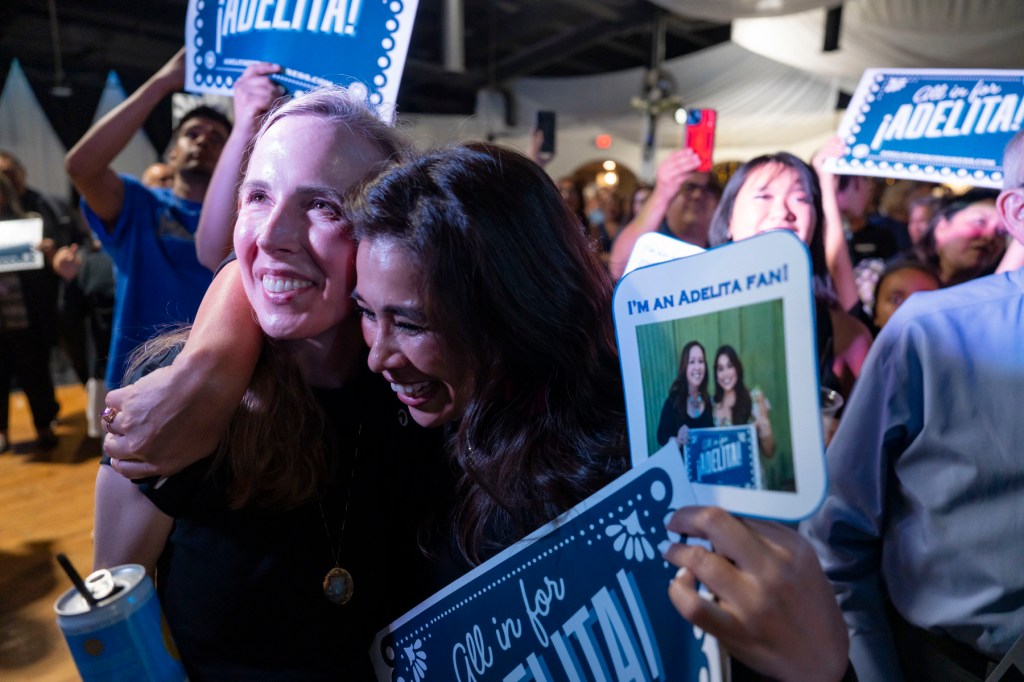
It’s also not lost on Grijalva what it would mean for her to be the first. “It’s very humbling. It is a huge honor and a huge responsibility. I want people to see me in these positions and say, ‘if she can do it, I can do it and push for change in their own communities,’” she said.
After the kickoff, Grijalva returned to her office, where behind her were reminders of why she’s running in the first place. In a window nook, a small painting and a bobblehead of her father is on display, flanked by prayer candles and paper flowers.
It’s still hard for Grijalva to talk about her father’s passing, and she tears up when asked how she’s doing. She’s running a campaign amid that grief because she feels a responsibility to protect his environmental legacy.
At the same time, she made clear in an interview that she has her own priorities to spearhead if she’s elected to Congress — ones that are distinct from her father’s and speak to her identities as a woman and mother. “The issues that I feel I’m going to want to champion are different. I want universal preschool,” she said. “I want people to keep their hands off of reproductive health.”
“Some of the fights will be the same,” she said. “[Indigenous] sovereignty is going to be very important, and environmental justice is going to be incredibly important.”
McGroary said Grijalva will play a critical role messaging to Latinx voters in Arizona headed into next year’s midterm elections.
-
Read Next:

In 2024, Donald Trump won the state by 5.5 percent, winning an absolute majority of the vote, which no presidential candidate had managed to do in the state since Mitt Romney in 2012. Arizona’s 7th District includes voters who live in the counties of Yuma and Santa Cruz, which shifted 14 and 17 points toward the GOP from 2020 to 2024, respectively, according to an analysis by The New York Times.
A report from the analytics firm Catalist estimates support among Latinx voters was 54 percent for then-Vice President Kamala Harris, compared with 46 percent for Trump, a narrower gap between the Democratic and Republican candidate than in past presidential elections. The same report estimates that about 60 percent of Latinas backed Harris, a 17-point drop since 2016. As for Latino men, support was lower at 47 percent, a 14-point since 2016.
In the same election, however, Arizona voters elected Democrat Ruben Gallego to the U.S. Senate.
Grijalva has spent time touring the district, stopping in border communities like Yuma, where much of the country’s winter vegetables like lettuce is grown by migrant farmworkers, and Sells, on the Tohono O’odham Nation, a reservation that straddles the U.S.-Mexico border.
She said voters are worried about the state of U.S. democracy, immigration, the economy, and cuts being made under Trump to Social Security and Medicare.
In speaking to Arizonans on both sides of the aisle she’s hearing calls for immigration reform. It’s an issue she plans to work on while in Congress. She also hopes to elevate the stories of community members that can combat the narrative being pushed by the right depicting undocumented immigrants as criminals.
“There is a woman being detained right now, who has three businesses here in Tucson that are threatened to be closed down, she hires 70 people,” she said. “It’s telling those individual stories of how this policy and lack of process is impacting all of our communities repeatedly.”
She also hopes to hold a bipartisan hearing on the impact of border patrol on the Tohono O’odham Nation.
Outside of immigration, she’s focused on the rising cost of living, which McGroary said is a top issue for Latinas.
“Latino families are talking about costs, they are talking about job security,” McGroary said. “They are talking about, how do we make ends meet?”
“Adelita is really focused on that, and I think that just speaks volumes to sort of the issues that Democrats should really be focused on,” McGroary added.
Gomez said that Grijalva’s election and her focus on the “pain points” of a community she understands really well will help her reach out to voters who may not have supported Democrats this past election.
“We’re living in a really complicated political terrain, and you need someone that believes that everyone deserves to be represented,” Gomez said. “That is Adelita.”


