
Editor’s note: This article has been updated with Friday's federal court ruling.
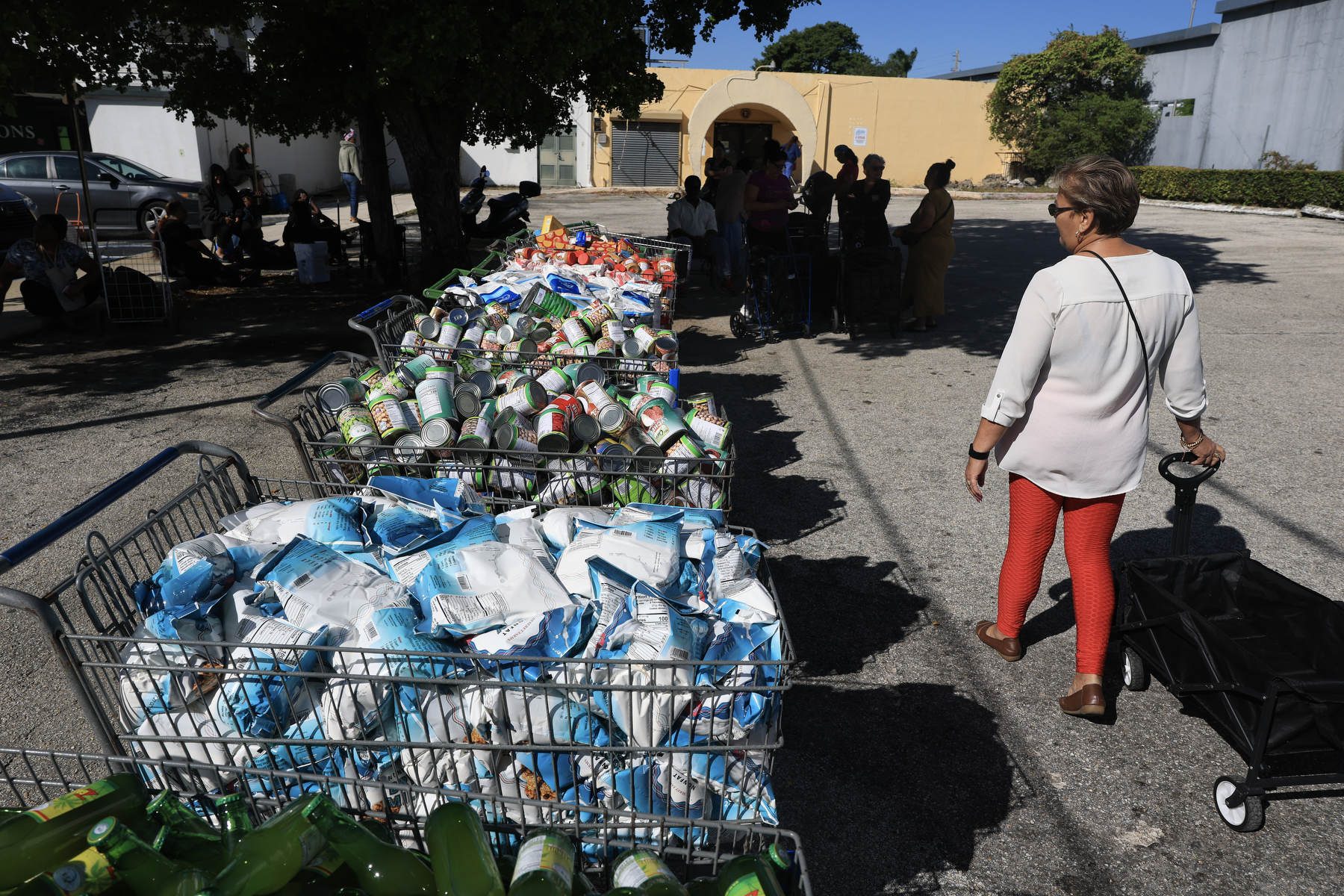
If the ongoing government shutdown extends into Saturday — and there is every indication that it will — funding will lapse for the Supplemental Nutrition Assistance Program, known as food stamps or SNAP, which helps feed some 42 million lower-income Americans.
It will be the first such disruption to the federally funded but state-administered safety net program that disproportionately feeds women, children, disabled people and the elderly since it was started in its current form in the 1960s.
That includes during previous government shutdowns. For example, during the longest shutdown in U.S. history — 35 days in late 2018 and early 2019 during President Donald Trump’s first administration — the U.S. Department of Agriculture, or USDA, directed states to issue SNAP benefits early. SNAP recipients’ debit cards were filled and the program continued without a lapse.
This time, Republicans and Democrats are at an impasse over how to proceed, despite leaders of both parties acknowledging that a lapse in SNAP funding would be devastating for food-insecure Americans.
“It means that tens of millions of American families will struggle to keep food on the table because the SNAP program benefits will run dry,” Republican House Speaker Mike Johnson said during a Thursday news conference.
-
Read Next:

Each party is hoping that voters blame the other for the ongoing shutdown, along with its impacts on SNAP and other programs.
Republicans, who control both chambers of Congress in addition to the White House, want Democrats to temporarily fund the government, including SNAP, at current levels, until a long-term funding deal can be negotiated. They need a handful of Democrats in the Senate to join them to overcome the filibuster.
Democrats, given their minority status, do not want to give up their leverage in longer-term deal negotiations by agreeing to a short-term deal. They argue it is the only hope they have to stave off the looming expiration of Affordable Care Act subsidies that could result in health care costs more than doubling for some 24 million Americans, according to the nonprofit health analysis organization KFF. Influential progressive organizing groups, including Indivisible, are encouraging congressional Democrats to hold steady until Republicans come to the table for health care negotiations.
This week, as Trump traveled through Asia, he said of funding SNAP: “We’re going to get it done.” He did not offer details as to when or how. His USDA has refused to use $5 billion in contingency funds to do so.
Here are the ways that a disruption in SNAP benefits could be avoided:
Pass annual government funding bill(s)
The federal government’s fiscal year runs from October 1 to September 30.
The annual appropriations process begins when the president submits their budget request to congressional leaders on the first Monday in February. Appropriators in the House and Senate then draft and negotiate 12 separate bills to fund various parts of the government. Often, these bills are combined into one large piece of legislation that’s called an omnibus bill. The funding levels for some programs like Medicare and Social Security are set by other laws and are not a part of the appropriations process.
It would be all but impossible for Congress to pass an annual appropriations bill before SNAP benefits are disrupted. There are virtually no negotiations happening between Republican and Democratic appropriators and leaders. Johnson has not called House lawmakers back to Washington since the government closed, in the process blocking the swearing-in of Arizona Democrat Adelita Grijalva, who was elected more than a month ago in a special election. In the Senate, Republican Majority Leader John Thune has presided over a series of votes leaders from both parties knew would fail on a short-term measure to keep the government open while a long-term funding bill is negotiated.
Pass a continuing resolution
The congressional appropriations process has broken down in recent years, and Congress has increasingly relied on one or more stop-gap bills called continuing resolutions to keep government programs funded, usually at the same levels as the prior fiscal year. These short-term measures buy time to negotiate an annual bill.
Republicans want to pass a continuing resolution that would fund the government at current levels through November 21. Democrats believe agreeing to the short-term measure would remove any leverage they have to renew the expiring health care subsidies because it is not a GOP priority to protect Democratic former President Barack Obama’s Affordable Care Act.
Congress approving a continuing resolution to fund the government at current levels for several weeks, including the SNAP program, would require Democrats giving up on their demands or health care negotiations between the two parties, which aren’t happening.
Pass stand-alone legislation
Democratic Sen. Ben Ray Luján of New Mexico introduced the Keep SNAP and WIC Funded Act of 2025 that would require the USDA to release existing contingency funds to fund the nutrition programs for the duration of the government shutdown. (WIC is shorthand for the Special Supplemental Nutrition Program for Women, Infants, and Children.) It has the support of the entire Senate Democratic Caucus. New Mexico is the state with the highest rate of SNAP participation in the country.
Sen. Josh Hawley of Missouri, meanwhile, introduced GOP legislation to fund SNAP through the shutdown called the Keep SNAP Funded Act of 2025. It has support from at least 10 other Senate Republicans: Lisa Murkowski of Alaska, Susan Collins of Maine, Bernie Moreno and Jon Husted of Ohio, James Lankford of Oklahoma, Marsha Blackburn of Tennessee, Kevin Cramer of North Dakota, Bill Cassidy of Louisiana, Katie Britt of Alabama and John Cornyn of Texas. Also, Democratic Sen. Peter Welch of Vermont co-sponsored Hawley’s bill.
Minority Leader Chuck Schumer of New York said this week that Democrats would vote for Hawley’s bill if the Republican support exists to pass it.
But Thune would need to bring either bill up for a vote for it to have a chance to pass. As of Thursday evening, he had not committed to doing so.

USDA releases contingency funds
USDA has never allowed SNAP to go unfunded, including in the 2018-2019 government shutdown that was the longest in history.
USDA had a plan in place to fund SNAP during a government shutdown but, as NOTUS reported this week, the document detailing the plan recently disappeared from the agency’s website.
In a partisan document obtained by Politico that places the shutdown blame on Democrats, USDA said that it cannot legally use its $5 billion in contingency funds for SNAP during the shutdown because the agency must keep it on hand for natural disasters and other emergencies.
Twenty-five states led by Democrats sued the USDA over its refusal to use contingency funds for SNAP. A federal judge ruled Friday that the USDA must use its contingency funds to cover November SNAP benefits but the $5 billion in the fund is less than the monthly cost of the program. The agency has said it could take days, or even weeks, to calculate partial payments and send the money to states, meaning many SNAP recipients will still face periods without funds on their debit cards or have lower-than-normal amounts loaded.
States step in to fund SNAP
Leaders in more than a dozen states — mostly Democrats — have said they will use state funds to either fund SNAP or bolster other nutrition programs until the shutdown ends.
Gov. Jeff Landry, the Republican leading Louisiana, where about one-fifth of the population participates in SNAP, said that he will use state money to fund the program through November 4.
In Vermont, which is led by GOP Gov. Phil Scott and a Democratic-controlled legislature, $6.3 million in state funds will be used to fund SNAP and $250,000 more will go to the state’s food bank system.
Maryland’s Democratic governor, Wes Moore, said Thursday he would direct $10 million to food banks to help SNAP recipients weather the continued shutdown and lapse in funding. New York Gov. Kathy Hochul, also a Democrat, declared a state of emergency in order to authorize an additional $65 million in nutrition assistance for food banks and other programs.
While the sums of money sound large, experts say in many cases state efforts would cover only days or at best weeks of food assistance for the individuals and families losing SNAP benefits.


