Skip to content Skip to search

Republish This Story

* Please read before republishing *

We’re happy to make this story available to republish for free under an Attribution-NonCommercial-NoDerivatives Creative Commons license as long as you follow our republishing guidelines, which require that you credit The 19th and retain our pixel. See our full guidelines for more information.

To republish, simply copy the HTML at right, which includes our tracking pixel, all paragraph styles and hyperlinks, the author byline and credit to The 19th. Have questions? Please email partnerships@19thnews.org.

— The Editors

Loading...

Modal Gallery

/
Sign up for our newsletter

Menu

Topics

  • Abortion
  • Politics
  • Education
  • LGBTQ+
  • Caregiving
  • Environment & Climate
  • Business & Economy
View all topics

Daily Newsletter

A smart, relatable digest of our latest stories and top news affecting women and LGBTQ+ people.

Look for a confirmation sent to

Did you mean

The email didn't go through.

or Contact us for support
  • Latest Stories
  • Our Mission
  • Our Team
  • Strategic Plan
  • Ways to Give
  • Search
  • Contact
Donate
Home

We’re an independent, nonprofit newsroom reporting on gender, politics, policy and power. Read our story.

Topics

  • Abortion
  • Politics
  • Education
  • LGBTQ+
  • Caregiving
  • Environment & Climate
  • Business & Economy
View all topics

Daily Newsletter

A smart, relatable digest of our latest stories and top news affecting women and LGBTQ+ people.

Look for a confirmation sent to

Did you mean

The email didn't go through.

or Contact us for support
  • Latest Stories
  • Our Mission
  • Our Team
  • Strategic Plan
  • Ways to Give
  • Search
  • Contact

We’re an independent, nonprofit newsroom reporting on gender, politics, policy and power. Read our story.

Daily Newsletter

A smart, relatable digest of our latest stories and top news affecting women and LGBTQ+ people.

Look for a confirmation sent to

Did you mean

The email didn't go through.

or Contact us for support

Become a member

The 19th thanks our sponsors. Become one.

Obituary

Alice Wong, disability justice advocate and author, dies at 51

Wong envisioned a world where disabled people, particularly those from multiple marginalized backgrounds, could live freely and with full autonomy.

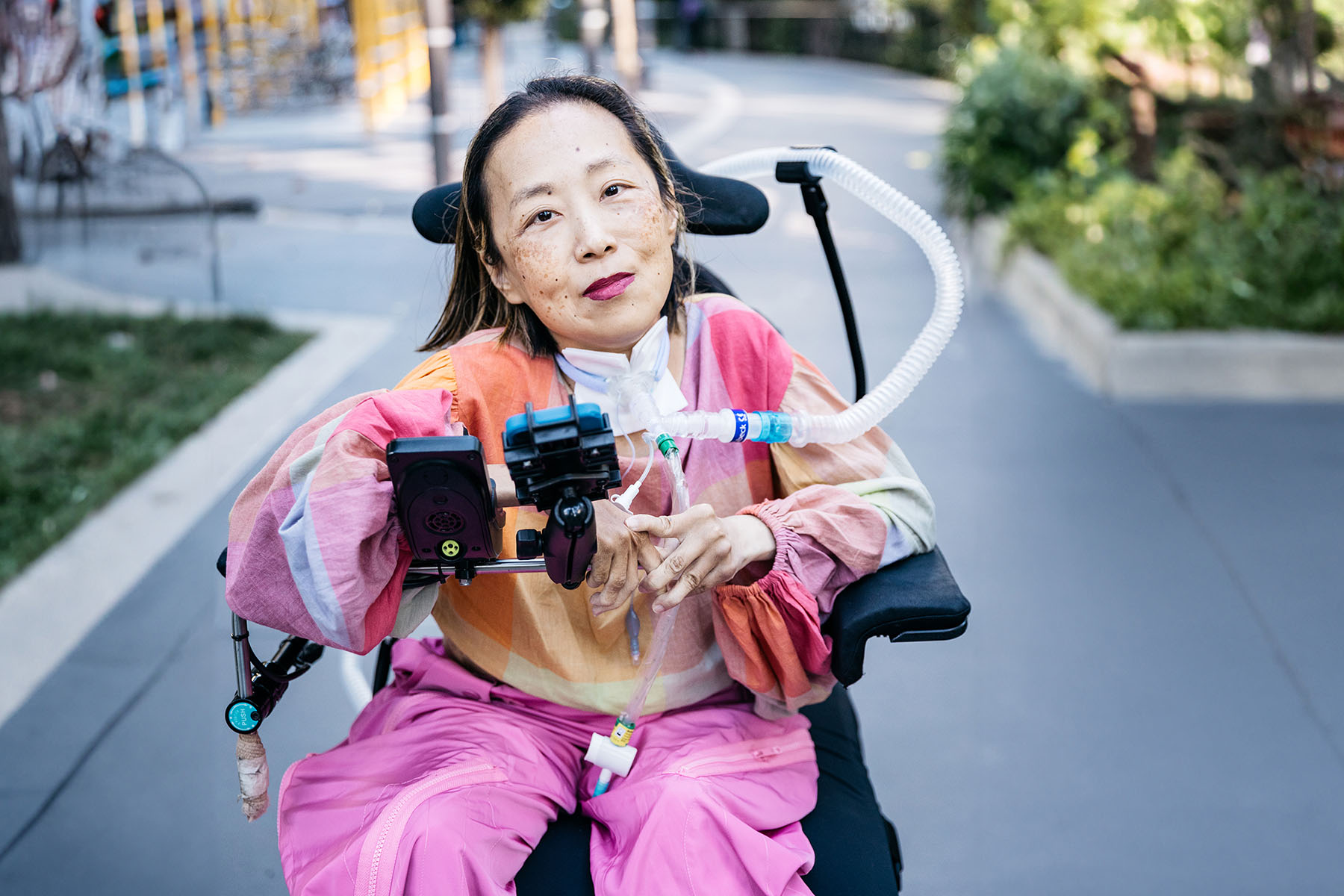
Alice Wong, using a power wheelchair, sits outdoors on a paved path. She has a tracheostomy tube connected to a ventilator and holds her hands together near the controls mounted in front of her. She wears a multicolored long-sleeve top and bright pink pants.
Wong is best known for her work on the Disability Visibility Project, which she founded in 2014 to magnify disabled culture, particularly the work and lives of those who are multiply marginalized. (Dana Rogers/John D. and Catherine T. MacArthur Foundation)

Sara Luterman

Disability and Aging Reporter

Published

2025-11-17 11:58
11:58
November 17, 2025
am
America/Chicago

Republish this story

Share

  • Bluesky
  • Facebook
  • Email

Republish this story


As The 19th makes plans for 2026, we want to hear from you. Complete our annual survey to let us know your thoughts.

Alice Wong, a visionary leader in disability justice and culture, died from an infection on November 14 in San Francisco. She was 51.

In a message shared on social media by friend and fellow activist Sandy Ho, Wong wrote:

The 19th thanks our sponsors. Become one.

“Hi everyone, it looks like I ran out of time. I have so many dreams that I wanted to fulfill and plans to create new stories for you. There are a few in progress that might come to fruition in a few years if things work out. I did not ever imagine I would live to this age and end up a writer, editor, activist, and more.”  

Wong is best known for her work on the Disability Visibility Project, which she founded to magnify disabled culture, particularly the work and lives of those who are multiply marginalized: Disabled women of color, LGBTQ+ people and immigrants. 

Wong was born on March 27, 1974 in Indianapolis. Her parents, Henry and Bobby  Wong, had immigrated to the United States from Hong Kong two years earlier. She was diagnosed at birth with spinal muscular atrophy, a progressive neuromuscular disease that slowly weakened her muscles, including the muscles in her lungs that she needed to breathe. Doctors told her parents that she wouldn’t live past 18.

As her disability progressed, Wong acquired more mechanical support. She conceptualized herself as a “disabled cyborg” and the advancement of her condition as “cyborg turning points” in her 2022 memoir, “The Year of the Tiger.” 

  • From the archives
    Emily Voorde sits for a portrait near a mural of South Bend, Indiana.
  • Meet the woman behind some of the biggest changes for disabled travelers in over 30 years
  • ‘There is still work to be done’: Voters with disabilities face unaddressed barriers to the ballot

“I am a disabled cyborg that has gone through another series of augmentations that extended her life until another system fails,” she told The Guardian earlier this year. 

One of Wong’s more recent cyborg components was the use of text-to-speech software, after she lost the ability to speak. She became an advocate for people who use augmentative and alternative communication through her work on the advisory council for CommunicationFirst, a nonprofit dedicated to protecting and advancing the rights of nonspeakers, as well as others who cannot rely on speech alone to be understood.

In 2013, then-President Barack Obama appointed Wong to the National Council on Disability, an independent agency that advises the federal government and Congress on disability policy. In 2015, she became the first person to visit the White House by robot telepresence, as she was not able to travel, to celebrate the 25th anniversary of the Americans with Disabilities Act. 

The Disability Visibility Project began in 2014 as an oral history project in cooperation with StoryCorps, a nonprofit that collects, preserves and shares stories of everyday people. Over a hundred interviews are now housed at the Library of Congress. 

She wrote multiple books, a column for Teen Vogue and more. One of her final projects was Crips for eSims for Gaza, which she co-founded with writers Jane Shi and Leah Lakshmi Piepzna-Samarasinha. They raised over $3 million to help connect people living in Gaza to the Internet and the rest of the world. 

In 2024, Wong was awarded a MacArthur “genius grant” for her contributions to disability activism and culture. That same year, Wong wrote about turning 50 for Time. The average lifespan for someone with her condition grew throughout her lifetime as new technologies and treatments emerged, but she was aware she had limited time from a very young age. According to Wong, it shaped the way she lived.  

“Death remains my intimate shadow partner. It has been with me since birth, always hovering close by. I understand one day we will finally waltz together into the ether. I hope when that time comes, I die with the satisfaction of a life well-lived, unapologetic, joyful, and full of love,” she said. 

In addition to her parents, Wong is survived by her younger sisters, Emily and Grace Wong. 


Disclosure: Sara Luterman completed a contract to write a plain language edition of Alice Wong’s first book in 2019.

Republish this story

Share

  • Bluesky
  • Facebook
  • Email

Recommended for you

Two women smile and talk seated on a bus alongside a man looking out the window.
How Rosa Parks’ legacy inspired a new fight over who could ride the bus
A U.S. quarter featuring Stacey Park Milbern seated in her wheelchair, wearing glasses, with the inscriptions “Stacey Park Milbern,” “Disability Justice,” and “United States of America Quarter Dollar.”
What it means to have a woman in a wheelchair featured on U.S. currency
Smiling photo of Patty Berne on black background.
In life and in art, Patty Berne made space for disabled people to thrive
Digital collage of a person standing beside an older adult seated in a wheelchair places a hand on the seated person’s shoulder.
Trans people and people of color have been quietly erased from national caregiving plan

Daily Newsletter

A smart, relatable digest of our latest stories and top news affecting women and LGBTQ+ people.

Look for a confirmation sent to

Did you mean

The email didn't go through.

or Contact us for support

Become a member

Explore more coverage from The 19th
Abortion Politics Education LGBTQ+ Caregiving
View all topics

Support representative journalism today.

Learn more about membership.

  • Give $19
  • Give $50
  • Give $100
  • Any amount
  • Transparency
    • About
    • Team
    • Contact
    • Privacy Policy
    • Community Guidelines
    • Gift Acceptance Policy
    • Financials
  • Newsroom
    • Latest Stories
    • Strategic Plan
    • 19th News Network
    • Events
    • Careers
    • Fellowships
  • Newsletters
    • Daily
    • The Amendment
    • Menopause
  • Support
    • Ways to Give
    • Sponsorship
    • Republishing
    • Volunteer

The 19th is a reader-supported nonprofit news organization. Our stories are free to republish with these guidelines.