Skip to content Skip to search

Republish This Story

* Please read before republishing *

We’re happy to make this story available to republish for free under an Attribution-NonCommercial-NoDerivatives Creative Commons license as long as you follow our republishing guidelines, which require that you credit The 19th and retain our pixel. See our full guidelines for more information.

To republish, simply copy the HTML at right, which includes our tracking pixel, all paragraph styles and hyperlinks, the author byline and credit to The 19th. Have questions? Please email partnerships@19thnews.org.

— The Editors

Loading...

Modal Gallery

/
Sign up for our newsletter

Menu

Topics

  • Abortion
  • Politics
  • Education
  • LGBTQ+
  • Caregiving
  • Environment & Climate
  • Business & Economy
View all topics

Daily Newsletter

A smart, relatable digest of our latest stories and top news affecting women and LGBTQ+ people.

Look for a confirmation sent to

Did you mean

The email didn't go through.

or Contact us for support
  • Latest Stories
  • Our Mission
  • Our Team
  • Strategic Plan
  • Ways to Give
  • Search
  • Contact
Donate
Home

We’re an independent, nonprofit newsroom reporting on gender, politics, policy and power. Read our story.

Topics

  • Abortion
  • Politics
  • Education
  • LGBTQ+
  • Caregiving
  • Environment & Climate
  • Business & Economy
View all topics

Daily Newsletter

A smart, relatable digest of our latest stories and top news affecting women and LGBTQ+ people.

Look for a confirmation sent to

Did you mean

The email didn't go through.

or Contact us for support
  • Latest Stories
  • Our Mission
  • Our Team
  • Strategic Plan
  • Ways to Give
  • Search
  • Contact

We’re an independent, nonprofit newsroom reporting on gender, politics, policy and power. Read our story.

Daily Newsletter

A smart, relatable digest of our latest stories and top news affecting women and LGBTQ+ people.

Look for a confirmation sent to

Did you mean

The email didn't go through.

or Contact us for support

Become a member

The 19th thanks our sponsors. Become one.

Race

She reimagined dolls for her daughter — and defied stereotypes about Indigenous women

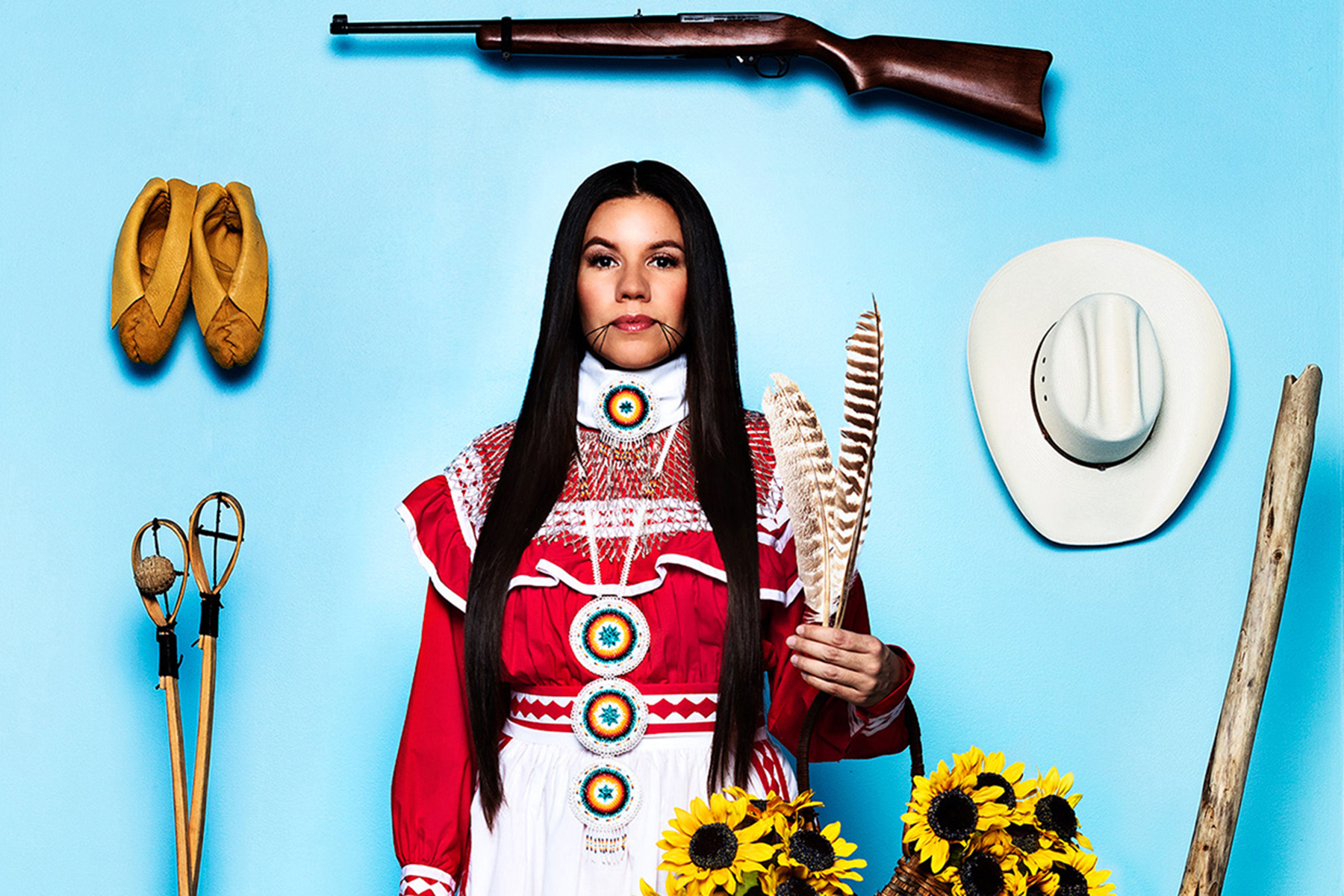
In her “First American Doll” series, Indigenous photographer Cara Romero showcases the diversity of tribes and their unique regalia and cultural histories.

An image of an Indigenous woman wearing and surrounded by symbols of her tribal culture, photographed within a life-size box made to look like a doll’s box.
“Amber Morningstar,” Choctaw Tribe. (Courtesy of Cara Romero)

Jessica Kutz

Gender, climate and sustainability reporter

Published

2025-12-11 05:00
5:00
December 11, 2025
am
America/Chicago

Republish this story

Share

  • Bluesky
  • Facebook
  • Email

Republish this story

When Cara Romero’s daughter was 11, she became interested in dolls. Romero, who is an enrolled member of the Chemehuevi Indian Tribe in Southern California, began to think about doll culture more deeply and what it can convey to the next generation. 

Romero’s husband grew up collecting G.I. Joes, and her mother-in-law had her own Victorian-style porcelain doll collection. For Romero, though, her daughter’s doll phase reminded her of the Native American dolls she grew up seeing at truck stops along I-40.

The dolls were often dressed in plastic pony beads and fake buckskin that parroted the Native American Halloween costumes she knew all too well as dehumanizing stereotypes. So Romero, who is a photographer and artist, set out to create a series of photos that broke down these tropes.

The 19th thanks our sponsors. Become one.

Each photograph in the “First American Doll” series features a life-sized doll box that she designed and crafted, where she poses the women with objects that represent their families, traditions and unique stories. 

She wanted her daughter to be proud of her heritage. “I come from a community where women are allowed to have a voice, allowed to be really strong,” she said. “So [I was] wanting to pass down good self esteem and a strong sense of self and identity,” she said. “That’s what we aim to do as moms.”

  • An image of an Indigenous woman wearing and surrounded by symbols of her tribal culture, photographed within a life-size box made to look like a dollÕs box.
  • An image of an Indigenous woman wearing and surrounded by symbols of her tribal culture, photographed within a life-size box made to look like a doll’s box.
  • “Naomi” of the YTT Northern Chumash Tribe.
  • “Kaitlyn,” Kānaka Maoli (Native Hawaiian). (Courtesy of Cara Romero)

She started the series with artist and powwow dancer Wakeah Jhane, who is of Kiowa, Comanche and Blackfeet descent. While the Plains Tribes that she is from are the models for stereotypical dolls and costumes, Romero’s photograph captures her intricate buckskin regalia, which was made by her family. Also on display are her moccasins and a fan.

“You can see the stark contrast between what she’s wearing and the Halloween costumes that  people portray Plains people as,” she said. “I really wanted to kind of own it and be like, “You guys even have this wrong.’” 

She has since published nine photographs for the series, the most recent featuring Fawn Douglas, an artist, activist and enrolled member of the Las Vegas Paiute Tribe, who is posed with handcrafted baskets and a gourd rattle made by her family. The box is bordered by a Las Vegas playing card motif. 

  • An image of an Indigenous woman wearing and surrounded by symbols of her tribal culture, photographed within a life-size box made to look like a dollÕs box.
  • An image of an Indigenous woman and child wearing and surrounded by symbols of their tribal culture, photographed within a life-size box made to look like a dollÕs box.
  • “Wakeah” of Kiowa, Comanche and Blackfeet descent.
  • “Julia and Joslynn” of Cochiti, San Ildefonso and Santa Clara descent. (Courtesy of Cara Romero)

The current day symbolism and high fashion lighting communicates that these women are also contemporary, Romero said. “When artwork, and specifically photography, is devoid of modern context, it does something psychologically, it perpetuates [this idea] that we’re gone and only living in history.”  

Naming each of the pieces after the models was also meant to humanize Indigenous women in a way that they weren’t in historical photos. “A lot of times in the ethnographic photographs, they didn’t even say their name,” she said. “We don’t know who they were.”

Some of the photographs from the series are currently traveling the country as part of Romero’s first solo museum exhibition, titled: “Panûpünüwügai (Living Light).” They will be on display next at the Phoenix Art Museum in Arizona starting in February.

Republish this story

Share

  • Bluesky
  • Facebook
  • Email

Recommended for you

Primatologist Jane Goodall interacts with a chimpanzee in 2009.
Jane Goodall lived her childhood dream
Smiling portrait of Jane Clougherty standing on an overpass.
In a single email, the EPA ended her research into how climate change endangers children
Ego Nwodim attends the 2025 Met Gala at the Metropolitan Museum of Art.
Without Ego Nwodim, ‘SNL’ has no Black women cast members — again
Side-by-side portraits of Kaitlyn McNab and Aiyana Ishmael. On the left, McNab sits in a patterned dress with long braids, looking directly at the camera. On the right, Ishmael poses in a blue off-the-shoulder dress against a green backdrop with her hand raised near her face.
Teen Vogue changed how a generation saw politics and inclusion. That era could be over.

Daily Newsletter

A smart, relatable digest of our latest stories and top news affecting women and LGBTQ+ people.

Look for a confirmation sent to

Did you mean

The email didn't go through.

or Contact us for support

Become a member

Explore more coverage from The 19th
Abortion Politics Education LGBTQ+ Caregiving
View all topics

Support representative journalism today.

Learn more about membership.

  • Give $19
  • Give $50
  • Give $100
  • Any amount
  • Transparency
    • About
    • Team
    • Contact
    • Privacy Policy
    • Community Guidelines
    • Gift Acceptance Policy
    • Financials
  • Newsroom
    • Latest Stories
    • Strategic Plan
    • 19th News Network
    • Events
    • Careers
    • Fellowships
  • Newsletters
    • Daily
    • The Amendment
    • Menopause
  • Support
    • Ways to Give
    • Sponsorship
    • Republishing
    • Volunteer

The 19th is a reader-supported nonprofit news organization. Our stories are free to republish with these guidelines.