
A transgender worker is repeatedly and intentionally misgendered by their coworker. A workplace bars an employee from using facilities that match their gender identity. A supervisor suggests a transgender subordinate shouldn’t be in public-facing work.
Going forward, it will be more difficult, timely and costly for LGBTQ+ workers to seek justice for these and other workplace harassment issues related to their gender identities and sexualities.
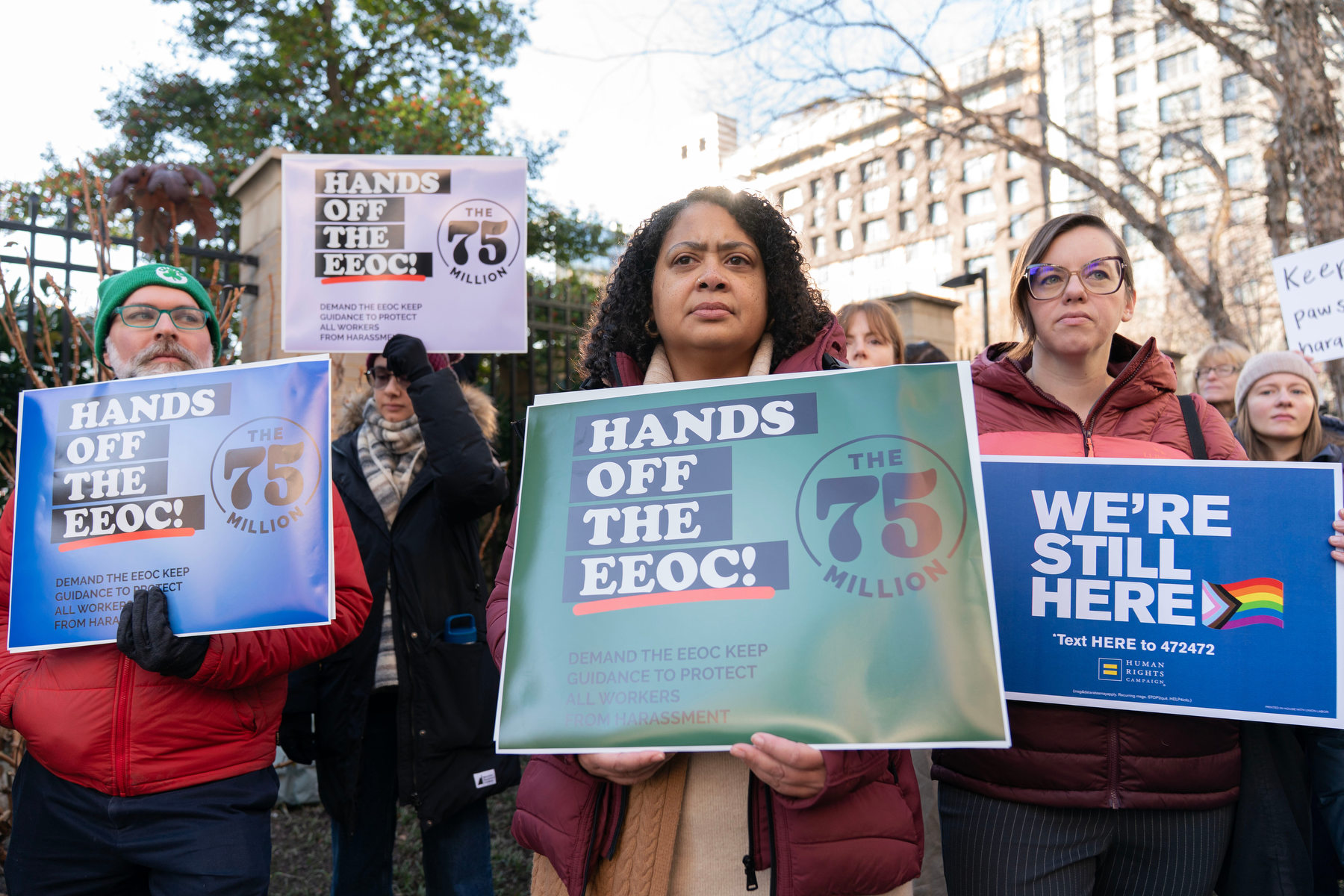
The U.S. Equal Employment Opportunity Commission, or EEOC, on Thursday voted 2-to-1 to rescind years-in-the-making guidance that the agency released in 2024 on applying current civil rights laws to workplace harassment. The 200-page document included more than 75 examples of harassment scenarios that employers might encounter and explained the agency’s thinking.
The EEOC’s move to toss the guidance out will be most immediately felt by LGBTQ+ workers, experts told The 19th, but it will also have broader implications for anyone who experiences harassment related to their gender, race or ethnicity while they’re at work — and for employers trying to comply with the underlying law.
“One of the main services that the EEOC provides to employees is a free investigation and a free resolution of their complaint,” explained Chai Feldblum, who served as one of the civil rights agency’s five commissioners during the Obama administration and into the beginning of President Donald Trump’s first term.
“But we should not conflate the EEOC rescinding guidance with rescinding the law that’s in place. Even though it does not change the law, it will still have an adverse, tangible, harmful effect on LGBTQ+ employees, because it will be expensive and time consuming” to pursue these cases in court, she added.
In the earliest days of his second White House term, Trump fired two of the three Democratic EEOC commissioners before their terms ended — a first by a president in the agency’s 60-year history. He elevated Andrea Lucas, who had served on the commission since the end of his first term, to chair the agency on an interim basis. Without a quorum, the EEOC was limited in what it could do, though Lucas signaled early on that one of her top priorities was impeding the ability for gender-diverse people to lodge harassment complaints. Lucas was confirmed as chair in July, and then Trump pick Brittany Bull Panuccio was confirmed in October. Kalpana Kotagal is the only remaining Democratic commissioner.
Once a quorum was in place, the EEOC announced that it would meet to consider rescinding the 2024 guidance, which Lucas said protected LGBTQ+ people at the expense of women. The agency developed much of the guidance related to LGBTQ+ workers — and the examples of how employers should apply it — after the Supreme Court’s 2020 decision in Bostock v. Clayton County, a landmark ruling that found the Civil Rights Act of 1964 protected workers from discrimination on the basis of their gender identity or sexuality.
“Women’s sex-based rights in the workplace are under attack — and from the EEOC, the very federal agency charged with protecting women from sexual harassment and sex-based discrimination at work,” Lucas wrote at the time the guidance was released.
In December, Lucas released a video in which she urged White men to report workplace harassment related to their race or gender, signaling that the EEOC’s enforcement priorities going forward will be related to the administration’s broader focus on curtailing efforts related to diversity, equity and inclusion, or DEI.
The EEOC did not pick and choose which portions of the harassment guidance to rescind, instead nullifying the 200-page document altogether. Picking and choosing, Feldblum suggested, might have required a lengthier comment period, and drawn attention to the reasons behind the push to rescind it. The EEOC skipped the traditional 30-day notice-and-comment period for the public to weigh in.
“The guidance addresses harassment on all protected bases — race, color, sex, national origin, religion, age, disability, and genetic information,” Kotagal, the Democratic commissioner, said during the meeting.
She noted that the EEOC is often the “only opportunity” for many workers to “vindicate their civil rights.” She said she was “proud” to support the EEOC’s guidance, because it “empowers workers to know their rights and enables employers, particularly small businesses, to know their responsibilities.”
Panuccio said Thursday that the “private sector is filled with resources” about how employers should apply workplace harassment law.
The EEOC’s decision to rescind the guidance was widely criticized by advocacy organizations supporting women and LGBTQ+ people. The National Women’s Law Center said it was “yet another example of the EEOC straying from its core mission … leaving workers without the protections they deserve — especially women, Black people and other people of color, LGBTQIA+ people, and other workers that face harassment and violence at disproportionately high rates.” The Human Rights Campaign said it would “destabilize our understanding of civil rights protections — for communities across the board — that generations of Americans have fought for, demanded and defended.”