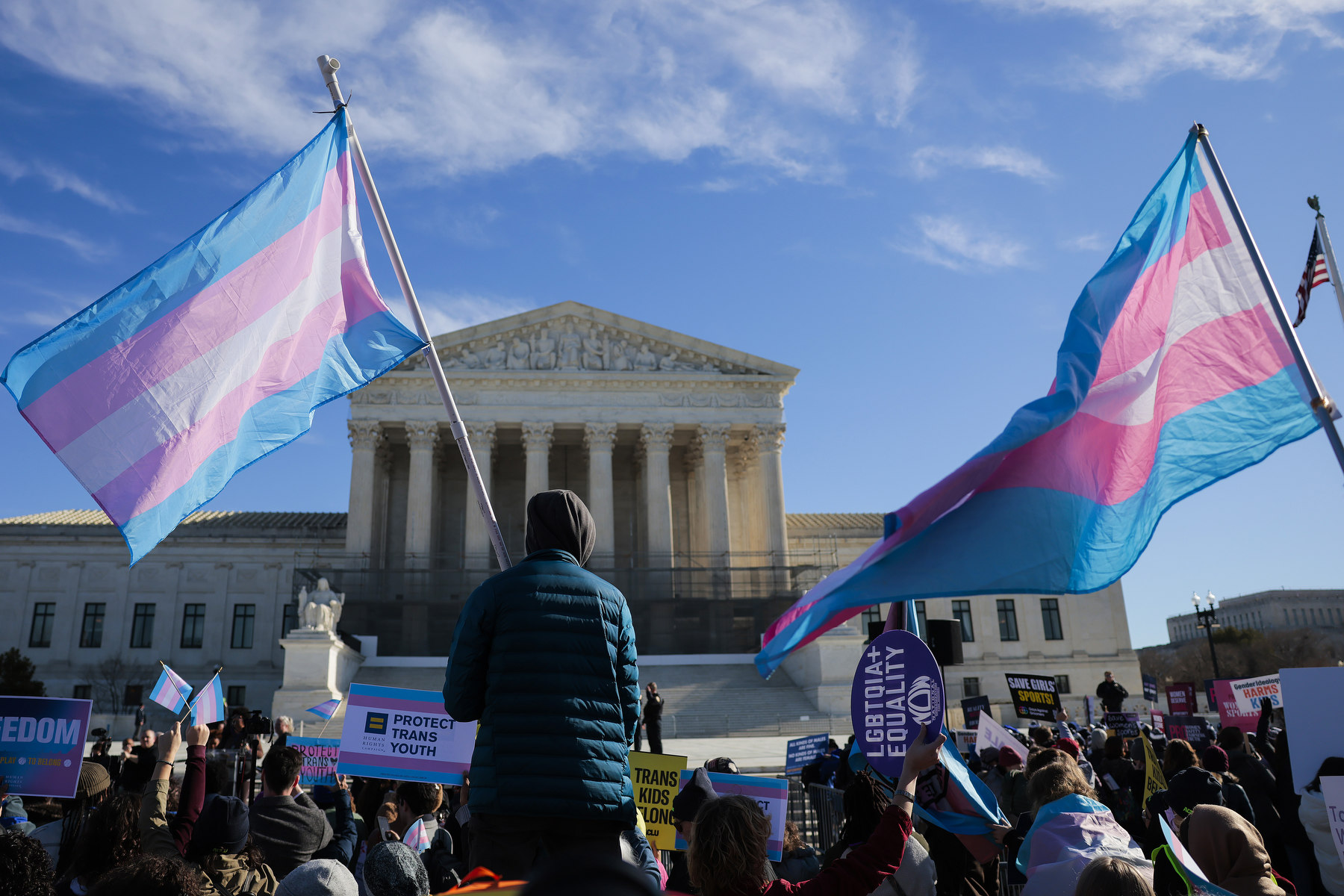

Over more than three hours of oral arguments on Tuesday, justices grappled extensively with questions about sex and gender as the Supreme Court heard cases on whether bans in Idaho and West Virginia are violating transgender athletes’ rights to compete in organized sports.
Shannon Minter, the legal director for the National Center for LGBTQ Rights and a veteran LGBTQ+ rights attorney, said he was stunned by the justices’ openness to questions about transgender girls in sports.
“I was encouraged,” he said. “I think a majority of the justices seem to recognize that if … individual unfairness can be challenged in an equal protection case, that these girls would win.”
Attorneys for Lambda Legal and the American Civil Liberties Union argued the states violated the constitutional rights of Becky Pepper-Jackson, 15, and Lindsay Hecox, 25, when they barred them from competing. The cases deal with just Hecox and Pepper-Jackson, but advocates have worried that a worst-case scenario could result in a nationwide ban on transgender athletes.
“Whatever they rule in this case, they do not seem at all inclined to try to impose a ban on the entire country,” Minter said. “They seem very committed to leaving the door open for states that want to permit transgender girls to play on girls’ teams.”
Attorneys for Idaho and West Virginia claimed it was impossible for states to sort through which trans people should and should not qualify for athletics and therefore that the states needed a blanket ban against all transgender women.

While rulings in the cases, Little v. Hecox and West Virginia v. B.P.J, could apply more broadly, they could also be limited to just the two athletes, who defy conservative stereotypes about transgender athletes.
Pepper-Jackson, a high school athlete, transitioned before ever undergoing male puberty. Hecox, a runner at Boise State University, didn’t qualify for her school’s track team but played club sports until a 2020 law barred her from competing.
Alan Hurst, solicitor general for the state of Idaho, tried to argue that transgender girls did not face the same kind of discrimination as other protected groups of people and that barring them all from athletics was necessary to protect cisgender girls.
“If we look at that history, and we compare it to the history of African Americans and women who were not able to vote, who were not able to own property, who had express classifications based on their status written into the law for most of this country’s history, these things don’t compare,” Hurst said.
West Virginia’s solicitor general, Michael Williams, tried to make the case that the law was not discriminatory because transgender girls could still participate on boys’ sports teams.
Lawyers for the states, as well as Hashim Mooppan, representing the Trump administration, asserted that the girls were actually boys taking performance-enhancing drugs. They argued that the case was one of sex classification, not gender identity, and that based on sex, the trans girls should be excluded from girls’ sports.
But Justice Ketanji Brown Jackson, a part of the court’s liberal minority, pushed back on that classification, saying that the ban meant the law didn’t apply equally to everyone.
“The law actually operates differently, I think, for cisgender women and transgender women, that is with respect to their desire to play on a team that matches their gender identity. Cisgender women can do it. Transgender women cannot,” she said.
Conservative Justice Amy Coney Barrett asked if allowing transgender girls to play would open the gate for cisgender boys who got cut from boys’ teams to join girls’ teams.
No, said the ACLU’s Joshua Block.
“We don’t think the boys’ team is for better athletes, and you have a backup team for athletes that aren’t as good,” he said “I think the purpose of the teams is to control for the variable of sex-based advantages, so that talented women athletes have all the same opportunities as talented male athletes.”
Kathleen Hartnett, representing Hecox, urged the court to rule in favor of Hecox and Pepper-Jackson while science on transgender athletics develops.
“I don’t think this court needs to set rules forever on this area,” Hartnett said. “I think the most important thing would be to allow a record to develop, even in areas of controversy.”
The court will decide if the states violated Title IX and the equal protection clause of the Constitution in barring the girls from participating.
Research on transgender athletes remains limited, but overall it has not found that transgender women have an unfair advantage in sports after medical transition.
It’s not known how many trans athletes are competing at the grade-school level in sports, but advocates insist the number represents a small fraction of overall competitors. In 2024, NCAA President Charlie Baker said that of 500,000 college athletes, openly trans people account fewer than 10 total.
A decision is expected later this year.


