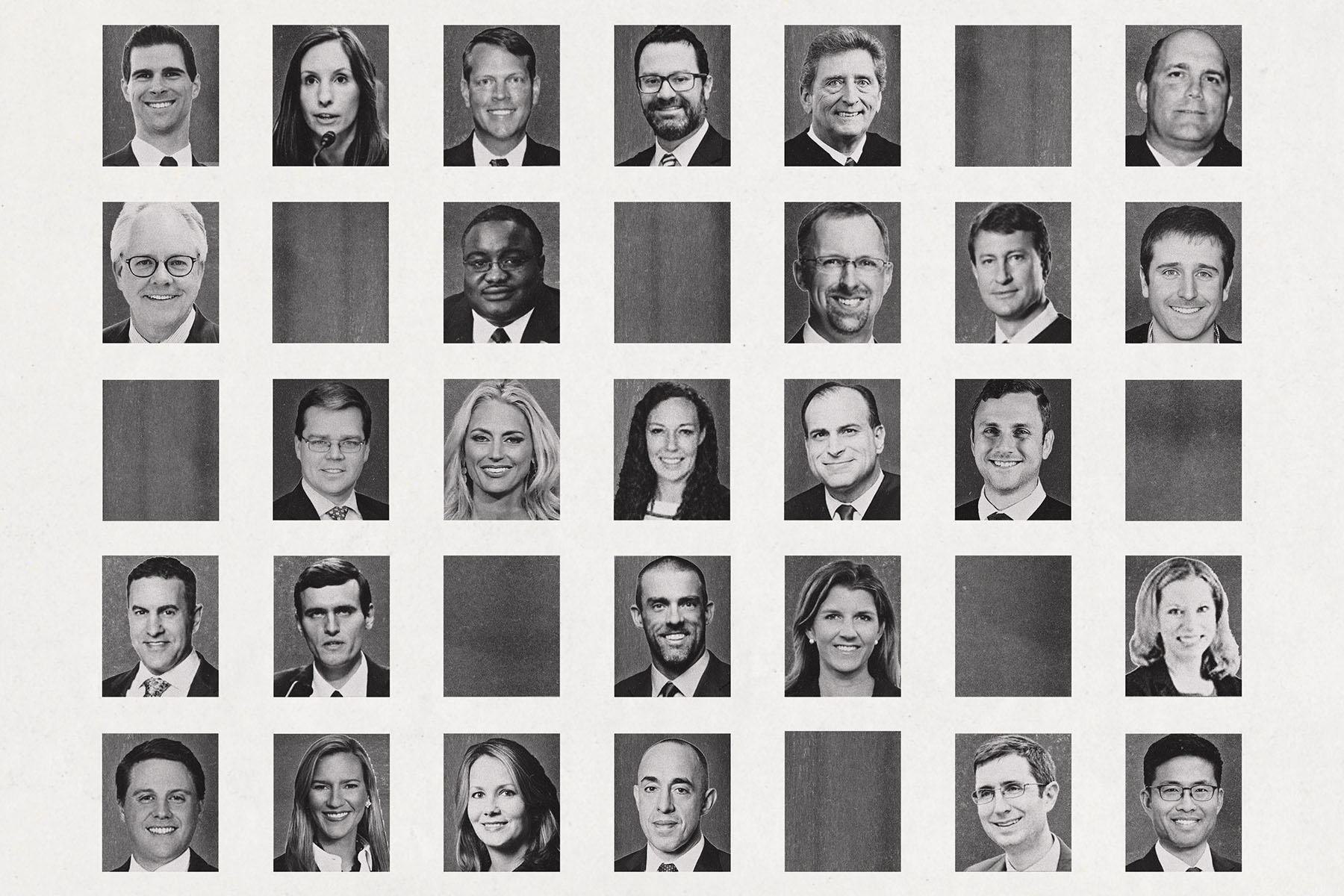

More than a year into his second term, President Donald Trump has appointed 27 judges to the federal bench. Seventeen of these judges — roughly 63 percent — are White men. Seven of them, or 25 percent, are women. None are women of color.
These figures alone are not a surprise. When Trump’s first term ended in 2021, White men comprised 64 percent of his judicial confirmations, White women made up 19 percent and just 5 percent were women of color. What is notable about the first year of his second term is the political climate surrounding these latest judicial confirmations, experts told The 19th.
This term, Trump is more brazen and intentional in his efforts, often equating diversity in race and gender with professional incompetence, while signaling that independent members of the federal judiciary must loyally carry out his agenda. He has publicly praised judges who rule in his favor and called for the impeachment of judges who rule against him. Meanwhile, he has condemned what he views as “anti-White” racism and has banned efforts to diversify hiring within the federal government.
“If he’s just choosing judges on the basis of who he thinks will be politically loyal to him, it turns out that a lot of them are White dudes,” said Josh Orton, president of the progressive judicial advocacy group Demand Justice.
About 40 percent of all 831 active federal judges in the United States are women and 17
percent are women of color, according to data pulled from the Federal Judicial Center. President Jimmy Carter was the first to make significant inroads in diversity by appointing 41 women and 57 people of color to the bench during his four-year term. Since that time, each Democratic president has surpassed the diversity benchmark set by his Democratic predecessor, and each Republican president has surpassed the diversity benchmark of his Republican predecessor.
During his first term, Trump improved modestly on President George W. Bush’s record for women judges appointed by a Republican president — from 21 percent to 24 percent. The percentage of judges who were women of color during Trump’s first term (4.8 percent) fell slightly short of Bush’s 6 percent, which is the highest figure for a Republican president.
The persisting power imbalance on the federal bench means that women judges continue to experience a range of biases, said Rachael K. Hinkle, a professor in the Department of Political Science at the University at Buffalo.
The U.S. Supreme Court — which has four women on the bench, including two women of color — hears fewer than 100 cases annually from the federal appeals courts. The 12 regional appellate courts, however, rule on about 40,000 cases annually. Hinkle’s research found that on these courts, women judges tend to do more under-the-radar work, like authoring unpublished opinions that do not have the policymaking power of published court opinions. Her latest research also suggests that lawyers are more likely to request that an appellate court decision be reconsidered when the judge who authored the opinion is a woman or person of color.
“This is kind of speculative, but I think it’s probably subconscious norms about competence,” Hinkle said. “People have a perception of competence that’s linked to those demographic characteristics. So I think what the data are suggesting overall is there’s still this differential perception of competence based on race and gender.”
It will likely be another decade or more before researchers are able to capture the long-term impact of how Trump’s judicial nominees are shaping the federal court system, Hinkle said. She expressed hope that the judiciary will maintain its independence from outside political pressure, but also noted that the Trump administration appears to be associating historically marginalized communities with professional incompetence.
Project 2025, the far-right Christian nationalist document that seeks to restructure the federal government, states that “the Administration should stop the messaging on wokeness and diversity and focus instead on attracting the best talent.”
Though Trump has insisted that he has “nothing to do with Project 2025,” analysis indicates that his administration has implemented about half of the project’s goals within his first year in office. These priorities range from eliminating funding for gender affirming care for transgender military members to undermining education discussing race and gender identity.
Throughout the 920-page document, Project 2025 repeatedly calls for eliminating federal staff and programming centered on diversity, equity and inclusion (DEI). The Trump administration followed suit, signing five executive orders that ban DEI requirements throughout the federal government and federally funded organizations. Those actions and mindset could have a direct effect on the make-up of the judiciary itself, according to Alicia Bannon, the director of the judiciary program at the Brennan Center for Justice.
“The president’s executive orders and other broader attacks on DEI that we’ve seen, all of that is going after exactly the kinds of programs that have enabled us to make progress with respect to diversity within the legal profession and diversity on the bench,” Bannon said.
By the end of Carter’s administration, only 50 women and nine women of color had ever sat on the federal bench. Since Carter, an additional 563 women and 182 women of color have held this distinction.
“I think the fact that we’ve seen more diversity over time within the legal profession and within positions of power, including the judiciary, is real testament to how important those initiatives have been,” Bannon said.
Women judges and judges from racial minority groups tend to vote more progressively on issues concerning civil rights or gender compared to their White colleagues.
A narrowing pipeline of diverse judges is exacerbated by the administration’s focus on ideological loyalty from judicial nominees, according to Orton from Demand Justice.
One New York Times report last month found that 92 percent of the decisions in cases brought before Trump nominees sitting on U.S. appellate courts during the first year of the second term favored the Trump administration’s policies. This is compared to 68 percent of rulings in favor of Trump policies by other Republican-nominated judges.
Another report released by Demand Justice in November analyzed the questionnaire submitted by Trump’s judicial nominees last year and found that all 30 respondents would not state affirmatively that Joe Biden won the 2020 election, often opting instead to say that Biden “was certified as the winner.” When asked whether a “violent mob” attacked the U.S. Capitol on January 6, 2021, and whether they agree that the attack was an insurrection, nearly all respondents declined to answer, stating that it would be an inappropriate expression of political beliefs.
It is a common practice for federal judges to withhold public commentary on political issues. This is an expectation aimed at maintaining public confidence that judges can act freely without political pressure. But these questionnaire responses from Trump’s judicial nominees come at a time when Trump continues to claim, without evidence, that the 2020 election results were “rigged.” On the fourth anniversary of the January 6 attack, the White House published a website that rewrites the history of the attack, including falsely accusing former House Speaker Nancy Pelosi and other Democrats of fabricating an “insurrection narrative.”
In this environment, judicial nominees who evade answering questions about the 2020 election and the January 6 attack may raise concerns about their judicial independence, Bannon said.
“The job of a judge is to, in a fair and impartial way, decide cases based on their understanding of the law and the facts in front of them,” Bannon said. “When you have indications that there are judges who are taking the bench who have these sort of close ties to the president, it can create concerns that ultimately they’re not going to be able to hear cases squarely.”

Trump’s critics most frequently cite Emil Bove, who was confirmed by the Senate to the U.S. Court of Appeals for the Third Circuit last year, as an example of a key Trump loyalist on the bench. Bove had been a top Justice Department official as well as the president’s personal lawyer. He represented Trump during his 2024 New York criminal trial that resulted in 34 felony convictions. During his time at DOJ, Bove’s work included directing the expansion of immigration enforcement and firing lawyers involved with prosecuting January 6 rioters.
The Third Circuit, which until Bove’s controversial Senate confirmation had been evenly split between Republican and Democratic-appointed judges, holds the powerful position of hearing federal appeals from New Jersey, Pennsylvania and Delaware.
Delaware is home to an estimated 68 percent of Fortune 500 companies and 1.5 million other business entities, and hears high-profile appeals in cases concerning consumer financial protection actions and Fair Credit Reporting Act disputes. Pennsylvania is a key swing state, meaning the Third Circuit weighs in on voting rights cases and election laws. Trump challenged Biden’s win in Pennsylvania in 2020, and the appeals court ultimately held that the Republican nominee’s case “had no merit.”
None of the other judges confirmed over the last year appear to have this kind of direct personal tie to Trump, though one Tennessee district court nominee still awaiting confirmation, Brian Lea, is currently a deputy associate attorney general with the DOJ. Left-leaning groups like Demand Justice argue that by prioritizing political loyalty, the Trump administration is reshaping the federal court system in a way that will further restrict the rights of women, LGBTQ+ people and people of color.
“If you choose nominees based on political loyalty, then it is much more likely that they are going to share your views of diversity as an evil,” Orton said. “So, political loyalty isn’t just a harm because the judge’s loyalty should be to the Constitution and not the President, but I think it’s a problem because it’s not just loyalty to the president, it’s loyalty to Trumpism.”