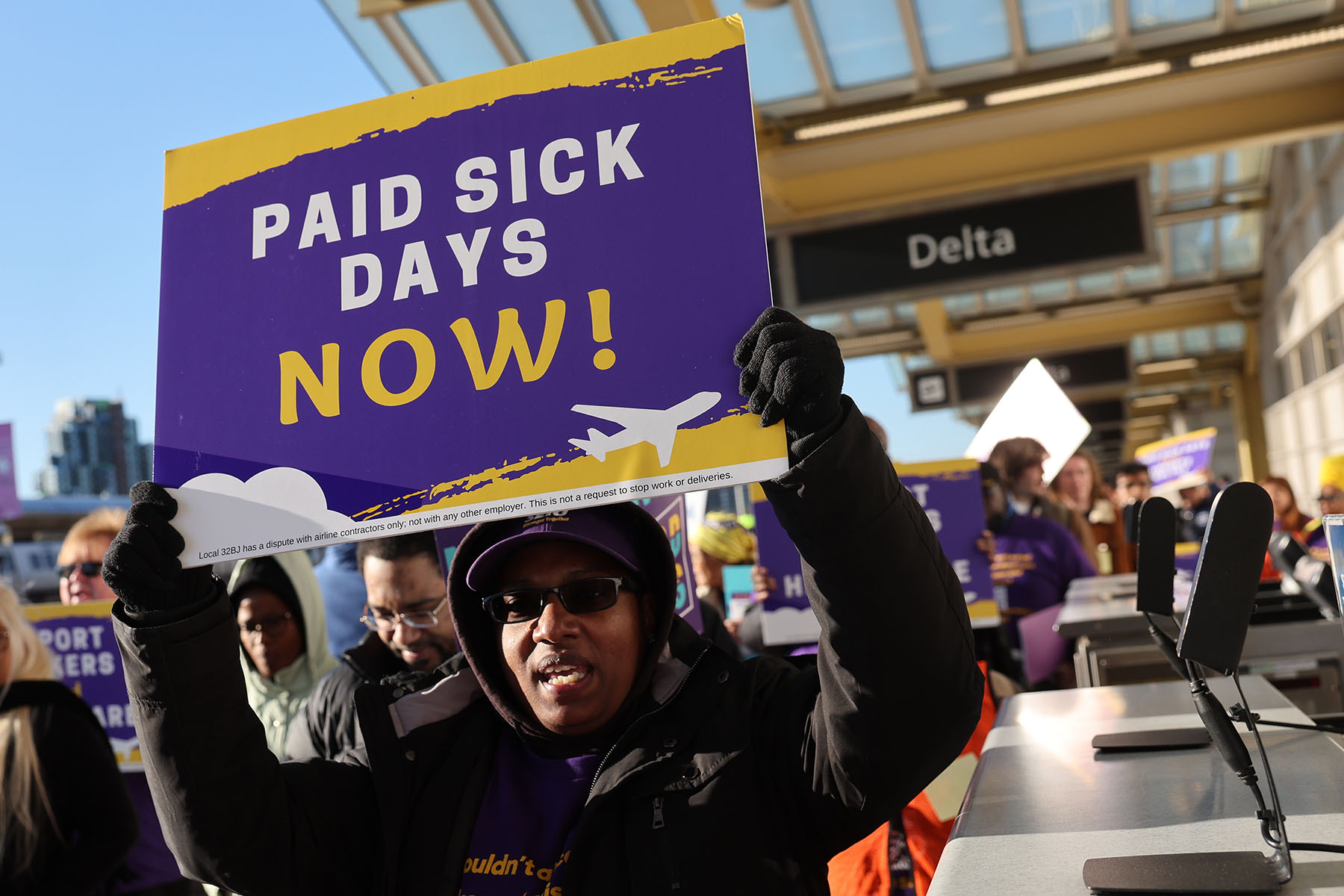

A third of American workers now have access to some form of government-issued paid leave — the biggest share ever.
The United States is one of only a handful of countries that doesn’t have a federal paid leave policy offering workers paid time off after the birth of a child or to seek medical care, for example, and access to unpaid leave is only about 30 years old. In that dearth of federal action, states have moved ahead to pass 14 paid leave laws since 2002, which now cover a third of the population. Ten of those were passed in the past decade, as support for paid leave has risen; three go into effect this year.
Some states’ paid family and medical leave programs expand beyond time off to care for a new baby or to get medical treatment. Last year, Colorado expanded its paid leave program to include an additional 12 weeks for parents of babies in the neonatal intensive care unit. In Oregon, survivors of domestic violence also qualify for paid leave. Connecticut offers paid leave if you’re serving as an organ or bone marrow donor.
According to research from the National Partnership for Women & Families, a nonprofit advocacy group, the 14 laws now cover 32 percent of private-sector workers, an estimated 46 million people. A third of the women in the private-sector labor force are now eligible for state paid leave, as well as a third of men and a third of parents. Asian American, Native Hawaiian and Pacific Islanders have especially benefited — 55 percent have paid leave through their state programs, as do 41 percent of Latinx workers due to a concentration of these communities in states that have enacted programs.
Paid leave laws are in 13 blue states and the District of Columbia: California, New Jersey, Rhode Island, New York, Washington, Massachusetts, Maine, Connecticut, Oregon, Colorado, Maryland, Delaware and Minnesota.
Though other workers may receive paid leave from their employers, workers of color — and especially women of color — are less likely to be in jobs that offer any paid leave. That’s one of the reasons advocates have pointed to a state or federal system as an equalizer that could improve access.
“All workers will at some point need paid leave, whether for their own health or to care for loved ones. But when access is not guaranteed, the workers least likely to have paid leave also tend to be those who are likely to face greater health and caregiving challenges and have fewer financial resources to fall back on,” the National Partnership for Women & Families noted in its report.
Low-wage workers, two-thirds of whom are women, have less access to paid family and medical leave from their employers than do high-wage workers.
“This creates a double bind for low-wage workers who often can’t take off unpaid time because they lack savings or might lose their job if they do. This inequity especially impacts women who are more likely to be low-wage workers and at the same time do two-thirds of unpaid caregiving,” said Katherine Gallagher Robbins, a senior fellow at the National Partnership for Women & Families and one of the authors of the report.
Large paid leave campaigns in six more states — Hawaii, Illinois, Nevada, New Mexico, Pennsylvania and Virginia — could, if passed, bring the share of American workers covered to 44 percent, the national partnership estimated.
The most imminent of those is a proposal in Virginia. Last month, lawmakers in the Virginia House and Senate passed a pair of paid family and medical leave bills that are likely to be signed by Democratic Gov. Abigail Spanberger, who called for passing a state program in her State of the Commonwealth speech this year.
In Pennsylvania, lawmakers are hoping to reignite momentum behind a paid leave bill that has bipartisan support. Lawmakers in Hawaii and Illinois are also considering a bill this session. And both Nevada and New Mexico have come close: In Nevada, a paid leave bill passed in the legislature last year was vetoed by Republican Gov. Joe Lombardo and in New Mexico, a paid leave bill passed the House last year but not the Senate.
At the federal level, part of the momentum of the past decade has come from men — especially dads in Congress — pushing for more paid leave access. During the Biden administration, the United States got as close as it ever has to passing a federal paid leave policy before it was removed from a spending bill. Now during the Trump administration, lawmakers made permanent a tax credit for employers who voluntarily offer paid leave to certain employees.
So while the issue does have bipartisan support, Republicans and Democrats remain at odds about what form a federal paid leave policy should take. At a House hearing last week, U.S. Rep. Ryan Mackenzie, a Pennsylvania Republican who has a newborn, said his wife is able to care for their daughter because of her company’s paid leave policy.
“We know that this practice makes an important difference for many in our community. Unfortunately, paid family leave has been out of reach for millions of Americans who are hoping to grow their families,” he said.
But while state bills are “encouraging,” Mackenzie said it is also “difficult for state administrators and private-sector benefits managers to navigate the patchwork of paid leave policies across different states. While one program may work in Maryland, Alabama likely has its own workforce challenges to manage. One state’s approach should not be forced upon another’s workforce, or vice versa.”
For paid leave, he said, “there is no silver bullet solution.”
Dawn Huckelbridge, the director of Paid Leave for All, a national advocacy organization pushing for federal paid family and medical leave, said she is “heartened to see there is bipartisan interest and dialogue” on the subject.
But, she added, “there are states that will likely never pass paid leave, so as long as there isn’t a federal guarantee, this is going to create a system and have and have nots that will just continue to grow inequities.”


