

It started with crayons.
When Sheila Morovati took her children out to restaurants she’d inevitably feel guilty that their new crayons, which often accompanied the kids menu, would be thrown out at the end of the meal. That led to her first foray into sustainability.
In 2009, Morovati started a nonprofit that collects used restaurant crayons and redistributes them to area Head Start programs, which offer early learning for lower-income families. From there, her work expanded from an effort to put pressure on the city council to ban plastic straws and cutlery in Malibu to a nonprofit that helps the entertainment industry rethink how they portray single-use plastics on screen.
“At a certain point in time, you can only go to city council meetings so much, you can only ban so much, but it’s like you’re swimming upstream,” said Morovati, who is a sociologist by training. “I knew that shifting culture is one of the key parts to this whole mess, and that’s what Hollywood does really well, is shape culture.”
In 2021, she launched a campaign — Lights, Camera, Plastic? — to shift the messaging around single-use plastics, like straws, on screen. Through her work, she connects with Hollywood productions to advise on alternatives they can present on screen to promote sustainable behaviors. This could include having characters carrying reusable water bottles over single-use plastic or taking a reusable grocery bag to the store. The “swaps” she promotes have expanded to include things like showing characters on screen carpooling and walking versus driving, or eating plant-based meals over meat.
And she’s not alone in her work. She’s part of a women-led movement to make Hollywood more sustainable off and on screen. At a time when the political willpower to take action on climate is not just dwindling, but facing a White House hostile to the concept, the entertainment industry is a place where society can still be influenced to take the climate crisis seriously and change their behaviors accordingly.
So far, Morovati has had success with spreading her message through Universal’s GreenerLight Program, an initiative launched in 2023 to bring sustainability messages both on screen and behind the scenes and led by another woman in the business, Kimberly Burnick, the senior director of sustainable content at NBCUniversal. The project has worked on films like “Wicked” and “Hamnet,” which is nominated for eight Academy Awards this year, including Best Picture, Best Director and Best Actress. Nature is an important backdrop to “Hamnet”, and GreenerLight focused on reducing impact on the environment during filming by using hybrid and electric vehicles to transport cast and opt for train travel over flights. The production also instituted a waste management system that included recycling and composting and donating materials like wood and costume fabric after shooting wrapped.
Morovati says a new Universal release, “You, Me and Tuscany,” which will hit theaters in April, has utilized her campaign’s swap guide to minimize depictions of wasteful plastic on screen. The movie also featured electric vehicles over gas-guzzlers when possible. “It’s not perfect, but we do believe that what people watch, it influences their choices,” Kat Coiro, the director of the film, told Yahoo News.
Allison Begalman, a former screenwriter and current community organizer, is one of the most prominent faces of the movement. She launched the Hollywood Climate Summit in the middle of the pandemic, after she realized there was a clear desire from people in the industry to learn more about how they could be part of the solution to the climate crisis and some of the wasteful practices in the industry.
“We were just trying to democratize the conversation around climate,” the co-founder of the summit said. “There really just weren’t spaces where anyone who is a creative or a climate leader or nonprofit or scientist or comedian could come and just access a conversation.” So she created one. While the inaugural summit took place online during the pandemic, it still attracted 15,000 people on YouTube. “We were blown away,” she said.
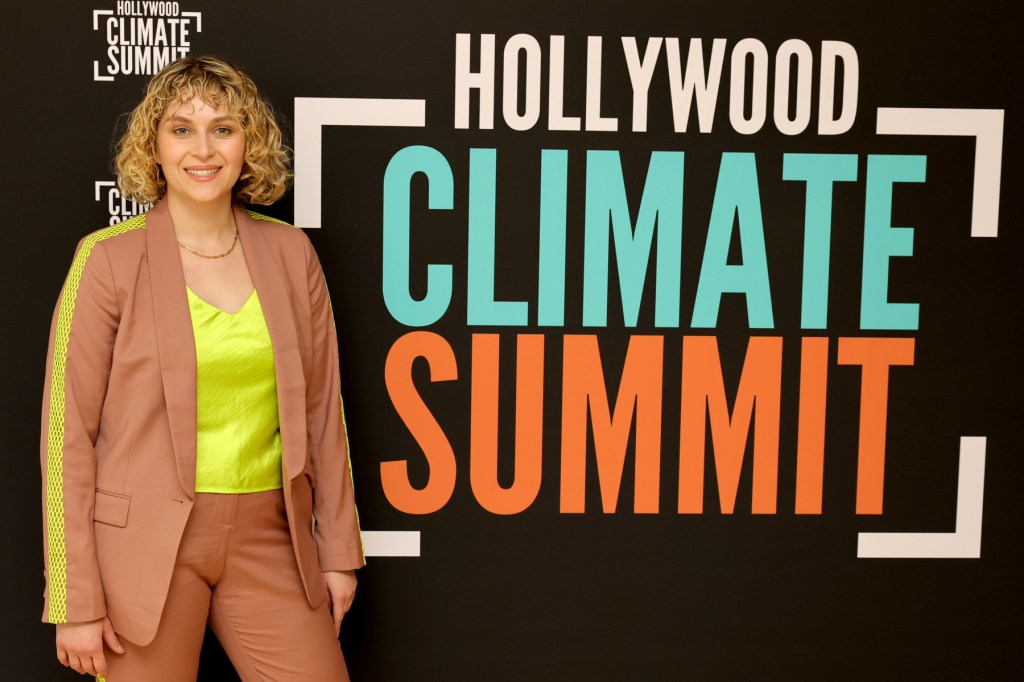
“It was like, ‘cool,’ let’s build this intergenerational space to have a conversation and make it fun and flashy and sexy, but also practical,’” she said. “And that included a lot of sustainable production and carbon emissions conversations.”
From there, the work grew. Six years later, it serves as a hub where climate communicators and entertainment industry insiders meet annually to figure out how they can work together and learn from each other.
One example of climate professionals and Hollywood coming together can be found in a “Grey’s Anatomy” episode that aired last year and centered on a heat dome descending on the Pacific Northwest. In the show, the cascading impacts of the heat strains the hospital’s capacity and shows how different populations are more vulnerable to extreme heat, including a storyline featuring a pregnant woman who goes into early labor. The plot was informed by experts at the Natural Resources Defense Council (NRDC), an environmental organization that has taken the lead in working with Hollywood to spread its climate messaging and promote climate storytelling in entertainment.
The summit has also served as a hub for other types of climate communicators, including content creators like Suzie Hicks, known by her social media moniker, The Climate Chick. She makes educational content for kids and, because of the summit, has been able to connect with organizations like NRDC. Other climate influencers based in Los Angeles have found community at the summit, too, including Leah Thomas, who became famous for her book, “The Intersectional Environmentalist,” and has over 200,000 followers on Instagram. In response to the ways culture and communication are shifting online, Begalman recently rebranded her organization as the Context Collaborative, to reflect its growing mission to spread the climate story in various forms.
For Begalman, the impact that Hollywood can have on communicating climate change is obvious. “We know what the solutions are for the climate crisis, and we could implement them, but we need a full societal shift in our understanding of this to put pressure on policymakers to act,” she said. “At this point we need to integrate through culture, because it feels like the only trusted vehicle we have left.”
This kind of cultural messaging has worked before. During the late 1980s when the organization Mothers against Drunk Driving (MADD) gained recognition for its advocacy work, the Harvard School of Public Health worked with Hollywood to integrate messaging around drunk driving and promote the concept of designated drivers in popular TV shows like “Cheers,” “Dallas” and “L.A. Law.” The messaging was credited with helping reduce traffic fatalities in the 1990s.
More recently, advocates have turned to Hollywood to influence how caregiving is portrayed on screen. An initiative called Re-Scripting Gender, Work, Family, and Care, aims to help Hollywood incorporate the difficulties of caregiving in scripts in an effort to boost cultural support for paid family leave.
Outside of influencing viewers’ habits, other women, like Hillary Cohen, are working to change the habits of productions themselves. Cohen was shocked when she worked on some of her first big sets in Hollywood for TV shows like “Private Practice” and saw the enormous amount of food thrown in the garbage at the end of each day. In a city with a large homeless population, “it was so upsetting to me,” she said. So during COVID, she decided to do something about it. She co-founded a nonprofit, Your Every Day Action, to divert some of that waste to organizations who distribute it to people facing food insecurity.
Last year, the organization successfully saved 140,000 pounds of food by picking it up from television shows like “Abbott Elementary” and taking it to area nonprofits. The redistributed food saves organizations like the Homeless Coalition an estimated $25,000 on food that it would otherwise be buying for its programs.
Since they launched, she’s expanded to pick up other items like water bottles and hygiene products, and even furniture, particularly from commercials. “Those productions are coming in for two to three days of shooting and they’re done,” Cohen said. “So they buy all these things, and then they have to get rid of them, and there’s nowhere to store them.” Last Thanksgiving, her organization picked up six ovens and multiple carloads of kitchen appliances after a cooking promo wrapped up production. She was able to redistribute the items to low-income housing units that needed those supplies for their kitchens.
Now she’s renovating a warehouse in Los Angeles in partnership with four other nonprofits. It will include a large walk-in freezer that will be able to store some of the food donations. But after the Los Angeles wildfires she anticipates that it could serve another purpose. “We’re set up to be a disaster relief zone in the middle of Los Angeles.”
Both supply and demand for her work is growing. This year, California is ramping up enforcement of a law passed in 2016 that requires companies to reallocate food that would otherwise go to waste, and that has led to a surge in requests for Cohen’s services. The rising cost of living in Los Angeles is also leading to more people needing assistance. ”Food insecurity is such a prevalent issue,” she said. “It’s currently becoming such a trending thing, because so many people who’ve never experienced it before … are now suddenly knowing what food insecurity is.”
Alongside the efforts of people like Cohen, many large film and TV studios have also shifted how they approach the topic of climate change and sustainability. Heidi Kindberg, the vice president of of sustainability at Warner Bros Discovery, said that the studio has a robust production program called HBO Green that encourages shows under the studio’s umbrella to lower their impact on the environment through reducing emissions by using battery power and renewable diesel when possible, promoting composting on set and reducing red meat consumption. Similar to Morovati’s work, the studio also promotes modeling sustainable behaviors on screen.
That modeling could look like anything from characters driving electric cars in movies to showcasing a vegan restaurant in the background of a scene or showcasing Earth Day posters at a set designed to look like a school. One example of how sustainability messaging might make it into a script can be found in an episode of “And Just Like That…” where the characters, Charlotte and Miranda, are ordering at Chipotle. As she’s ordering, Miranda switches from a steak burrito to a plant-based meat. It’s a simple and subtle nod to normalizing the option of reducing red meat consumption.
Cohen said that Rare, a nonprofit that works to change people’s behaviors to protect the planet, created a study based off of the scene to test how viewers responded to the dialogue. “It found that people thought that eating plant-based food was accepted and was going to become more prevalent,” she said. “One of the important findings was that it didn’t take away from the story. Nobody had a negative reaction.”
Cohen said that overall she’s seen the message of sustainability grow throughout Hollywood in the last few years, even as outside support and awareness has ebbed and flowed. “The political climate has an impact,” she said. “But through all of that, there has been an upward momentum.”
Correction: An earlier version of this story misspelled Suzie Hicks' first name.