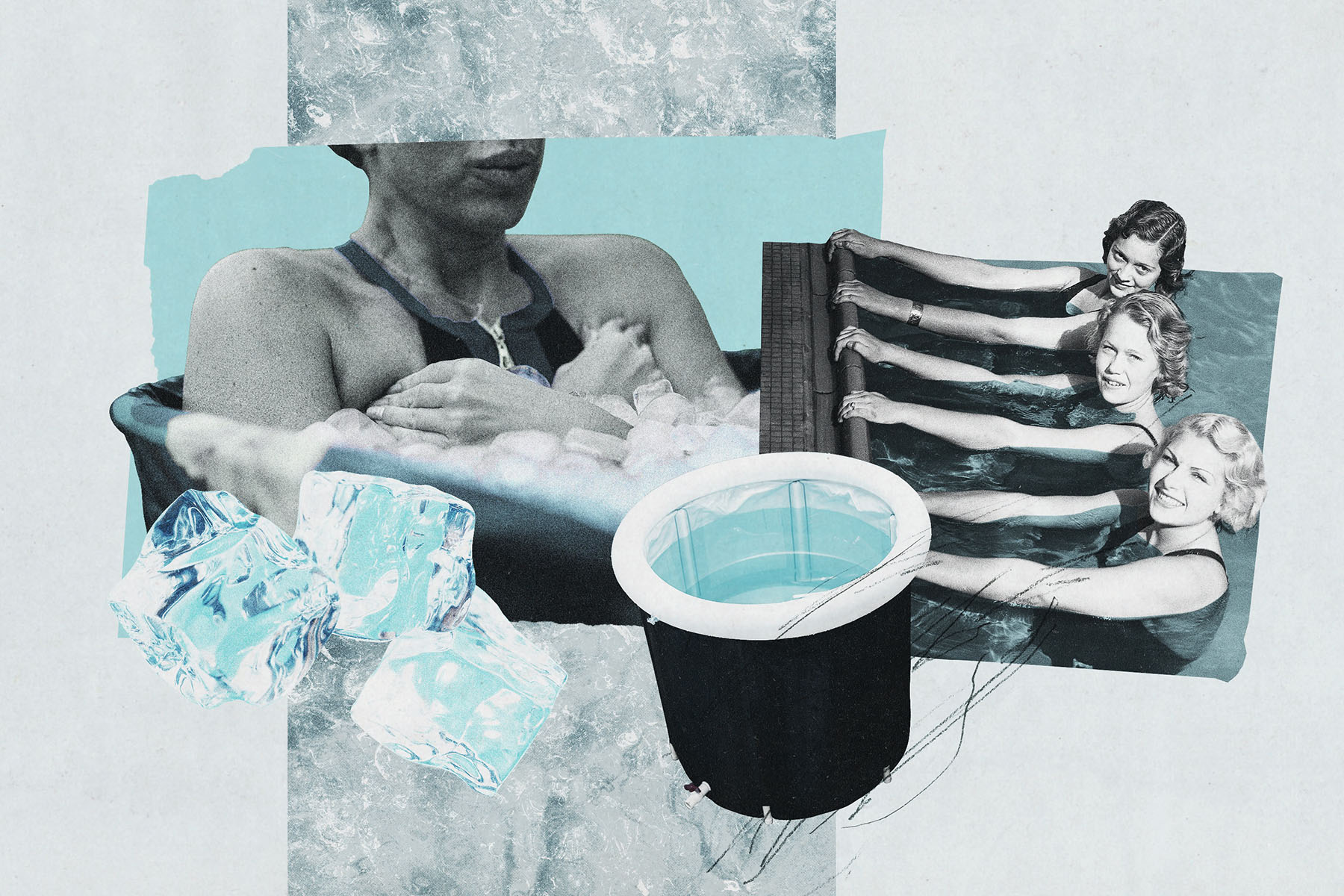

This is the second installment of Deinfluencing Month, a series in our menopause newsletter where we explore some of the biggest viral health trends that the algorithm is constantly promoting to people in perimenopause and beyond. We’re connecting with vetted experts to help you know what these things actually can do, can’t do — and the contextual “why” of their ubiquity. Want more? Sign up for our menopause newsletter.
Welcome to Week 2 of Deinfluencing Month, where I’m digging into viral health trends, figuring out what they mean culturally, and very selfishly trying to figure out if I ought to be doing any of them too. From the jump, I knew a topic I definitely wanted to explore for this: cold plunges.
Given the relationship between hot flashes and menopause, I had to look into whether literally sitting in a tub of very cold water could cure all that ails you. After all, who among us has not been drenched in sweat at 3 am and thought, “Hmm, maybe a bath tub filled with icy water would cure all that ails me?”
Though the practice has never been more pop-culture-forward — New York City blocks are dotted with boutique cold plunging studios — it’s hardly a new trend. It’s a practice long used by high-performance athletes to reduce inflammation after intense physical activity, something that in turn can reduce muscle soreness and help expedite recovery.
But not all of us are elite athletes. Not all of us can afford a boutique cold plunge membership. And, well, not all of us hear about sitting in a tub of cold water and think, “Wow that sounds like so much fun!”
So once again, I got on the phone and asked my favorite question: Do I need to do this?
Cue expert #1
First, I spoke with Dr. Deborah Kado, a geriatrics specialist and the co-director of the Stanford Longevity Center, whose work has long focused on helping people develop individualized protocols to help them age happily and well.
Kado said that one thing that makes her a little nervous about the buzz around cold plunging is how the practice is increasingly offered at unregulated “longevity clinics.” Such clinics are purported by influencers to have all kinds of almost magical anti-aging benefits — though the science and medical supervision are often lacking.
“Two comments that I can make with confidence in terms of increasing health span and lifespan is that there are no studies to demonstrate that doing regular cold plunges can do that,” Kado said.
There is good evidence for one benefit of cold plunging: stress reduction. And reducing stress is definitely good for quality of life. Cold plunging can also help trigger a kind of endorphin response that can give people more energy afterward. But Kado cautions that there isn’t good data looking at these benefits specifically for women, and especially not specifically for women going through menopause.
And that can be a problem, Kado said: “We have increasing evidence that men and women do differ biologically.”

Risks versus benefits
Kado also said it’s really important that people think about how they feel when they cold plunge, versus just following what someone on social media tells them to do. There are risks to it, too.
“For some, the benefits are that they feel it — they do the cold plunges, they feel great, they have more energy. They feel like, ‘OK, I’m dealing with my inflammation and my stress and it’s worth it.’ But for others, it may not be and they may not be realizing that there could actually be harm associated with investing in a cold plunge,” she said.
The main risk is related to the cold shock response: There’s the potential for cardiovascular stress and a spike in blood pressure. And this risk does increase as you age, so it’s a caution many women may want to heed as they enter midlife and beyond.
Cardiovascular events are a real concern for women as they get older — and cardiovascular disease is widely underdiagnosed in older women — and the shock of cold plunging can present risk for those with underlying conditions.
Kado said supervised cold water immersion by healthy, fit individuals may be safe when practiced carefully and reasonably if it is something you enjoy, but — like so many things when it comes to midlife health — checking with your doctor about whether your own health history makes you a good candidate for it is important too.
Not into cold plunging and want to reduce inflammation and stress? Kado recommends one of my personal favorite pastimes: taking a nap.
Cue expert #2
I also wanted to talk to someone who is all about that cold plunge life — and has brought a journalist’s eye to her practice. That’s why I called Liz Baker Plosser, the former editor in chief of Women’s Health, a veteran health journalist and the author of the Substack Best Case Scenario, in which she parses fact from myth when it comes to the latest trends in the women’s health space.
She started cold plunging in her 20s, when she was routinely doing triathlons, and has continued with it in different ways over the past 20 years.
As she dug more into the research on cold plunging in her own work, she found vocal advocates — but also doctors encouraging caution.
She also found a real lack of data on women.
“The research might bear out that it’s every bit as powerful and beneficial, it’s just that unfortunately we don’t know because women haven’t been studied in a lab the same way. It tends to be men. And even within that subset, it’s almost all been done on athletes specifically, which is a very different demographic.”
If it feels good, do it
Her investigation into the science of cold plunging brought Plosser right back to one of her guiding principles when it comes to all things health and fitness: She would like to see more women, especially in the health and fitness space, hold the duality that we both want to age well and that we should do what feels right for us.
“Some of the biggest voices in the podcast space who talk about health and health protocols are men and some of them are very problematic,” Plosser said. Many rarely have women experts on. Changing this landscape could have a real impact on the choices women get to make.
“The more voices, the more prominent voices, we have who are talking about this stuff — whether longform podcasts, newsletters, media articles, or shorter form social media — the better because I think it helps normalize it for women and hopefully gives them more places to seek really good information and have these conversations.”
In the absence of this, she recommends approaching cold plunging — and other health and fitness trends — with the kind of advice my own Pilates teacher gives: Don’t like this? You’re an adult, you don’t have to.
Plosser adds: Hear you need to eat before you work out, but you’re not hungry and eating before you exercise makes you feel sick? Great — then don’t do it.
Told you should be lifting really heavy weight to help with bone density and muscle mass but you were up all night with hot flashes? Great — lift some lighter weights today.
This philosophy still feels slightly radical, Plosser said. And the current conversation around cold plunging is a perfect distillation of all of the complexities around how we talk about healthspan and gender.
“Something that women really have to learn to do is to trust their bodies and their instincts and to always prioritize that over whatever the cool new trend on social media or the latest study is saying.”
And yes, she’s still cold plunging — but only when she feels like it.