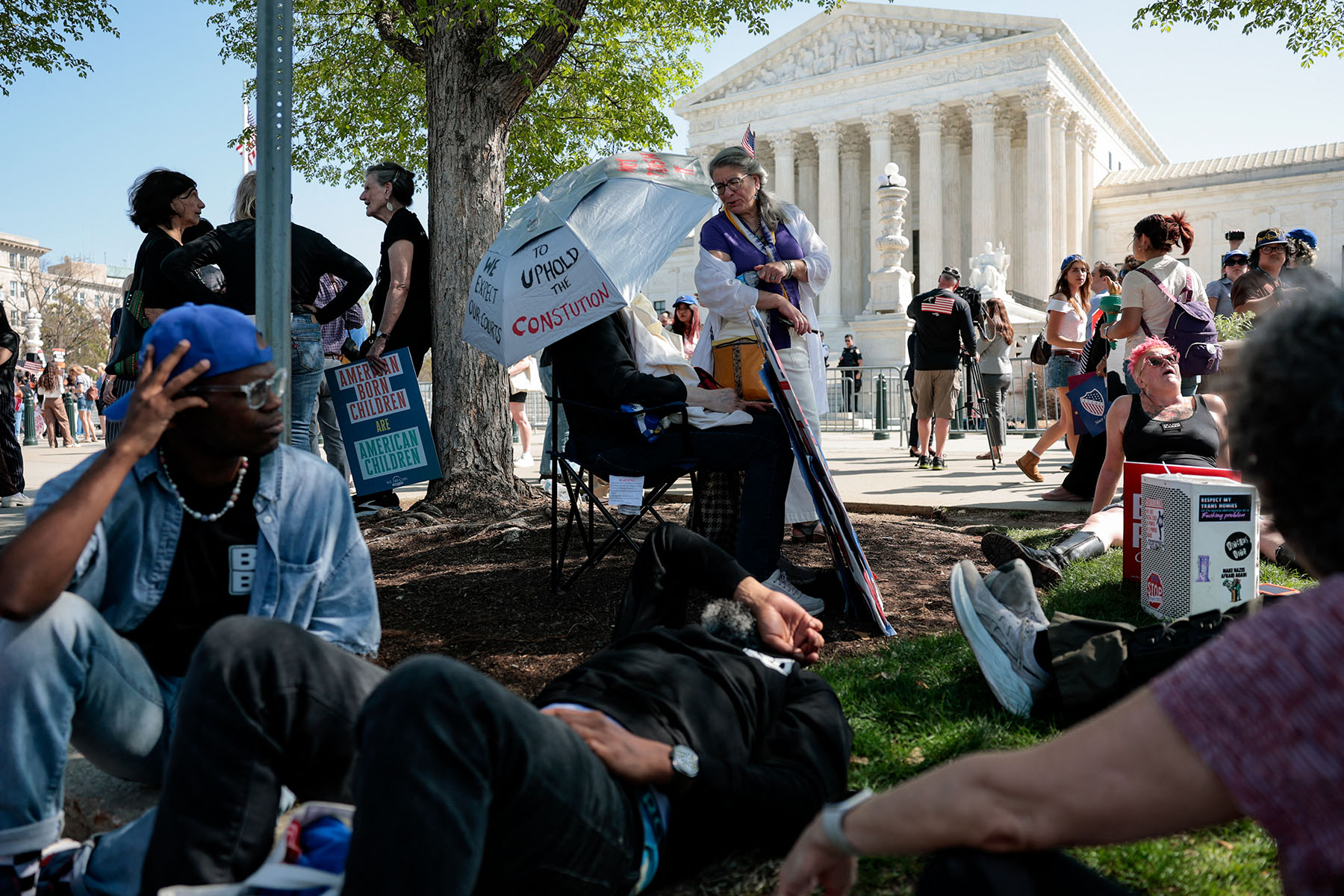

Supreme Court justices appeared skeptical on Wednesday of the Trump administration’s argument that the 14th Amendment does not extend birthright citizenship to the children of noncitizen parents.
The high court heard oral arguments on April 1 in Trump v. Barbara, a landmark case that will determine whether President Donald Trump can essentially redefine who is considered an American by restricting which babies born on U.S. soil have the right to citizenship.
The bulk of the Trump administration’s argument centered on whether the children of noncitizen or temporary-status immigrants have an allegiance to the United States, and whether they can claim a “permanent domicile and residence” inside the country.
Multiple justices raised questions about how the administration defines “domicile” and the logistics of how that definition might be applied if the executive order were to go into effect. Notably, three of the six justices who make up the court’s conservative majority — Chief Justice John Roberts Jr., Justice Neil Gorsuch and Justice Amy Coney Barrett — appeared unmoved.
“The examples you give to support that strike me as very quirky,” Roberts said. Barrett, for her part, questioned how the administration’s argument might apply to the children of people trafficked illegally into the country.
Trump listened in, becoming the first sitting president in history to attend a Supreme Court argument.
The court’s liberal women justices pressed the administration on how enforcing the order would work in practice. Justice Sonia Sotomayor wondered if the administration seeks to retroactively “unnaturalize” people born to noncitizen parents but have already secured birthright citizenship; Solicitor General D. John Sauer responded that the administration does not intend to take retroactive action. Justice Ketanji Brown Jackson asked, “Are we bringing pregnant women in for depositions?”
In an interview with The 19th after the oral arguments, Hannah Steinberg, a staff attorney on the ACLU’s Immigrants’ Rights Project who assisted with the case, brought up the issue of enforcement: Who will be responsible for verifying the immigration status of a newborn’s parents?
“Are women going to have to bring their identification to the hospital? Is the hospital going to check?” Steinberg said. “It’s a huge impact. It unsettles our entire system of law and practice.”
These questions underscore the wide-reaching effect Trump’s birthright order would have.
An estimated 250,000 babies are born on U.S. soil to immigrant parents without authorization. Narrowing the scope of birthright citizenship threatens to expand the number of people living in the country without authorization for generations. An estimated 2.7 million additional people would be unauthorized by 2045, and 5.4 million additional people by 2075, according to projections published by the Migration Policy Institute and Pennsylvania State University.
The American Civil Liberties Union is representing a group of parents and children who would be affected by Trump’s order. In its challenge to the administration, Cecillia Wang, national legal director for the ACLU, argued that establishing a permanent domicile was not the focus of the citizenship clause of the 14th Amendment.
“The 14th Amendment’s fixed bright line rule has contributed to the growth and thriving of our nation. It comes from text and history. It is workable and it prevents manipulation,” Wang told the justices.
She added, “The executive order fails on all those counts; swaths of American laws would be rendered senseless. Thousands of American babies will immediately lose their citizenship, and if you credit the government’s theory, the citizenship of millions of Americans past, present and future could be called into question.”
On the first day of his second term, Trump signed an executive order denying birthright citizenship to children born to immigrants without legal status and temporary visitors from foreign countries. The order ushered in some of the most aggressive immigration enforcement in U.S. history, one that has had a notable impact on immigrant families.
In a number of lawsuits, civil rights and immigrant advocacy organizations, as well as four states, argued that the order violates the 14th Amendment’s citizenship clause and longstanding legal precedent that has upheld birthright citizenship for the children of noncitizens. A federal judge issued a nationwide preliminary injunction temporarily blocking the administration’s ability to enforce the order, calling it “blatantly unconstitutional.”
The Trump administration filed an emergency petition last year asking the Supreme Court to limit federal judges’ ability to issue nationwide injunctions, also known as “universal” injunctions. In June 2025, the court’s conservative majority weakened the power of lower courts to issue injunctions that block the implementation of White House policies nationwide.
The ACLU argues that the scope of birthright citizenship and its inclusion of the children of noncitizen parents was affirmed by the 1898 case United States v. Wong Kim Ark, which ruled in favor of a man born in California to Chinese parents. If the Trump administration seeks to overturn the Ark ruling, the ACLU contends, then it has not provided enough evidence to justify its interpretation of the citizenship clause.
Steinberg told The 19th that the legal definition of domicile applies to a person residing in the country who intends to remain indefinitely. That definition is “nowhere within the 14th Amendment,” she said.
“There’s nothing that says, for example, that someone who is undocumented is not able to be domiciled here,” Steinberg added. “The government is not only inserting ‘domicile’ into the 14th Amendment, but totally reinventing what the concept even means.”
Many legal experts contend that birthright citizenship is settled law, strengthened by decades of court rulings. Still, the Supreme Court’s conservative majority has made it clear it is not averse to change long-standing legal precedent, as it did in recent years with the overturning of federal abortion protections and sharply limiting the consideration of race in college admissions.


