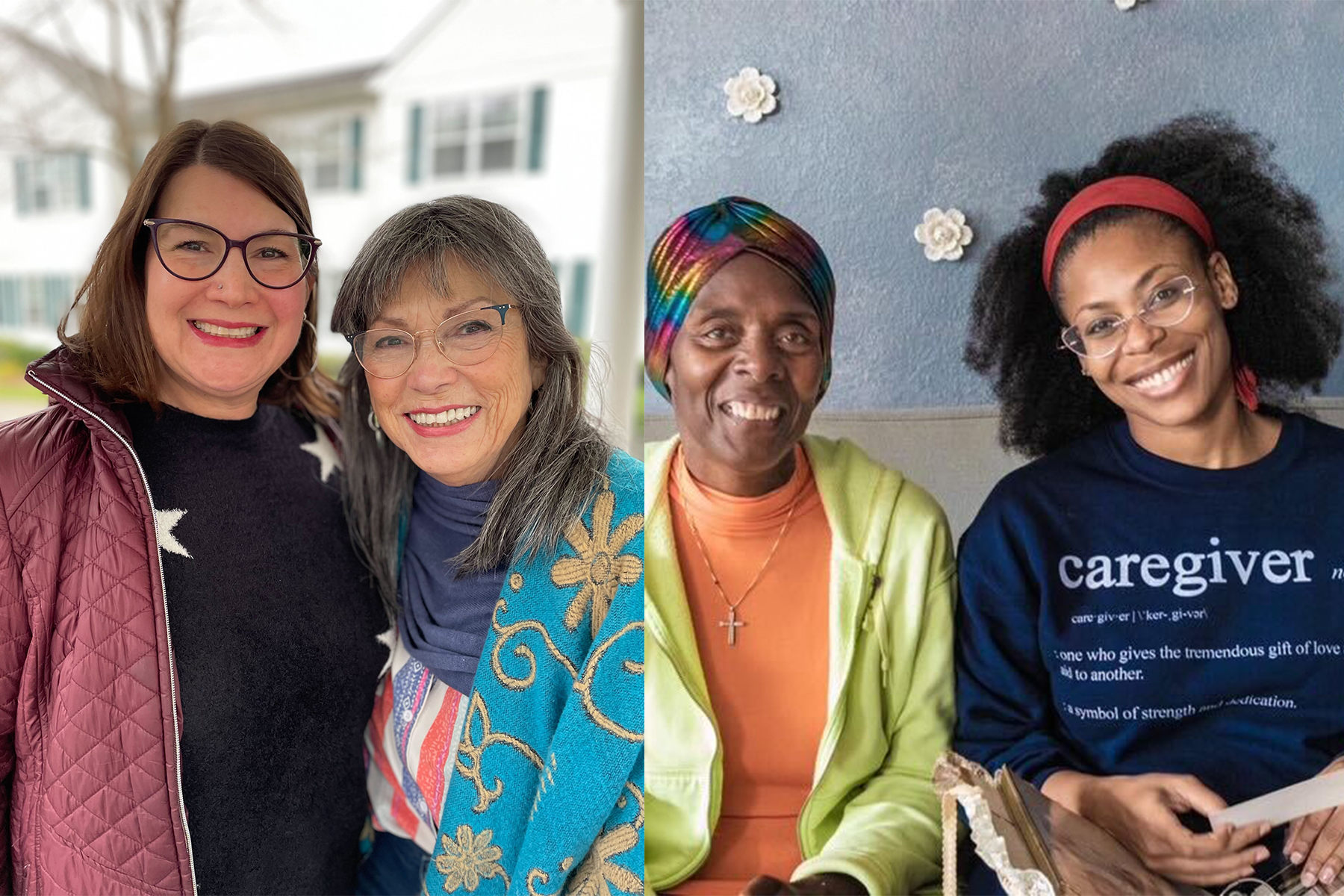

Helina Josephson retired from a career in university administration in 2017 due to autoimmune disease and chronic pain. She has ice pick headaches, which are exactly what they sound like — sudden, stabbing pain in her head. She has arthritis in her hips.
Last year, Josephson, 55, brought her mother, Rohana Miller, home from the emergency room. Miller is 80 and has dementia and diabetes, among other conditions. She moved in with Josephson last year, when it became clear that she wasn’t able to manage her diabetes safely on her own.
Josephson frequently feels like she is “running on fumes.” Taking time to rest, take pain medication or go to physical therapy appointments is often not possible. Her mother struggles with sequential tasks, like getting dressed in the morning or eating a meal. Sometimes, she gets confused and angry. Josephson is constantly monitoring her mother’s insulin. The sound of the monitor wakes Josephson up at night, not because Miller has low blood sugar, but because she has rolled over onto the sensor.
“I try really hard not to look as bad as I feel. People have no idea,” said Josephson, who lives in Canaan, New Hampshire.
Josephson’s experience is far from unusual. According to a recent report from the Lurie Institute for Disability Policy at Brandeis University, as many as 36 percent of caregivers have disabilities themselves. This reality is rarely discussed outside of support groups and is often not considered when developing caregiving policy.
“There are a lot of assumptions that disabled people are solely recipients of care,” said Lauren Bixby, a research scientist and one of the authors of the report.
Bixby and her colleagues found that not only are disabled people caregivers, but they are more likely to be caregivers than people without disabilities.
“It definitely disrupts narratives about this kind of one-directional way that care works,” Bixby said.
Joe Caldwell is the director of the Community Living Policy Center at Brandeis University and co-authored the report. He also worked to develop a national strategy for family caregivers during the first Trump administration. The national strategy’s final report has limited guidance for caregivers with disabilities.
“When we think about strategy, is it really inclusive of caregivers with disabilities? And how can it be more inclusive?” Caldwell said. It isn’t just that some caregivers have disabilities: Policy needs to be shaped so they can access the same services and supports available to everyone else, he said.
Jacquelyn Revere, 39, is a caregiving influencer living in the same home where she and her mother grew up in Los Angeles. She cared for her mother and grandmother through their dementia, documenting their journey on Instagram and TikTok through @MomOfMyMom, named because her mother started calling her “mommy.”
Revere’s grandmother died in 2017, and her mother died in 2022. Since then, Revere has dedicated her time to creating The Care Den, a supportive community for other caregivers, and learning how to take care of herself again.
Revere stutters in her videos and has stuttered since childhood; “I tend to stutter more when I’m under more stress — and of course, dementia caregiving is incredibly stressful,” she said. “You’re forced to pivot all the time. When I first moved home, I considered applying for disability, because my stutter had gotten so severe that I could hardly communicate.”
She had to make phone calls and doctor appointments. She needed to get access to accounts and pay bills.
“When I was having to take my mom and my grandmother to doctors’ appointments, there’s only a certain amount of time that you have to express what’s going on. If you’re stuttering severely through most of it, then doctors lose patience or they ask if you can just write it out. I had to adjust the way I could communicate in order to get what I needed done,” Revere said.
In addition to writing down questions, sometimes she would pre-record them for doctors and play them when she was in the office with her mother or grandmother. She often felt looked down upon in ways that made advocating for her family more difficult. “There is this assumption that we’re not as smart,” she said.
Neither Josephson nor Revere was surprised by the prevalence of disabled caregivers. They have met many people like themselves.
“In my dementia caregiver [support] group, most of those caregivers are spouses, so they are generally much older. Some of them have cancer and their partner with dementia can’t really understand it,” Josephson said. This is reflected in the data, which shows caregivers with disabilities are much more likely to be over the age of 65.
“There is a level of understanding the extra weight that you carry when you have to care for yourself while also having the responsibility of caring for another,” Revere said.
This is also complicated when cognitive disabilities like dementia are involved, because the person receiving care may forget or not understand that the family member caring for them has a disability.
Josephson’s mother does not always remember that Josephson is disabled.
“Sometimes she forgets that there’s anything wrong with me ever,” Josephson said.
Other times, though, her mother does notice that Josephson is in pain. “She’ll be like, ‘Oh, are you hurting? You should take better care of yourself.’”
Josephson will continue to do what she can.


