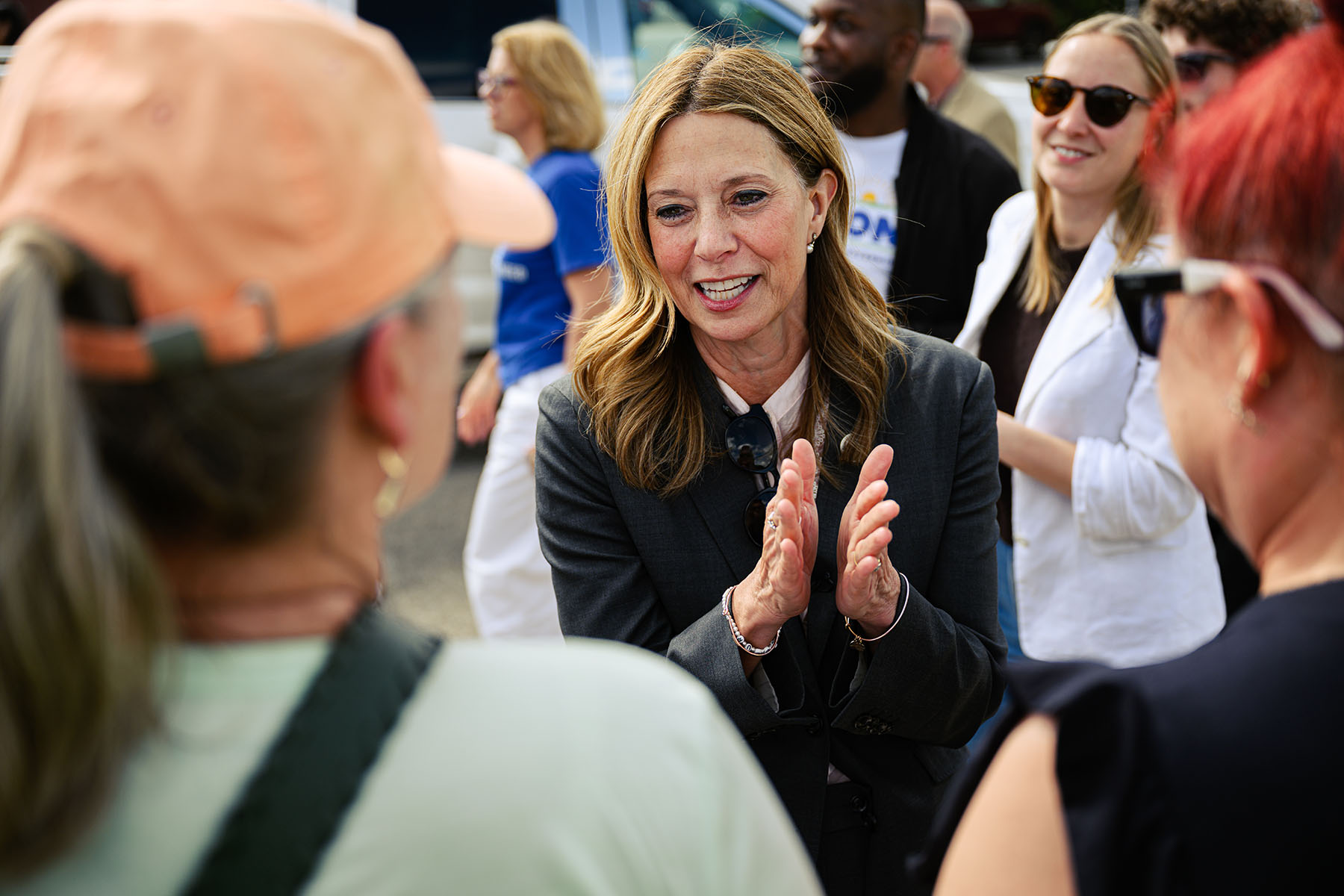

Dr. Amy Acton, who briefed Ohioans nearly every day during the height of the COVID-19 pandemic as public health director for a Republican administration, easily secured the Democratic nomination for governor on Tuesday, according to Decision Desk HQ. She will face Vivek Ramaswamy, a biotech entrepreneur aligned with the Trump administration who won the GOP nomination.
Their primary victories set up a history-making choice for Ohioans in the November midterm elections: Acton would be the first woman elected to govern the state; Ramaswamy would be the first South Asian.
The midterms will test the gains women have made in serving at the highest level of state governments. Maintaining their ranks at the gubernatorial level will likely hinge on whether candidates such as Acton prevail in key incumbent-free races, according to a recent analysis from Rutgers University’s The Center for American Women and Politics.
There are a record 14 women governors currently serving — 10 Democrats and four Republicans. Of those, four Democrats and two Republicans are leaving office this year due to term limits or retirement. Kelly Dittmar, a Rutgers political scientist and a scholar with the center, said it is possible for women to hold onto 14 governor’s mansions, “but the likelihood that we’re going to blast past that would mean all the stars have to align for all these women, both in primary elections and then, ultimately, in the general.”
Dittmar identified eight open-seat gubernatorial contests where non-incumbent women have the most promising chances of being elected as the path through which women’s representation could most easily be maintained or even surpassed.
One of them is in Alaska. Four Republican women are competing in a crowded August primary to succeed Republican Gov. Mike Dunleavy, who is term-limited — Lt. Gov. Nancy Dahlstrom, Matanuska-Susitna Borough Mayor Edna DeVries, former state Sen. Shelley Hughes, and business owner Bernadette Wilson. The state has a nonpartisan nominating contest; the top four vote-getters advance to a ranked-choice general election. It’s a race that solidly favors Republicans in November. Early polling shows that Wilson, in particular, has a good shot to advance to the general election.
In Minnesota and Tennessee, two women serving as U.S. senators are the strong frontrunners for their parties’ nominations, and given the states’ political makeups, the Democratic and Republican primary winners are respectively expected to prevail. In Minnesota, Sen. Amy Klobuchar is leading in the Democratic primary — and Democrats are strongly favored to win the general election. In Tennessee, Sen. Marsha Blackburn is leading Republican primary polls in a general-election race that is rated “solid Republican” by the nonpartisan Cook Political Report. Neither Minnesota nor Tennessee has ever had a woman governor.
Women are also running in some of the most competitive gubernatorial contests in the country, including in Georgia, Wisconsin and Michigan. These are the type of contests they would need to win to surpass the high mark of 14 in office.
In Georgia, Atlanta Mayor Keisha Lance Bottoms is leading polls for the Democratic nomination, but would face a tough matchup for Democrats in November. Wisconsin’s crowded Democratic nominating contest has four women — Rep. Francesca Hong, Lt. Gov. Sara Rodriguez, state Sen. Kelda Roys and Missy Hughes, a lawyer. The Democrat who advances to the general election is expected to face a highly competitive race.
Neither Georgia nor Wisconsin has ever had a woman governor. Georgia has also never elected a Black governor, making Bottoms’ bid potentially history-making on two fronts.
In Michigan, Secretary of State Jocelyn Benson is leading all Democratic primary polls to succeed current Democratic Gov. Gretchen Whitmer, but would also face a tough toss-up race in November. The Republican primary is crowded and more competitive.
Dittmar said that while the electorate favors executive traits like “assertiveness, toughness, experience and perceived expertise on economics and security-related things” that have historically disadvantaged women candidates in gubernatorial races, “the most updated research on those stereotypes and perceptions that women in politics show that a lot of those are starting to go away.”
But “that lack of historic representation also makes a difference because we start to think, ‘Oh, well, a woman hasn’t done it before.’ So one, ‘Can she do it?’ And ‘Two, can she win?’” Dittmar said. She called it an “electability bias” at the highest levels of U.S. politics.
Acton will have a tougher road ahead in her incumbent-free race than some of her contemporaries will in states like Minnesota or Tennessee. There are nearly twice as many registered Republican voters in Ohio than registered Democratic voters, though voters unaffiliated with either party make up the bulk of the state’s electorate. President Donald Trump won the state with more than 55 percent of the vote in 2024.
Still, the gubernatorial race is shaping up to be surprisingly competitive given the state’s recent voting history: the Cook Political Report recently upgraded its competitiveness to “leans” Republican.
Due to the uncompetitive nature of both parties’ primaries, Acton and Ramaswamy had already begun testing their messages against each other before securing their respective nominations.
Since it would be the first time either candidate has served in elected office, Ramaswamy has focused on Acton’s tenure leading the state’s public health department under current Republican Gov. Mike DeWine, who cannot seek reelection because he is term-limited.
Ramaswamy’s attacks on Ohio’s COVID-19 lockdowns and closures, as well as his accusations that Acton ordered voting changes ahead of the 2020 primary elections, have prompted public refutations from DeWine as being inaccurate. The outgoing governor has nevertheless endorsed him. Ramaswamy previously competed in the GOP 2024 presidential primaries but dropped out following Iowa’s nominating contest.
Acton has focused on affordability, often campaigning in far-flung areas of the state, and has painted Ramaswamy as a billionaire out of touch with Ohioans’ needs. Her campaign has characterized his attacks on her tenure in enforcing DeWine’s decisions during her time in Ohio’s public health department as disingenuous. They have also called it “shameful” that the Republican candidate seemingly criticized Acton for being a victim of childhood sex abuse.