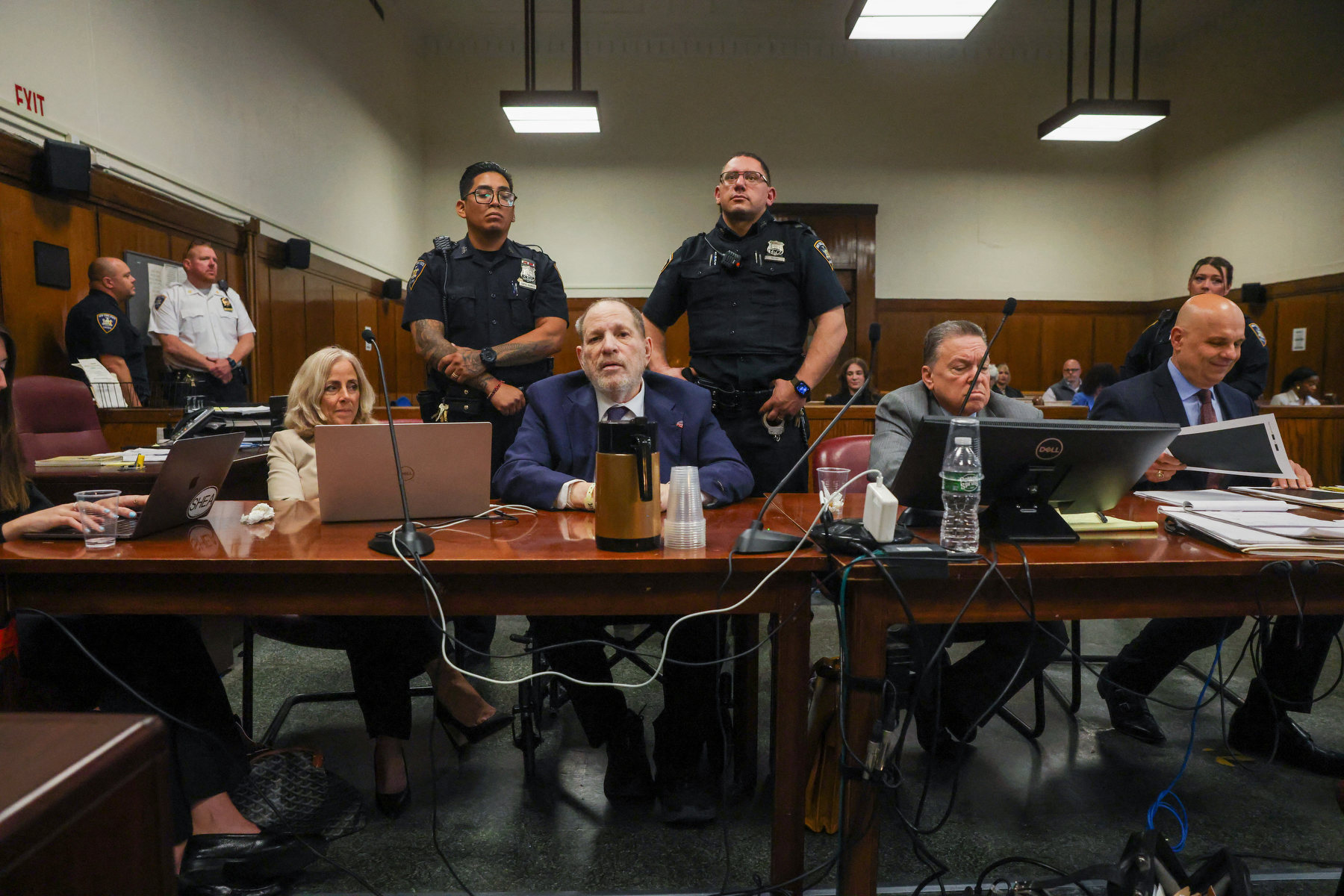

Six years ago, Jessica Mann took the stand for the first time in a New York City courtroom to publicly detail allegations that Harvey Weinstein raped her in a Manhattan hotel room in 2013.
That trial resulted in Weinstein being convicted of raping Mann, as well as committing a criminal sex act against a former production assistant. But four years later, the New York Court of Appeals overturned both convictions, ruling that the judge in the initial trial improperly allowed testimony that may have unfairly influenced the jury. The charges then had to be tried again with a new jury. In the second trial, the jury reconvicted Weinstein of the criminal sex act charge, but they could not reach a verdict on whether Weinstein raped Mann.
Then came a third trial this year focused entirely on Mann’s rape accusation. By this point, Weinstein had been convicted of four other charges related to the forced oral sex or rape of other women. The new trial began in April, and included Mann testifying for a third time against her alleged abuser. On May 15, another deadlocked jury could not reach a unanimous verdict. The prosecutors will now have to determine whether to move forward with another trial.
Mann’s case underscores the layers of messiness and complexity that shape how courts handle sexual violence throughout the country. Experts told The 19th that the high standard of proof required in criminal cases, in addition to juror biases and different understandings of power dynamics and consent can prolong survivors’ fight for justice.
Weinstein’s case isn’t the only high-profile example of a mistrial over sexual assault allegations.
In 2017, a judge in the sexual assault trial of Bill Cosby declared a mistrial after jurors deliberated for six days and reported being “hopelessly deadlocked.” Cosby was convicted in a retrial, but then the conviction was overturned in 2021 due to a legal technicality. In 2022, the jury deadlocked during the first trial of “That ’70s Show” actor Danny Masterson, who also stood accused of rape. A second jury ultimately convicted him. These three cases have individual circumstances and evidence that cannot be equated, experts said, but at some point, each involved an indecisive jury.
Less than 4 percent of sex crime allegations result in a conviction. In some cities, like Los Angeles or Chicago, the rate is 1 to 2 percent, according to an NBC News investigation. While jurors for criminal trials are randomly selected and purportedly aim to be a fair and representative sample of the community, personal biases still influence jury decision-making, according to research.
For example, multiple studies indicate that women defendants facing accusations of sex crimes receive more leniency from juries than men. Women jurors tend to vote in favor of a conviction in sexual violence cases, while jurors who are men show more leniency, according to Alissa Anderson Call, an associate professor of psychology at Black Hills State University in South Dakota, who researches jury decision making in sexual abuse and assault cases.
But if and how gender factors into a juror’s consideration of a criminal trial can be even more complicated, according to Aya Gruber, a law professor at the University of Southern California’s law school.
“Women jurors can be very hard on women defendants who don’t perform female stereotypical roles — for example, women are very prosecutorial when they come on juries with women charged with child abuse and neglect,” said Gruber, an expert in criminal law and feminist legal theory.
In the case of Weinstein’s most recent trial, eight of the jurors were men and four were women. In the aftermath of the mistrial, The New York Post reported that nine of the 12 jurors voted to acquit Weinstein, including all of the women.
Other factors that shape juror decisions in sexual violence cases include their understanding of consent and whether they believe common myths about sexual violence.
Oftentimes, discussion of consent frame a rape as a straightforward, harmful attack: a victim resists sexual advances, says “no,” and a perpetrator ignores these demands and attacks.
But in many cases, there’s some sort of pre-existing relationship between a victim and an abuser. This could be a workplace relationship, a familial relationship or even a consensual romantic relationship in some cases.
“These cases become complex because they’re not just a matter of, ‘Here’s a man who forces himself on a woman, and they’re never in touch again,’” Gruber said. If someone like Weinstein is in a position of power and has the ability to hire or fire someone, a victim is incentivized to maintain a good relationship with that person, even after an assault. In the case of a family or friend assaulting someone, the survivor may be forced to navigate complex feelings of love and care for the person who harmed them.
These complex dynamics challenge the myths that many people have about sexual violence, which can create doubts for jurors in criminal cases who are tasked with determining “beyond a reasonable doubt” that a defendant committed a crime. Gender-based violence researchers say that a juror’s “rape myth acceptance” influences whether they will vote to convict or acquit in sex crime cases.
These myths include “victim blaming,” the idea that a victim brought the assault on themselves by wearing revealing clothing, consuming alcohol or being friendly or romantic with the abuser. Another type of myth relates to questioning whether an interaction can be considered “real rape” if it involves two people who have a preexisting relationship, doesn’t involve a weapon or if the victim doesn’t forcefully fight back.

Support The 19th
Your donation helps our newsroom address the unfulfilled promises of our democracy. We are committed to being truly representative of our American story and our American electorate.
“People who score higher on this metric tend to accept these rape myths, things that are erroneous about sexual assault, and therefore they’re more likely to acquit a male defendant, when it’s a male versus female situation,” Call said.
While some measures can be implemented to reduce juror bias, ideally the country would work toward building a society where these types of assaults do not happen at all, Gruber said.
Crime research institutions have not found a strong link between harsh criminal prosecutions and sentences with deterring sexual crimes. Gruber pointed to the benefits of the #MeToo era for forcing conversations that pushed people in power to reevaluate the systems that enable these abuses. Reform efforts included expanded worker protections and restricting non-disclosure agreements in some states.
“To me it’s not such an easy proposition that ‘Weinstein’s in jail, now we can move on from all the problems of the world.’ They’re still going to happen, because nothing changed,” Gruber said. “I do think those kinds of attitudinal changes and structural changes can do a lot to help in a way that I don’t necessarily think that these high-profile convictions do.”
But for many survivors of sexual violence, the criminal legal system and civil lawsuits for monetary damages are the only means of justice that they can seek out.
“For years I have had to relive some of the hardest moments of my life while facing attempts to shame, humiliate and discredit me in open court,” Mann said in a statement after the latest mistrial, according to People. “I submitted myself to the highest standards, transparency, and accountability in coming forward through the justice system — choosing integrity even when the process flayed me open.”
“The power of predators remains too great,” she continued. “I deserve justice, which is why I stand up and face unbearable public scrutiny in the name of a greater good – a world where predators are not in power.”