This story was produced in collaboration with GBH News Rooted in Boston.
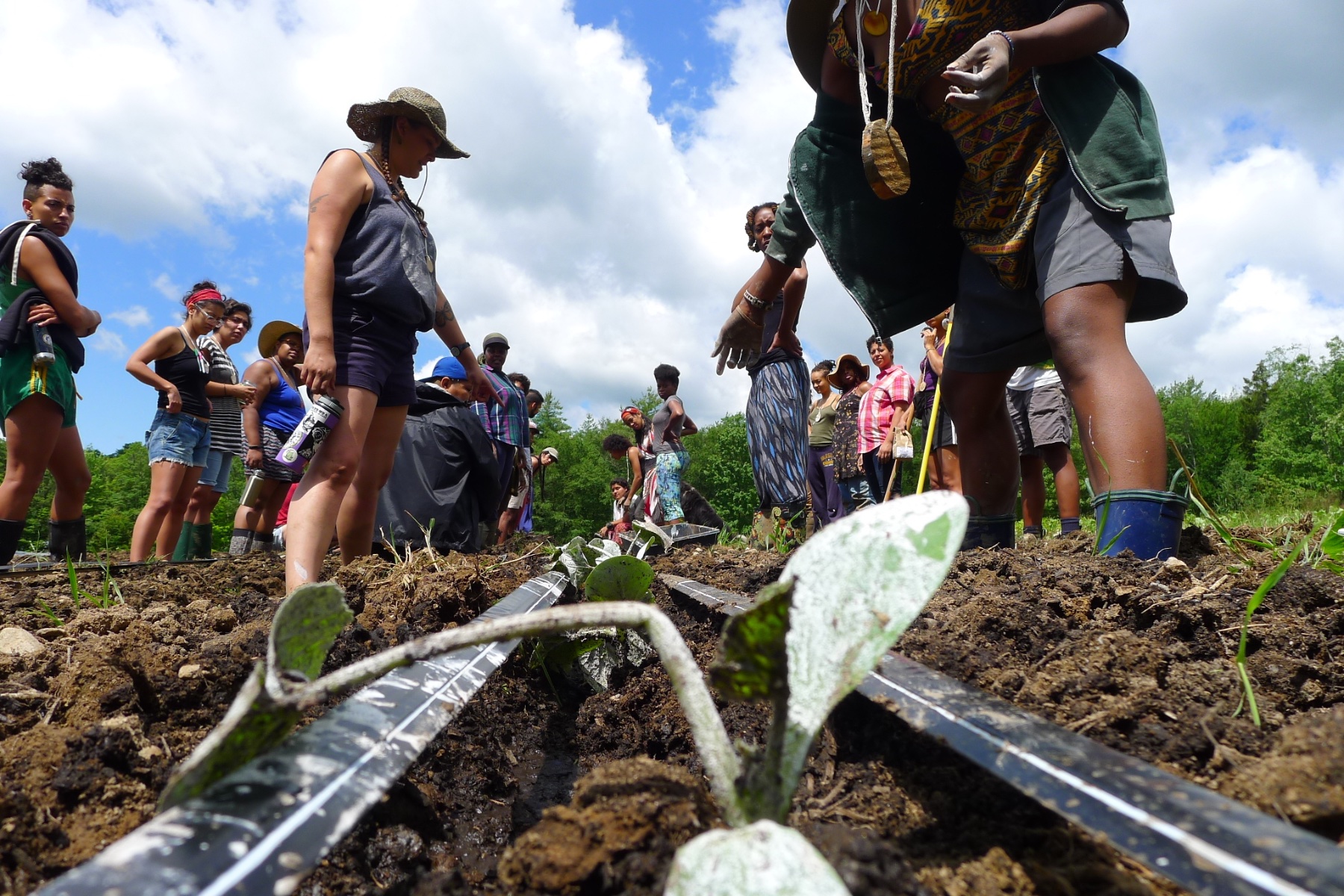
On a sunny morning in June, about two dozen people walk the land of Soul Fire Farm in Rensselaer County in Upstate New York, during a tour.
They are participants in a week-long immersion program that includes a “hands on the land” portion where they spend a few hours a day planting and harvesting on the several acres of former Mohican land. The rest of their time is dedicated to learning about ancestral connections to farming, especially for Black, Indigenous, and people of color.
“A lot of us maybe have grandmas, mamas, tatas, abuelas that have these beautiful herbal remedies that they’ve created. And they’re like 90 years old, they look like, you know, 50,” laughs tour guide Hillary Gaeta as she points to lusciously green rows of mint, lemon balm, oregano, and other herbs on the farm. “It’s a way to pass down that knowledge.”
Each participant has paid between $0 and $1,200, which covers a week of lodging, meals, and programming. I am one of them. I come from a long line of sharecroppers, tenant farmers, herbalists and healers. Many of them are Black women, including my grandmother Cornelia Rodgers, whose garden provided my earliest education in land stewardship.
“A lot of folks don’t realize that Black women grow the majority of the world’s food, when you look at small holder farms especially in Africa, Latin America and the Caribbean,” says Leah Penniman, the co-founder of Soul Fire Farm. Penniman, who uses all pronouns, says the space is about more than growing food. It’s about cultivating a healing relationship with the land, especially for those who have been divorced from it over time.
“I believe in the healing power and potential of land connection for Black women,” Penniman says.
According to the Food and Agriculture Organization of the United Nations, women are responsible for half of the world’s food production, and between 60 and 80 percent in developing countries. It is evidence of the historical connection between Black women and land, a bond dating back to pre-colonial West Africa. For groups like Ghana’s Akan people or the Tuareg in Mali and Niger, land was and continues to be passed through maternal lines even as their access rights are debated. Women have long been the backbone of agriculture — growing food, saving seeds, and sustaining entire communities. They have been stewards of the land.
That lineage includes those who were kidnapped and forced to the United States through enslavement. Realizing their fate, African women had the foresight to tuck seeds of crops like okra, rice and black eyed peas into the braids of their hair in hopes that their foodways would live on. In turn — and by force — their knowledge and expertise laid the foundation for American agriculture.
As chattel slavery took hold, the land became a source of pain. Penniman often quotes a conversation with friend and fellow farmer Chris Bolden Newsome, who once said to her “the land was the scene of the crime.” Her response: “But the land was never the criminal.”
Now, as the U.S. marks its 250th birthday and another celebration of Juneteenth, Penniman and other farmers of color are setting out to repair a relationship that should have never been broken in the first place.
The uprooting
Following the end of slavery in 1865, newly freed Black people were promised the infamous “40 acres and a mule.” It was short-lived. Within months of General William T. Sherman’s issuance of roughly 400,000 acres to formerly enslaved families across the South, President Andrew Johnson returned that land to their former enslavers. Many Black families returned to plantations as sharecroppers and tenant farmers, giving way to a new power dynamic enforced by Jim Crow. Those who managed to acquire property faced legal manipulation that often resulted in the fraudulent seizure of their land, and violence that destabilized Black families, shaking their ability to hold onto their property.
“The way in which policies impact Black women … came through how the rest of the Black farm population were discriminated against,” said Savi Horne, the executive director of the Land Loss Prevention Project. The project, which is under the North Carolina Black Lawyers Association, provides legal support to farmers and rural landowners facing economic and other challenges. “The way in which U.S. farm policy devolved … it would’ve impacted women growers, women farmers because it was always an uphill struggle to get the recognition. And I think that’s to be said as well for white women farmers.”
But the share — and loss — of farmland among Black women is disproportionate to the greater population. Data from the U.S. The Department of Agriculture Census finds that Black women make up less than 1 percent of farmers, and Horne says that since 1910, Black farmers have lost millions of acres. In North Carolina — where Horne does her work, and where I call home — 950,000 acres of farmland were lost between 2002 and 2022. A study found that forced land sales and discriminatory practices, including by the USDA, resulted in a $326 billion loss in land value for Black farmers throughout the 20th century. Horne noted that Indigenous women faced similar losses, given that the Dawes Act of 1887 authorized President Grover Cleveland to break up communally held Indigenous lands which were then forcibly sold off to white farmers.
When efforts were made to repair the harm inflicted by those practices — helping farmers access land and other resources — sexism was still at play.
“It’s staggering to the imagination that Black women’s representation in agriculture would be so low,” Horne said. “You can only, in my estimation, attribute that to the kind of oppression they may have felt in terms of gender oppression or denial of access or services even though the policies were there, it’s just that gender bias was at work to impact them.”
Today, Black women’s access to those resources is slipping further away. Earlier this year, the Trump administration canceled $300 million in USDA grants meant to alleviate land access disparities for underserved farmers amid its efforts to curb diversity, equity and inclusion policies. That funding, Horne said, would have “given Black women support needed to increase their farm ownership.”
Seeds of reclamation
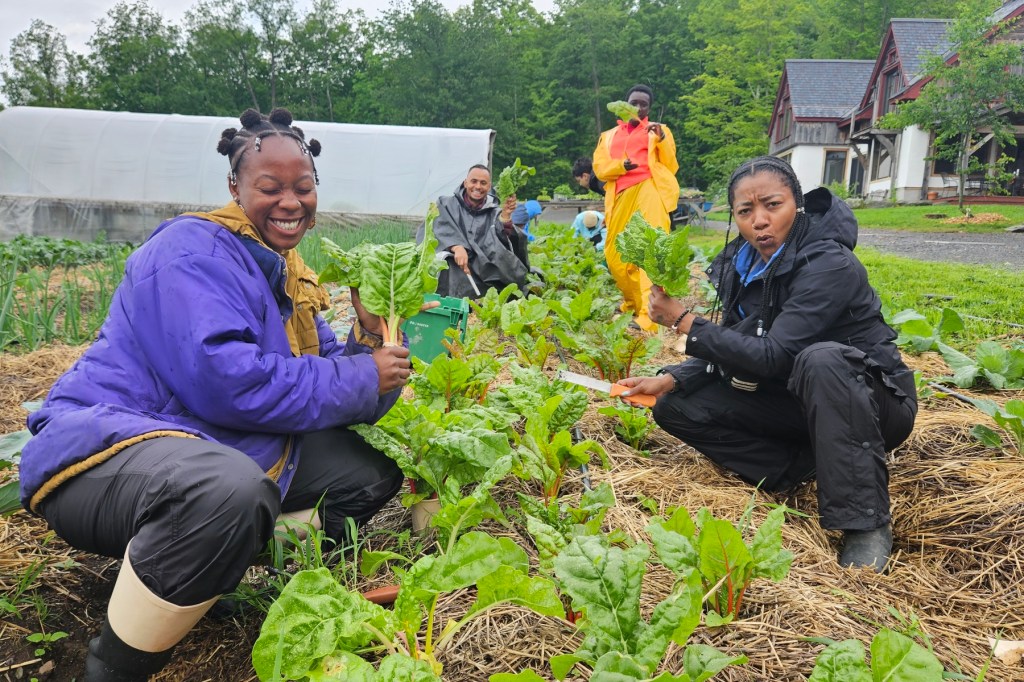
Despite the policy hurdles, Black women are still sowing seeds for land and farming projects. Capital remains a barrier to entry, given that startup costs for a land project can run anywhere from tens of thousands of dollars in rural areas to hundreds of thousands in urban ones.
Nataka Crayton is an urban agriculture specialist in Boston, where she co-created the Urban Farming Institute and serves on the board for Boston Farms Community Land Trust. She also assists with farming at Paige Academy, a Black-owned elementary school in Boston. There are benefits, she said, to Black women working on smaller plots of land like gardens, micro farms, or urban spaces, both in terms of alleviating costs and better serving their communities.
“You’re doing small scale, but your primary focus is educating the community. That could look like a whole new community center with gardens around,” she said. “But if you’re looking to scale up your production so that you can … sell those microgreens or sell those tomatoes or whatever it is that you choose to focus in on, you’re going to need to also think about, well, what does that look like?”
For some, that could look like a land trust, which helps underserved farmers by holding land collectively to protect it from being sold off or lost, especially in legal disputes. Crayton says this can be especially helpful for Black women, helping “reduce barriers to land access by providing growing space, technical assistance and small grant opportunities.
“Models like this are critical because access to land, resources, and support remain some of the greatest challenges facing emerging Black woman growers,” Crayton said.
Black women do not have to wait for permission to reclaim their rightful place on land. Their foremothers have laid the groundwork to grow and preserve their communities with generational knowledge and wisdom and, in turn, Black women are doing the same. They are tending not just to land, but to the future.
My time at Soul Fire Farm affirmed that. Upon returning home, I ran into my neighbor, a girl around 6 or 7 years old, near the garden bed outside our building in Boston. She immediately pointed to the mint regrowing in the summer sun, having survived a snowy winter. “I know how to harvest,” she said as she began to pick some off.
It was a reminder that the seeds we lay now are helping grow a generation of stewards who will hopefully never have to question whether the land is where they belong.