
Skip to content Site Search

Menu

Home

We’re an independent, nonprofit newsroom reporting on gender, politics, policy and power. Read our story.

Topics

  • Politics
  • LGBTQ+
  • Health
  • Justice
  • Caregiving
  • Education
  • Abortion
View all topics

Daily Newsletter

A smart, relatable digest of our latest stories and top news affecting women and LGBTQ+ people.

Look for a confirmation sent to

Did you mean

The email didn't go through.

or Contact us for support
  • Latest Stories
  • Our Mission
  • Our Team
  • Strategic Plan
  • Support the 19th
  • Search
  • Contact
Donate

Republish This Story

* Please read before republishing *

We’re happy to make this story available to republish for free under an Attribution-NonCommercial-NoDerivatives Creative Commons license as long as you follow our republishing guidelines, which require that you credit The 19th and retain our pixel. See our full guidelines for more information.

To republish, simply copy the HTML at right, which includes our tracking pixel, all paragraph styles and hyperlinks, the author byline and credit to The 19th. Have questions? Please email partnerships@19thnews.org.

— The Editors

Loading...

Modal Gallery

/
Sign up for our newsletter
Home

We’re an independent, nonprofit newsroom reporting on gender, politics, policy and power. Read our story.

Daily Newsletter

A smart, relatable digest of our latest stories and top news affecting women and LGBTQ+ people.

Look for a confirmation sent to

Did you mean

The email didn't go through.

or Contact us for support

Become a member

We’re an independent, nonprofit newsroom reporting on gender, politics, policy and power. Read our story.

Multi-color socks with

Our new merch store is now live!

Represent the newsroom that represents you. Every purchase directly supports our nonprofit newsroom.

Shop Now

The 19th thanks our sponsors. Become one.

Abortion

Suicide rates are higher for teen girls. Abortion bans could be making it worse.

A new study found a 'concerning increase' in suicidal ideation for teen girls in states with abortion bans — regardless of if they are pregnant. There was no increase for teen boys.

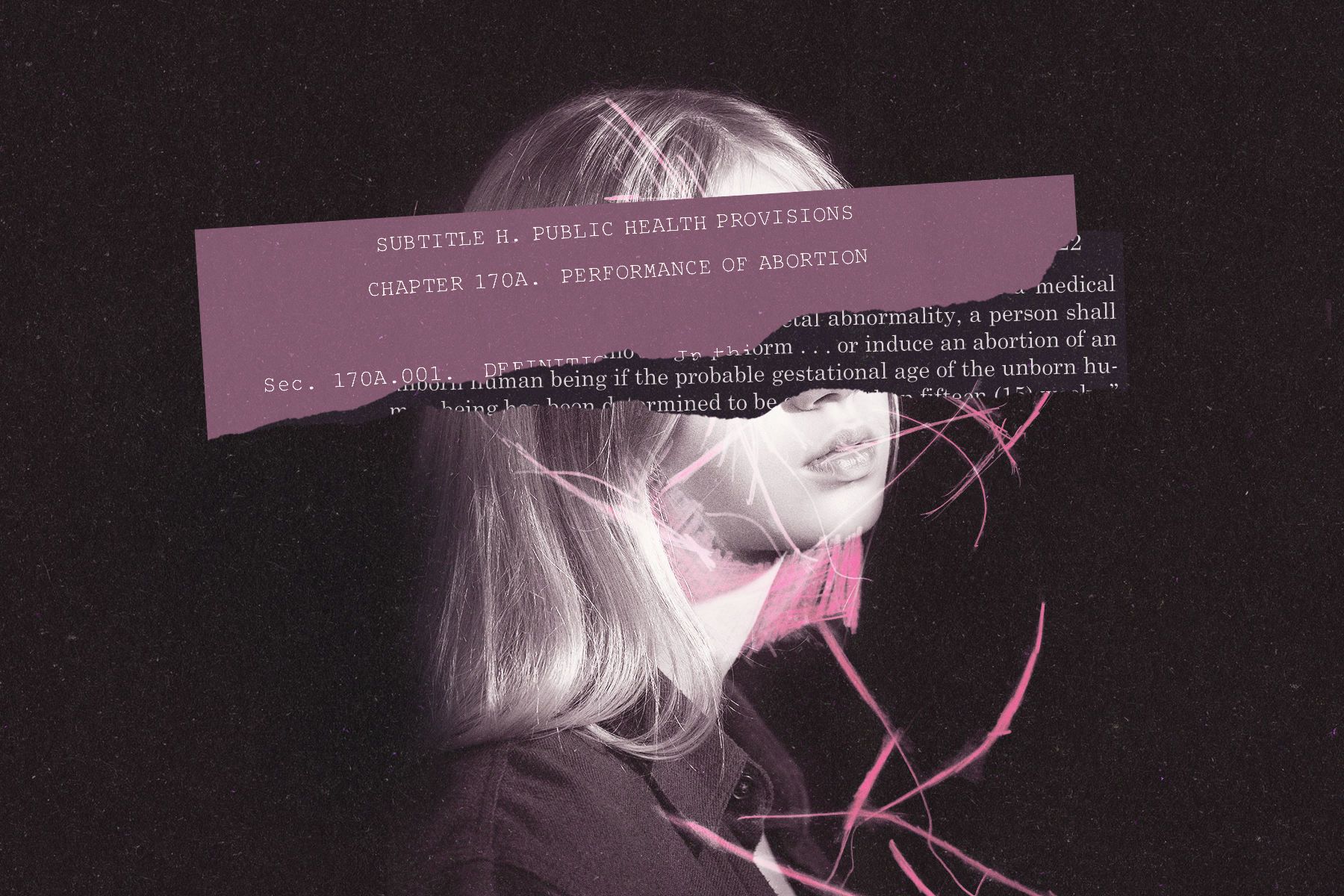
An illustration of a woman's face under strips of paper with text related to abortion laws.
A new psychiatric study suggests that teen girls in states with abortion bans are experiencing higher rates of suicidal ideation than those in states without. (Emily Scherer for The 19th)

Shefali Luthra

Reproductive Health Reporter

Published

2026-07-31 05:00
5:00
July 31, 2026
am
America/Chicago

Share

  • Bluesky
  • Facebook
  • Reddit
  • Email

If you or a loved one are in crisis, please call or text 988 or text HOME to 741741 to connect with a live volunteer crisis counselor.

Abortion bans may be driving more teenage girls to seriously contemplate suicide — regardless of whether they are pregnant, a new study finds.

Already, teenage girls are at greater risk of serious depression and suicidal ideation, which means considering or planning suicide. Some public health officials suggest the rates of depression may be at crisis levels: Federal data published in 2024 found that the year prior, 52.6 percent of high school girls said they felt persistently sad or hopeless — close to double the share of high school boys who said they felt similarly. About 27.1 percent of girls said they had seriously considered suicide, compared to 14.1 percent of boys. The federal data doesn’t account for nonbinary students.

The 19th thanks our sponsors. Become one.

Now, a new study published last week in JAMA Psychiatry, suggests that abortion bans — which have already been linked to higher rates of infant mortality and pregnancy complications, including pregnancy-related death — could be making things worse, with teen girls in states with bans experiencing higher rates of suicidal ideation than those in states without.

“There is this very concerning increase that is unique and specific among adolescent females in ban states. We need to pay more attention to what’s going on with them,” said Wendy Sheldon, the paper’s lead author and a scholar at the New York-based Verge Research, which focuses on reproductive health. 

Sheldon and her team analyzed federal data tracking suicidal ideation among high school students in 15 different states. The data identified sex but not gender and did not account for whether students were LGBTQ+; about half the students analyzed were identified as female and half as male. Researchers looked at data from 2017 to 2023. During that period, five of the states implemented near-total abortions bans; the remaining 10 did not. 

More from The 19th

  • Abortion bans are restricting miscarriage care, new study finds
    A patient lies on an exam table while an doula holds their hand during a procedure at a clinic.
  • Idaho voters will weigh in on one of the strictest abortion bans in the country
  • No, abortion pills aren’t polluting your water — but the EPA is testing for it

The researchers found that in states with strict abortion bans, the share of girls who reported suicidal ideation increased, and in states without bans it declined — resulting in a total difference of 4.3 percentage points between states with and without abortion bans. The researchers did not find any relationship between abortion bans and suicidal ideation among boys. Though the study also found a possible relationship between abortion bans and suicide attempts among teen girls, the results were not statistically significant. 

An increase of this size is substantial,  Sheldon said. “I think it’s really unprecedented here in the U.S. and probably elsewhere, too, that we lost a right — our rights have been rolled back.”

The findings suggest that bans’ health consequences radiate well beyond immediate abortion access.

“These policies clearly impact a broader population,” said Dr. Vanessa Dalton, an OBGYN and professor who has studied the mental health consequences of abortion law, and who was not involved in this study. “It’s not just an unrealized wanted abortion. It’s living in the context of this, amongst many other policies, in particular for women or the LGBTQ+ community — that those policies say things about you as a human being and what your value is.”

Researchers have for years found links between abortion restrictions and mental illness — especially for women and girls. 

A 2024 paper looking at anxiety and depression found that women living in states with “trigger bans,” which took effect when Roe v. Wade was overturned, reported spikes in anxiety and depression after the Supreme Court’s 2022 ruling; men did, too, but at a lower level than women. In 2022, another team of researchers looked at the consequences of abortion restrictions even before states had the power to ban the procedure entirely. In that study, scientists found that targeted laws limiting abortion were linked to higher rates of suicide for women between the ages of 20 and 34.

“There’s a potential of loss of autonomy and personal freedom and there’s concerns over the future,” said Benjamin Thornburg, an economist and postdoctoral fellow at Oregon Health and Science University, who led the 2024 paper. “If I had to think about what group might be most affected by, forward looking, ‘what does this mean for my future,’ adolescent girls seem like an acute target.”

Share

  • Bluesky
  • Facebook
  • Reddit
  • Email

Recommended for you

  • An image of a woman, Tierra Walker, and her husband, Eric.
    Tierra Walker died after she couldn’t get an abortion. Her family is suing Ken Paxton.
  • Ken Paxton, wearing a navy suit and red tie, waves while walking onstage between an American and a Texas flags.
    Why everyone will bring Ken Paxton’s abortion record up in his Senate race
  • Where abortion is on the ballot in 2026
  • Massachusetts expands abortion access to any point during pregnancy

Daily Newsletter

A smart, relatable digest of our latest stories and top news affecting women and LGBTQ+ people.

Look for a confirmation sent to

Did you mean

The email didn't go through.

or Contact us for support

Become a member

Explore more coverage from The 19th

  • Politics
  • LGBTQ+
  • Health
  • Justice
  • Caregiving
View all topics

Site Footer

Support representative journalism today.

Learn more about membership.

  • Give $19
  • Give $50
  • Give $100
  • Any amount

Transparency

  • About
  • Team
  • Contact
  • Privacy Policy
  • Community Guidelines
  • Gift Acceptance Policy
  • Financials

Newsroom

  • Latest Stories
  • Strategic Plan
  • 19th News Network
  • Events
  • Careers
  • Fellowships

Newsletters

  • Daily
  • The Amendment
  • Menopause
  • The Mom Guilt Economy
  • View all

Support

  • Ways to Give
  • Sponsorship
  • Republishing
  • Volunteer
  • Merch

The 19th is a reader-supported nonprofit news organization. Our stories are free to republish with these guidelines.