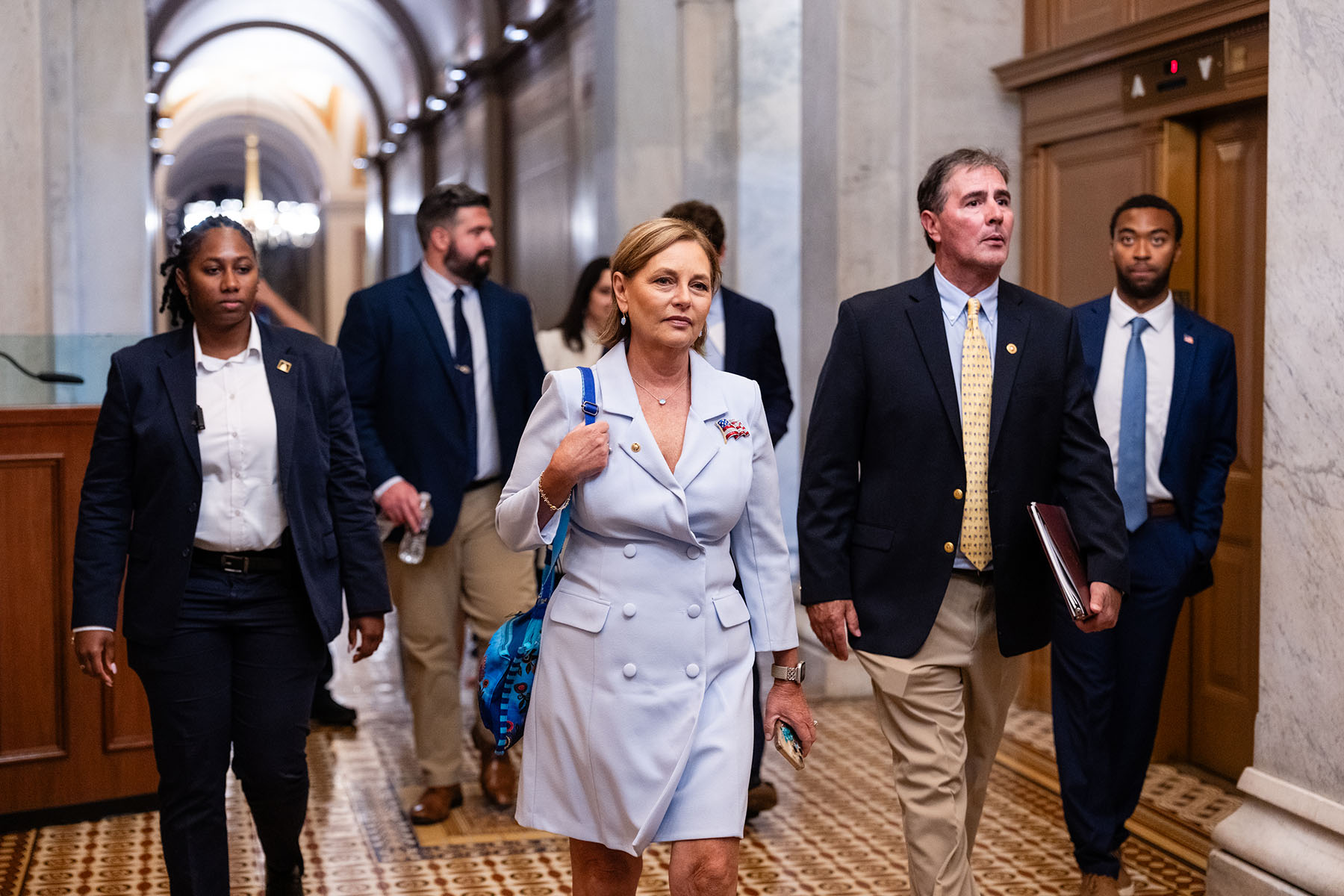

Unlike her late brother Lindsey, whose political career spanned 33 years, Darline Graham has never run for or held elected office — until she was appointed to serve the remainder of the U.S. senator’s term this week. Instead, she has worked in vocational rehabilitation, publicly funded programs that help people with disabilities overcome barriers to employment.
Due to her lack of political experience, it is difficult to know what her priorities will be between now and January 2027, when Lindsey Graham’s term ends, or if she wins the race to succeed him. She announced her candidacy on Monday in an interview with the Fox News host Sean Hannity, saying, “I’ve made a decision. I’m in.”
In a letter to her constituents posted on X on July 18, Graham connected her work in disability services to how she plans to govern.
“I am not Lindsey. I have my own way of doing things. But we were raised with the same values: Work hard every day, trust in the Lord, remember our roots and never forget who you work for,” Graham wrote.“That’s why I’ve spent my career helping South Carolinians with disabilities find employment and live independently.”
To former colleagues and the disability advocates who have worked with her, there is little doubt in Darline Graham’s capabilities. They describe the 62-year-old as a dedicated civil servant who is uninterested in the spotlight and deeply knowledgeable about issues facing the disability community. And they are optimistic she will bring that experience to Capitol Hill.
“She loved her brother. He raised her,” said Kimberly Tissot, president of Able South Carolina, the state’s Center for Independent Living, or CIL, a federally funded center that provides peer support and services for people with disabilities.
“Family is what defines her, but she’s not her brother. That’s what I’ve been telling people [in disability advocacy],” said Tissot, a cancer survivor and amputee who has known and worked alongside Graham for over a decade. “She is a leader, but she’s not the kind of leader to ever brag about what she’s done.”
Tissot was careful to note that she doesn’t think Graham is some kind of secret liberal nor a disability rights activist. In fact, Tissot said, Graham has never seemed particularly political; her dedication has been to her family and to employment for people with disabilities, which has long been a bipartisan issue.
That has certainly been the case in South Carolina. In 2022, the state passed a law ending subminimum wage for people with disabilities. The bill received a unanimous vote in the state Senate and a nearly unanimous vote in the state House. Both were majority Republican at the time. According to Tissot, she and Graham were present at the bill signing.
“But if you know Darline, she’s always in the back,” Tissot said. “For as long as I’ve known her, she just never wanted that recognition.”
Following the law’s passage, Graham was involved in the process of unwinding the state’s remaining subminimum wage. She served on key committees with Tissot, alongside other civil servants and disability advocates.
One of the bill’s main supporters and original sponsors was former Republican state Sen. Katrina Shealy, a longtime friend of Darline Graham’s and a supporter of disability rights legislation during her time in office. They live close to each other and Graham will sometimes come over and drink wine with Shealy on her back porch and “talk to the donkeys” that the former legislator keeps as pets, she said.
Shealy first met Graham through state Republican Party politics, but not because of any strong interest in politics on Graham’s part.
“She’s just been there for Lindsey always, but I don’t think she’s really that political,” Shealy said.
This is a very political moment for disability rights advocates. Massive cuts to Medicaid from the One Big Beautiful Bill Act, which Lindsey Graham supported, threaten disability services in many states. The Trump administration has also moved to dismantle the Department of Education and transfer oversight of special education services to the Department of Health and Human Services, a shift that many experts believe will put students with disabilities at risk. Lindsey Graham did not comment on these actions publicly, but he was a vocal ally of the president and his administration.
On Tuesday, Darline Graham said: “I promise to work hard over the next several months to support the president and carry forward the efforts of my brother on behalf of the citizens of South Carolina and the United States.”
According to Open Secrets’ database of political donations, Darline Graham has made one political donation since 1990, when the nonpartisan nonprofit organization began tracking: $100 to Shealy’s state Senate re-election campaign during the 2020 election cycle.
When Shealy was first elected in 2012, she was the only woman in the South Carolina Senate. She is best known as one of the “sister senators,” a group of five South Carolina lawmakers — three Republicans, one Democrat and one independent — who stood their ground to block a near-total abortion ban in the state. She and the two other Republican “sisters” lost to primary challengers in 2024.
Shealy is no longer working in politics. She is currently a community outreach coordinator for the Brain Health Center at University of South Carolina, one of 33 centers in the United States dedicated to studying Alzheimer’s. She became involved in Alzheimer’s advocacy after her husband Jimmy was diagnosed.
Since 2019, Graham has served as the head of South Carolina’s Commission for the Blind, which focuses on employment and training for people who are blind or have low vision.
David Houck, the executive director of the Federation Center of the Blind, a peer-led organization that trains blind and low vision people to use technology, has worked closely with the commission. Houck, who is blind himself, said he has met Graham on various occasions, although he more often works with her staff.
He has nothing but praise for Graham’s career, which, from Houck’s perspective, gives her knowledge and connections that will serve his community well. President Trump met with Graham on Friday and asked her to run for her brother’s seat. He officially endorsed her in a Truth Social post later that day.
“She has a great deal of experience from her background and I know the blind in South Carolina support her,” Houck said.