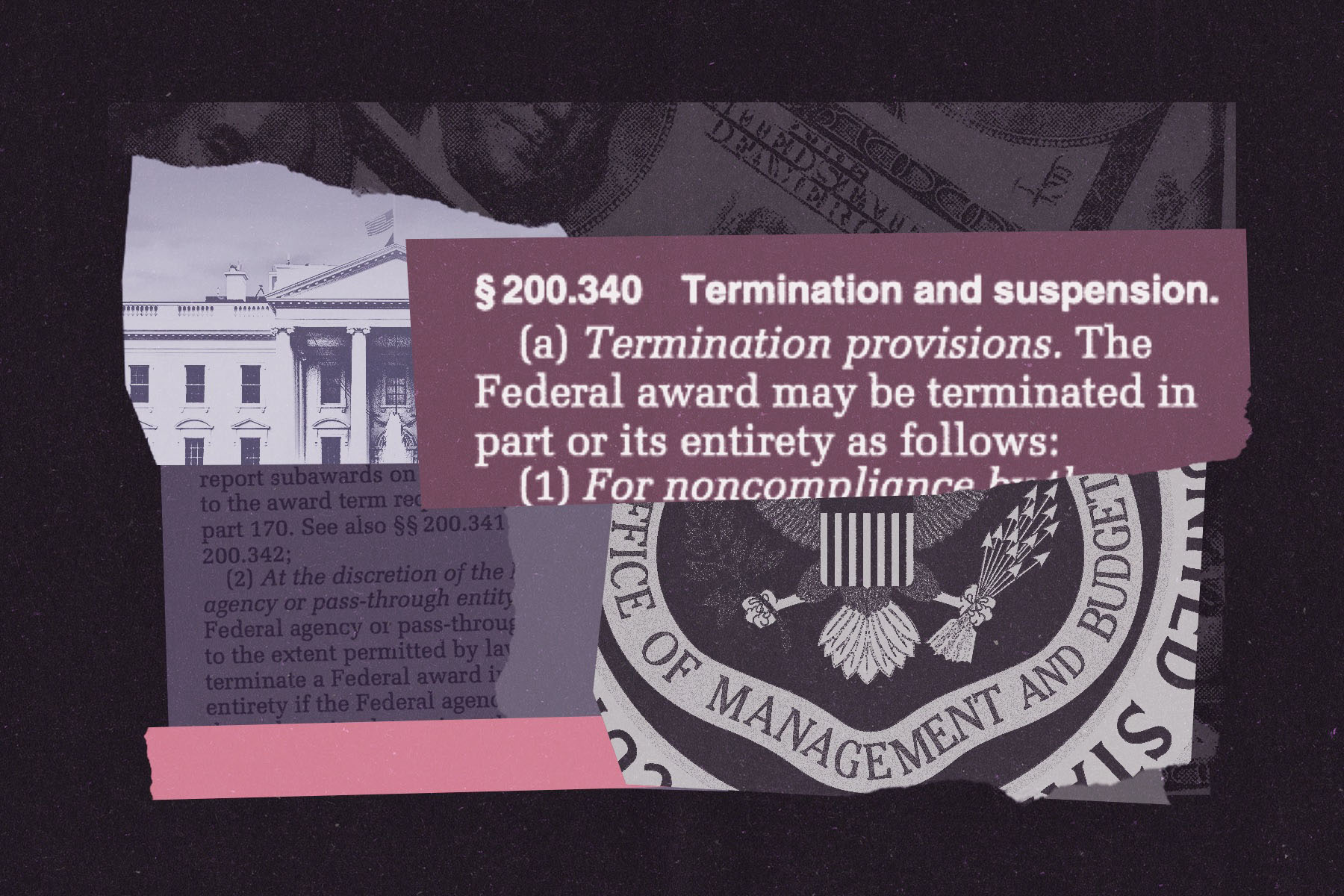
Domestic violence organizations are raising the alarm over a proposed federal rule change that policy analysts say politicizes the federal grantmaking process and clears the way for officials to cancel funding without cause.
The rule change, proposed by the Office of Management and Budget (OMB), would allow agencies — which have power over more than $1.1 trillion in funds — to terminate grants at any time, for any reason, without an appeal process. This would greatly expand the authority of political appointees to cancel promised funding for projects that do not align with an administration’s policy agenda. Under President Donald Trump, that means opposition to anything that promotes or facilitates diversity, equity and inclusion; gender ideology that “denies the biological reality of sex”; and gender-affirming care to youth.
The Trump administration argued that the change brought by this proposal, first released in May, would end a “woke policy agenda” from the Biden era that resulted in wasteful spending, “unlawful DEI practices” and “anti-American ideologies in American education.”
Scientists, nonprofit executives and localities have largely pushed back on the proposal, arguing that it would make sweeping changes to how federal grants are awarded by prioritizing politics over expertise — which they argue would have catastrophic ripple effects across society, from scientific inquiry to disaster relief and victims services. The domestic violence organizations in particular are concerned because the federal government is the largest funder of services for victims of domestic and sexual violence.
The 19th analyzed more than 52,000 public comments submitted to the federal government about the rule through Monday, when the public comment period closed, and found more than two dozen comments concerned with the rule’s impact on domestic violence and sexual assault victims.
Michelle Cates was one of tens of thousands to submit a public comment opposing the rule. As a sexual assault and family violence professional in Southern California, she wrote that her organization relies on federal and state funding for more than 70 percent of its budget.
“A mid-year grant termination, now permissible under this rule without appeal, could shut down a hotline or eliminate counseling staff overnight,” Cates wrote. “When a crisis line goes dark because funding was pulled mid-year, a survivor who calls at 2:00 a.m. gets a disconnected number.”
The 19th has spoken with multiple domestic violence service providers that have had to cut back hotline hours due to delays in federal grant payouts; most comments related to domestic violence aid emphasized that adding administrative overhead would stretch their already overburdened staff beyond capacity. That means less time to support people fleeing what can often be lethal violence.
Arianna Sessoms, a senior program specialist who has worked for many violence prevention organizations over the past decade, also submitted a public comment. She said that federal funding for violence prevention is already scarce and that this proposed rule would put it under political control.
“I understand viscerally what it means when a funder withdraws support mid-project,” Sessoms said. “It does not just pause a program — it ends it. Staff are laid off. Relationships with survivors are severed. Community trust is broken. The people who depended on those services don’t stop needing them just because a grant was terminated.”
Ivette Izea-Martinez, a senior program officer at Greater Twin Cities United Way, wrote in a public comment that restrictions on diversity, equity and inclusion are concerning because they put underserved communities at further risk and isolation. The proposed change also creates instability and funding unpredictability that “directly threatens life-saving programs that survivors and children depend on,” she added.
“I have seen how critical stable, culturally appropriate services are to ensuring safety and trust,” Izea-Martinez wrote. “Survivors, especially those navigating immigration concerns, language barriers or systemic inequities, are more likely to seek help when services reflect their full identities and lived realities.”
Marnie Shiels, an independent consultant on gender-based violence policy, spent nearly 25 years working on grants at the Department of Justice in the Office on Violence Against Women. Her responsibilities included reviewing the notices of funding opportunities (NOFO), award conditions and public comments. Shiels described an “overall wrongness” with this latest proposal.
“What’s wrong to me is that somebody applied based on what was in the NOFO. They did something around, say, an underserved population because that was listed as a priority, so they were encouraged to do that. And then they’re going to be penalized for it because of the change in administration,” Shiels said.
Shiels said the uncertainty around whether a grant will be terminated without any cause or reimbursement would add a layer of risk and might make people more hesitant to apply for federal funding altogether.
“This money has been provided by Congress for a reason, because there’s a need for these services,” Shiels said. “And if people are more reluctant to apply, it could reduce the services down the line — which then harms victims because the services aren’t there.”
Shiels said it’s unclear whether the overwhelmingly negative public comment will have any impact on whether the new rule is adopted. According to the Administrative Procedure Act, all of the public comments are supposed to be reviewed, summarized and responded to in an official explanation. The OMB said it hopes to issue a final rule by October 1.
The proposal says the rule change is to “improve transparency, accountability, and oversight” of federal grant awards, “ensure that basic American principles of equality and equal opportunity” are upheld through the grantmaking process and make it so “unlawful discrimination is no longer permitted.” The Trump administration has characterized diversity, equity and inclusion efforts as anti-merit and discriminatory toward White people.
The proposed change is yet another roadblock that domestic violence organizations have been navigating since the beginning of Trump’s second term.
On his first day back in office, the president signed executive orders that defined only two genders and banned spending on diversity, equity and inclusion — devastating many domestic violence organizations.
The Violence Against Women Act, the funding vehicle for most of the nation’s efforts addressing gender-based violence, has steadily increased its scope since its original passage in 1994. Over the past 30 years, these federal funds were distributed through the Department of Justice and have become more accessible to survivors. Organizations that receive this money cannot discriminate based on sex, gender, race, ethnicity, ability or nationality — legal statutes antithetical to the current administration’s policy priorities.
Then last year, new hires from the so-called Department of Government Efficiency terminated at least 373 federal grants issued by the Justice Department, according to the nonprofit Council on Criminal Justice. Thirty-seven of those were directly tied to domestic violence and sexual assault services or prevention. The targeted grants aimed to provide housing to domestic violence survivors, support transgender survivors of crime and provide sexual assault services in different languages.