
“Love Island” is the rare dating show that offers a cash prize at the end, and with brand deals and commercial spots, the contestants can hope to make even more money after leaving the villa.
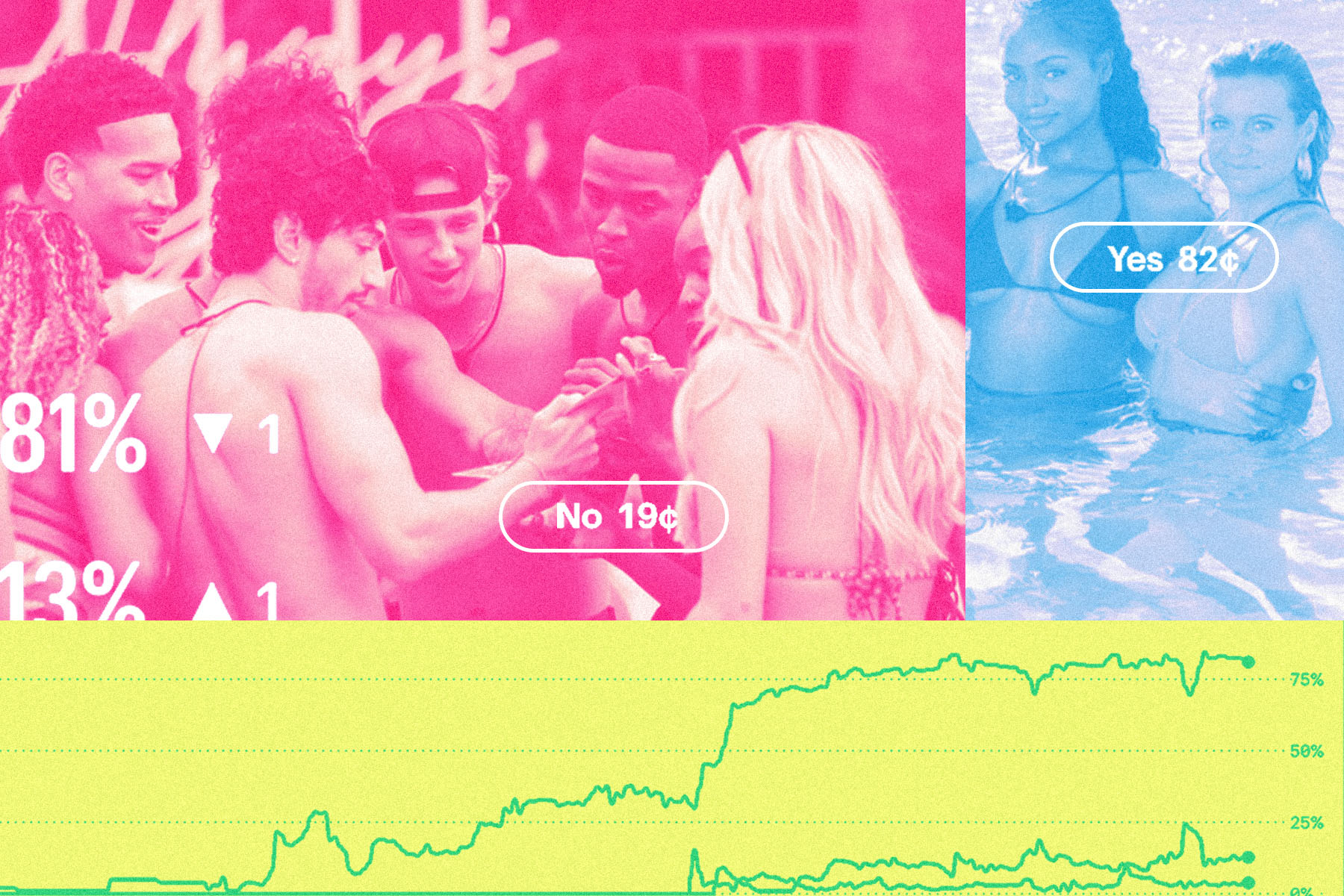
Now, the audience can also cash in. Prediction market apps like Polymarket and Kalshi, who have user bases dominated by men but have been trying to attract women, allow viewers to make trades on who will couple up and who will walk away.
The show’s basic premise involves hot young adults trying to find love in a bright neon villa in Fiji. The contestants compete in challenges — many of which involve making out while covered in various goo-like substances — and pull each other for “chats” to choose who they want to couple up with. “Love Island” heavily relies on audience participation via its app, and the audience has a say in who gets ejected from the villa and who the eventual winner will be. The winning couple receives a $100,000 cash prize.
Season 8 of “Love Island USA” is the show’s most popular yet. According to NBCUniversal, the season premiere showed a 74 percent increase over Season 7, also making it Peacock’s most streamed original season debut ever. It’s unclear just how many men make up the new viewership, but the growth has come with new voices entering a conversation that’s previously been commanded by women.
Last year, New York Knicks star Jalen Brunson went viral for posting about the show and later hosted former contestants on his podcast, “Roomates.” This year, popular streamers such as Plaqueboymax and Kai Cenat have discussed the show and even invited former islanders on their streams. Another popular Twitch streamer, DDG, ran into controversy for saying that it was “gay” for men to watch the show alone; he later posted his support for a couple on the show.
“Love Island” has always drawn commentary, but this season feels different, said sex educator and author Ericka Hart, who has followed both the British and American versions of the show for nearly a decade. Hart says she’s noticed a shift not just in who’s watching, but in how they’re watching.
“We rarely see cis men engaged in a conversation around ‘Love Island,’” Hart said. “And if they are talking about it, they are talking about it from the perspective of critiquing other men, critiquing systems. It’s never that we see cis men essentially rooting for other cis men. And I think that’s indicative of the gambling.”
Consumer advocates have raised concerns about the expansion or prediction markets, warning that gamified, app-based betting carries the same addiction risks as traditional sports betting, even if dressed up as entertainment trivia. Younger users are also at higher risk for addiction. According to NBCUniversal, 50 percent of last season’s “Love Island” viewers were under 30.
While men dominate prediction market apps, Kalshi in particular has been trying to encourage more women to use the platform. The popularity of “Love Island USA” has made the show a significant part of its engagement strategy.
According to a spokesperson from Kalshi, the percentage of women traders on its platform overall has doubled in the past year, and “Love Island” markets specifically have three times more women traders than the platform’s markets on average, with women making up two-thirds of new ”Love Island” traders. Still, men remain the majority of traders on Kalshi overall, mirroring patterns in sports betting more broadly.
The show’s near-daily structure and frequent eliminations make it uniquely appealing as a culture market, according to the spokesperson. New elimination markets open with nearly every episode, unlike one-time cultural events. Kalshi also has a social aspect, allowing traders to comment on specific markets and sometimes even make their case for their chosen couple.
However, like with many other culture markets, there are concerns about insider trading. Kalshi’s “Survivor” market correctly favored the eventual winner with unusual accuracy months before the pretaped season aired, prompting host Jeff Probst to accuse prediction markets of “incentivizing people to lie, cheat and steal.” Love Island airs on a short delay but is unfolding in real time, carrying a different risk, less about leaked final outcomes and more about real-time access to eliminations or votes before they’re public.
For Hart, whose book “Nasty Work: Resist Systems, Explore Desire, and Liberate Yourself” has a chapter that unpacks the desirability politics that shape “Love Island,” the show’s economics were never just about romance.Contestants have always had financial incentive to present a certain persona. Prediction markets, Hart says, just extend that logic to the people watching.
“Now we’re actually putting a price on people and their coupling, and based on what? What is the value? I think that’s about who is the person who’s not going to push back on patriarchy,” she said. “Capitalism inherently makes us vulnerable, not being single.”