DELAWARE, OHIO — When Angel Smith showed up for a mandatory staff meeting last month at OhioHealth Grady Memorial Hospital, the longtime labor and delivery nurse was fresh off a busy night shift caring for a patient who delivered her baby early, at about 35 weeks.
At the meeting, Smith learned that Grady Memorial, the only place to give birth in Delaware County, a fast-growing exurban-rural enclave 30 miles north of Columbus, would be discontinuing in-patient maternity services July 31.
“It hurt my heart,” Smith told The 19th.
Smith has been a labor and delivery nurse for about 20 years, the last four of those at Grady Memorial. She lives 35 minutes away from Grady in more rural Morrow County, one of the 24 Ohio counties that are already a maternity care desert. (There are 88 counties in the state.) If nothing changes by Saturday, patients in Delaware County will have to drive a half hour to deliver their babies at one of two OhioHealth hospitals in the Columbus suburbs. But patients who live in Morrow County, who were already driving a half hour or more to get to Grady Memorial, could face drives approaching an hour.
Smith worries that more mothers might be forced to deliver their babies on the side of the road, or show up at emergency rooms that don’t have specialized obstetrics services.
Smith said she doesn’t “get into politics much.” She has nevertheless become an enthusiastic participant in a nurses-led effort to save Grady Memorial’s delivery unit that is reverberating across local, state and federal races in this key midterms battleground. She submitted testimony to the nonpartisan Delaware City Council, protested Grady Memorial’s obstetrics closure alongside a Democratic candidate for state Senate and a Republican in the state House, and stood with fellow Grady Memorial nurses behind Dr. Amy Acton as the Democratic gubernatorial nominee participated in an Ohio Nurses Association-organized news conference about the planned closure.
Nurses like Smith are also asking the state’s Republican attorney general to investigate whether OhioHealth broke the terms of an operating agreement it signed in 2005 that listed obstetrics as a core service the hospital committed to provide. The agreement was made with a nonprofit foundation created to oversee the Methodist health network’s acquisition of Grady Memorial, but the foundation no longer exists.
Democratic candidates in competitive races in Ohio and states like Maine, Iowa and Wisconsin are hoping that anger over labor and delivery unit closures will prompt voters to reject the Republican lawmakers who helped enact President Donald Trump’s massive tax-and-spending law known as the One Big Beautiful Bill Act. The bill, which squeaked through the Republican-controlled Senate last summer, contained nearly $1 trillion in cuts to Medicaid, the government’s health insurance program for lower-income Americans that covers more than 40 percent of births nationwide.
Nonpartisan experts nearly universally predicted at the time of its passage that it would lead to services cutbacks and even closures at rural hospitals. While OhioHealth has not attributed ending obstetrics services to the legislation, about 74 percent of Grady Memorial’s births are covered by Medicaid. The reason the bill’s impacts are expected to hit rural hospitals particularly hard is because Medicaid reimbursement rates often don’t fully cover the cost of providing services like delivering a baby on a per-patient basis — and these hospitals don’t have the patient volume to make up the difference.
University of Michigan political scientist Michael Shepherd said that we’re still in a “wait-and-see place” when it comes to how the cuts in Trump’s law will resonate with voters. Another question, he said, is whether Democrats can effectively communicate their argument that Republicans are to blame for the hospital cutbacks they are seeing in their communities.
“People who are in the know and understand what’s going on are divided by partisanship pretty severely in terms of whether the ‘Big Beautiful Bill’ is to blame or a beautiful thing. For the people who are personally affected but maybe aren’t so partisan, there is a lot of confusion and lack of knowledge about what is going on and why,” Shepherd said.
The Delaware City Council passed a unanimous resolution calling for an investigation of the obstetric unit’s closure and sent it to Ohio Attorney General Andy Wilson, whose office has not yet said if it will investigate. In an email, an OhioHealth spokesperson told The 19th that the healthcare network has not been contacted by the state attorney general’s office about ending Grady Memorial’s labor and delivery services.
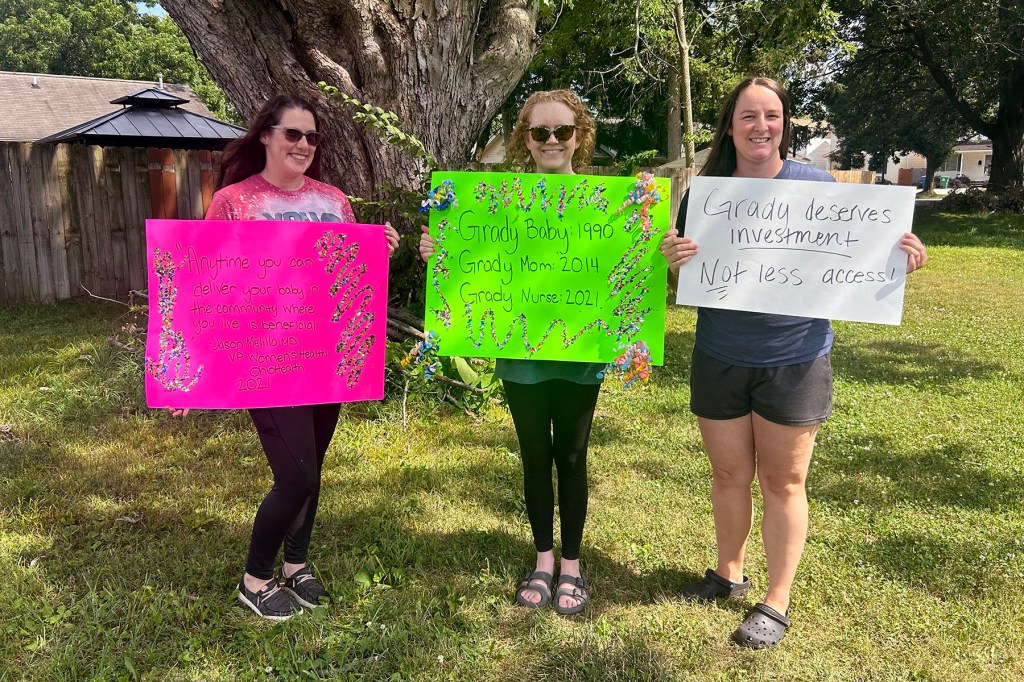
Smith and other nurses left the news conference on that sweltering mid-July day and gathered outside Grady Memorial’s emergency room, at a busy intersection. The crowd of 50 or so held signs protesting the obstetrics closure and chanted: “Hey hey, ho ho, corporate greed has got to go!”
Passing drivers honked their car horns in near-universal support. A woman behind the wheel of a white Jeep Grand Cherokee rolled down her window and shouted: “I agree with you 100 percent!”
The financial realities of obstetrics care — labor and delivery is one of the most expensive services offered by hospitals, particularly in rural areas — contributed significantly to OhioHealth’s decision to close Grady Family Birthplace. In its announcement, the healthcare network noted that “obstetric volumes are decreasing in rural and suburban areas nationally and in local markets.”
Delaware Councilwoman Linsey Griffith, who offered the resolution that called for the attorney general probe, told The 19th that she “understand[s] this is just a really difficult time for hospitals right now.” But, she said, OhioHealth is fiscally sound: In 2025, the nonprofit healthcare network reported more than $1.5 billion in overall surplus. (Griffith is also a doula, midwife and lactation consultant who founded a doula network.)
Brock Slabach, a former hospital administrator now with the National Rural Health Association, said that 331 rural hospitals stopped offering obstetrics services between 2011 and 2024 — more than 1 in 4 rural hospitals. One of the precursors to overall hospital closure, he noted, “is service-line reductions,” citing obstetrics, chemotherapy, general surgery and nursing homes as the most common.
Since 2010, 151 rural hospitals have closed. The association has identified 417 additional rural hospitals in danger of closing, and roughly half of those are deemed at high risk.
“So what hospitals will do, as they contemplate their fiscal statuses, is they look at services that aren’t pulling their weight in terms of financial viability,” he said.
Some 2.3 million American women of childbearing age live in a county where there is no place to give birth, according to the March of Dimes, a nonprofit advocacy group that works to improve health outcomes for mothers and babies. Among rank-and-file voters, there is no consensus about who is ultimately responsible for the series of public policy decisions that created this reality.
Looming over the situation is the One Big Beautiful Bill Act, with nearly $1 trillion in Medicaid cuts that the National Rural Health Association and other advocacy groups warned could further devastate rural hospitals already struggling with staffing shortages and low reimbursement rates.
Key Republicans in the closely divided U.S. Senate objected to the cuts when the bill came up for a vote. Sen. Thom Tillis of North Carolina chose to retire rather than acquiesce to Trump’s demands that party lawmakers fall in line to approve the package. Another GOP holdout, Sen. Susan Collins of Maine, who is in one of the most competitive reelection bids in the country, was not won over by the late addition of a $50 billion rural healthcare fund. Vice President JD Vance, previously a senator representing Ohio, cast the tie-breaking vote to push the legislative package over the finish line.
Some of the bill’s most contentious provisions, including cuts to Medicaid and SNAP, the federal government’s nutrition assistance program, are just beginning to take effect. Most will roll out after the midterms.
Republicans are on the defensive in three of four Senate races and in four of five gubernatorial races that the nonpartisan Cook Political Report has rated the most competitive in the country.
Ohio is on both lists. GOP Sen. Jon Husted, who was elected to finish Vance’s term, is trying to fend off a comeback bid from former longtime Sen. Sherrod Brown. Acton is trying to take the governor’s mansion back for Democrats for the first time in 15 years. Husted voted for the One Big Beautiful Bill Act. Acton’s Republican rival, pharmaceutical entrepreneur Vivek Ramaswamy, has proposed additional state cuts to Medicaid and suggested that the 1965 creation of the program was a mistake. Ramaswamy’s campaign did not respond to multiple requests for comment on the closure of Grady Memorial’s labor and delivery unit.
Democrats believe that what was supposed to be Republicans’ top legislative achievement headed into the midterms has instead become a liability. They’re also looking to highlight the law’s impacts to make inroads in statehouses, where Republicans currently hold supermajorities in both chambers in 19 states. (Democrats hold double supermajorities in just nine.)
But Shepherd, the University of Michigan political scientist, cautioned that how voters connect healthcare policy to on-the-ground impacts isn’t often cut-and-dry. He said there is a lack of objective information available to rural voters in particular about the links between hospital closures and federal Medicaid cutbacks.
“Like most things in American politics, Democrats and Republicans are going to disagree, and who is really persuadable is the 15 percent of the public who are independent or persuadable voters,” he said. “It’s possible that we observe some real backlash [for Republicans], but so far, the data that I have shows that there is a lot of room for the public to still be informed about what is happening and why.”
Or as Smith, the labor and delivery nurse, put it: “I don’t know who is to blame. I just know that it’s unsafe.”