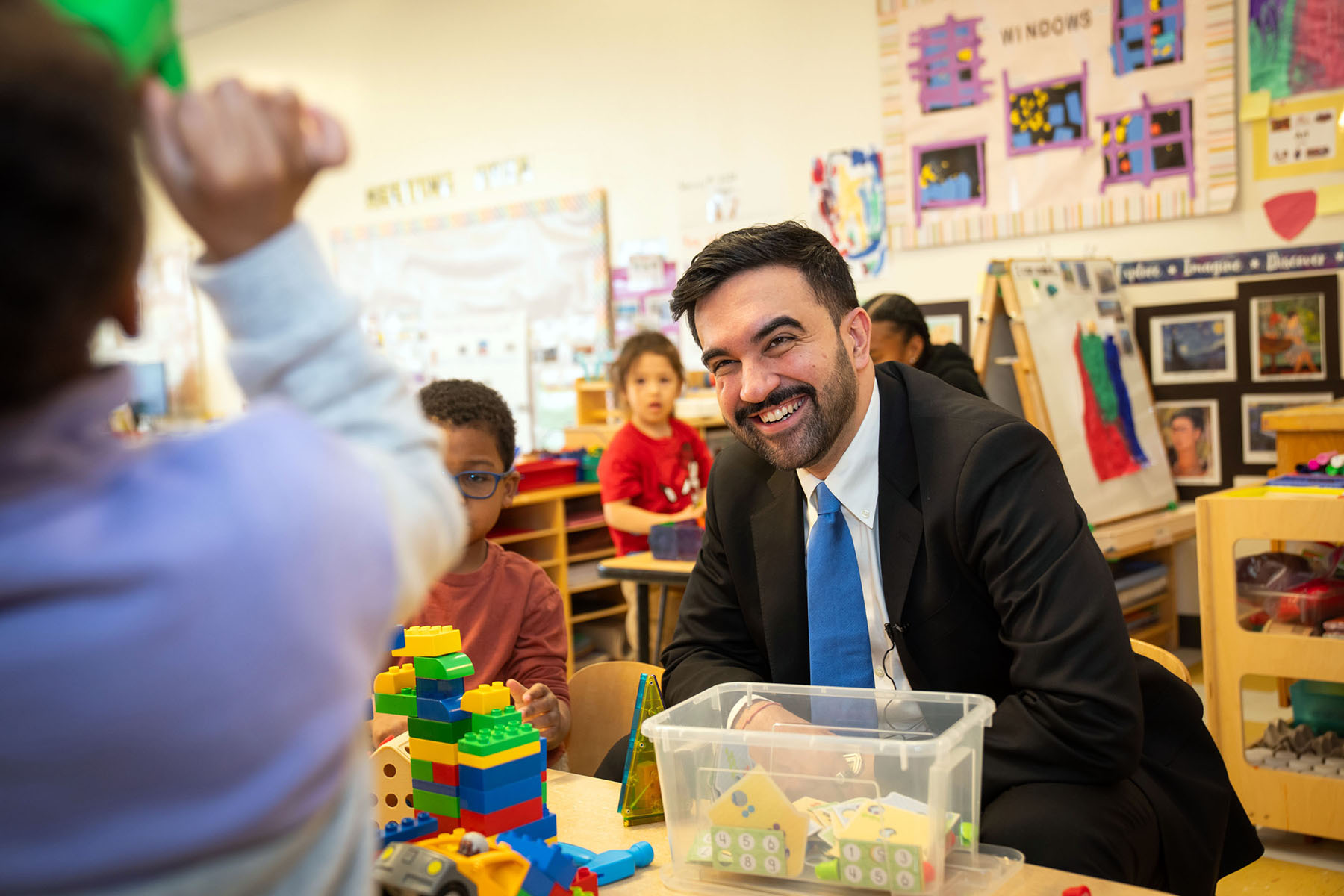

Preschoolers with disabilities in New York City will gain access to an unprecedented set of programs and services thanks to a major expansion in special education announced Tuesday by Mayor Zohran Mamdani and New York City Public Schools Chancellor Kamar Samuels.
The nation’s largest school system is investing $67.5 million in special education as families across the country fear the needs of their children with disabilities will go unmet amid the federal Department of Education’s continued dismantling.
In New York City, young learners will be able to participate in three programs designed specifically for students with autism that were previously only available to K-12 students. They will also have access to initiatives for students with emotional disabilities or in need of adapted academics and life-skills training. The programs will be available starting in the fall in 14 of the city’s 32 community school districts. The majority of them are located in areas with some of the highest concentrations of working-class and immigrant families in the city.
“Children with disabilities should not be forced to travel across the city just to get the education they deserve,” Mamdani said in a statement. “That’s why we’re bringing those classrooms closer to home and taking another critical step toward making Pre-K truly universal. Every child deserves to learn and grow in their community, and every family deserves a public education system that meets them exactly where they are.”
The specificity of the investment is unprecedented in New York City, where more than 200,000 students are eligible for special education services.
“For the first time, we’re giving young children with autism and other disabilities the same high-quality, specialized instruction that has delivered real results for our older students,” Samuels said in a statement. “This investment is about strengthening the foundation and when we get early childhood education right, we set children up for a lifetime of success.”
To expand special education services to the city’s youngest learners, New York City Public Schools will hire hundreds of staffers to help lower evaluation delays; assist families through the process of creating a legally binding personalized school roadmap for children with special needs, known as Individualized Education Program (IEP); and provide more bilingual assessment options. Overall, more than half of all children in New York City come from homes where a language other than English is spoken and in the majority of those homes, that language is Spanish. Among the new hires will be 35 psychologists, social workers, speech evaluators and occupational therapists across 10 additional Preschool Regional Assessment Centers, or city-run evaluation hubs that identify children ages 3 to 5 who qualify for special education services.
The Special Education Itinerant Teacher program will also grow, with an additional 29 therapists and specialists to support children attending community-based 3-K and pre-K programs. According to city officials, the placement of more special education teachers in general education preschool classes will help boost the number of small children with IEPs in inclusive learning environments.
In June, the Trump administration announced that the Department of Health and Human Services will oversee the Education Department’s special education and rehabilitative services — a move that advocates and parents said will make it more challenging for millions of students to access services and for their families to appeal for help when needed.
The transitions at the federal level concern Chris Treiber, vice president of advocacy services for AHRC New York City, which serves individuals with intellectual and developmental disabilities.
“When you move services out of the U.S. Department of Education and start to put them in other places like the Department of Health and Human Services and then also into the Justice Department, you kind of lose all of the expertise and the specialized support that the US DOE provided for so many years to so many states,” Treiber said. “It’s all going to be basically evaporated.”
In a statement, State Sen. Robert Jackson, a Democrat whose district includes several Black and immigrant neighborhoods in Manhattan, pointed out how families with disabled children have long had to fight simply to get basic support, a concern often raised by critics of the Trump administration’s gutting of the federal Education Department.
“For generations, families of children with disabilities have been asked to navigate systems that too often made support feel distant, delayed, or conditional,” Jackson said. “This investment reflects a different promise: that the doors of public education must open early, fully, and with dignity.”
Maria Odom, executive director of Advocates for Children of New York, drew a connection between special education for preschool children and universal childcare, which Mamdani and New York Gov. Kathy Hochul launched in January.
“Child care can only truly be universal if every child has access to a program that meets their needs,” Odom said in a statement. “We thank Mayor Mamdani for making this important investment, which will help ensure more preschoolers with disabilities receive needed, legally required support. Access to high-quality specialized programs during these critical early years can have a lasting impact on children’s development while helping make New York City a more affordable and appealing place to raise a family.”
Advocates like Treiber and Jenn Choi of Jenn Choi Advocates LLC, which provides parents with support through the IEP process, told The 19th they welcomed the preschool special education expansion. Still, both raised concerns about the logistics and reach of the new effort.
Choi hopes it gives economically disadvantaged families greater access to services. “There’s a lot of parents in the city who know how great these programs are,” she said. “These programs are very popular in neighborhoods like District 15 where the income is higher, but maybe they’re not as popular in other areas where there isn’t a cultural history of how important these programs are within the community.”
Choi also would like officials to work toward making these specialized programs available to all students who need them; one student she advocated for went without speech, occupational and physical therapy for two consecutive years, she said.
Treiber, for his part, wondered how the city plans to adapt programs designed for older kids to the preschool set. He also noted that many children in pre-K did not receive the early intervention services they needed from ages 0-3 and as a result, they might need even more intense support in preschool.
Most importantly, he wants officials to communicate effectively with families about the new programs.
“They have to be able to provide some concrete information to families so they understand either the parameters of what’s being offered here or maybe the limitations,” Treiber said. “Like if I put my kid in this program, a parent should understand that they may not have a program for my child the following September when they turn 5 and go into kindergarten. It’s just important for parents to be as informed as possible so they can make really smart, informed decisions about their kids’ education.”


