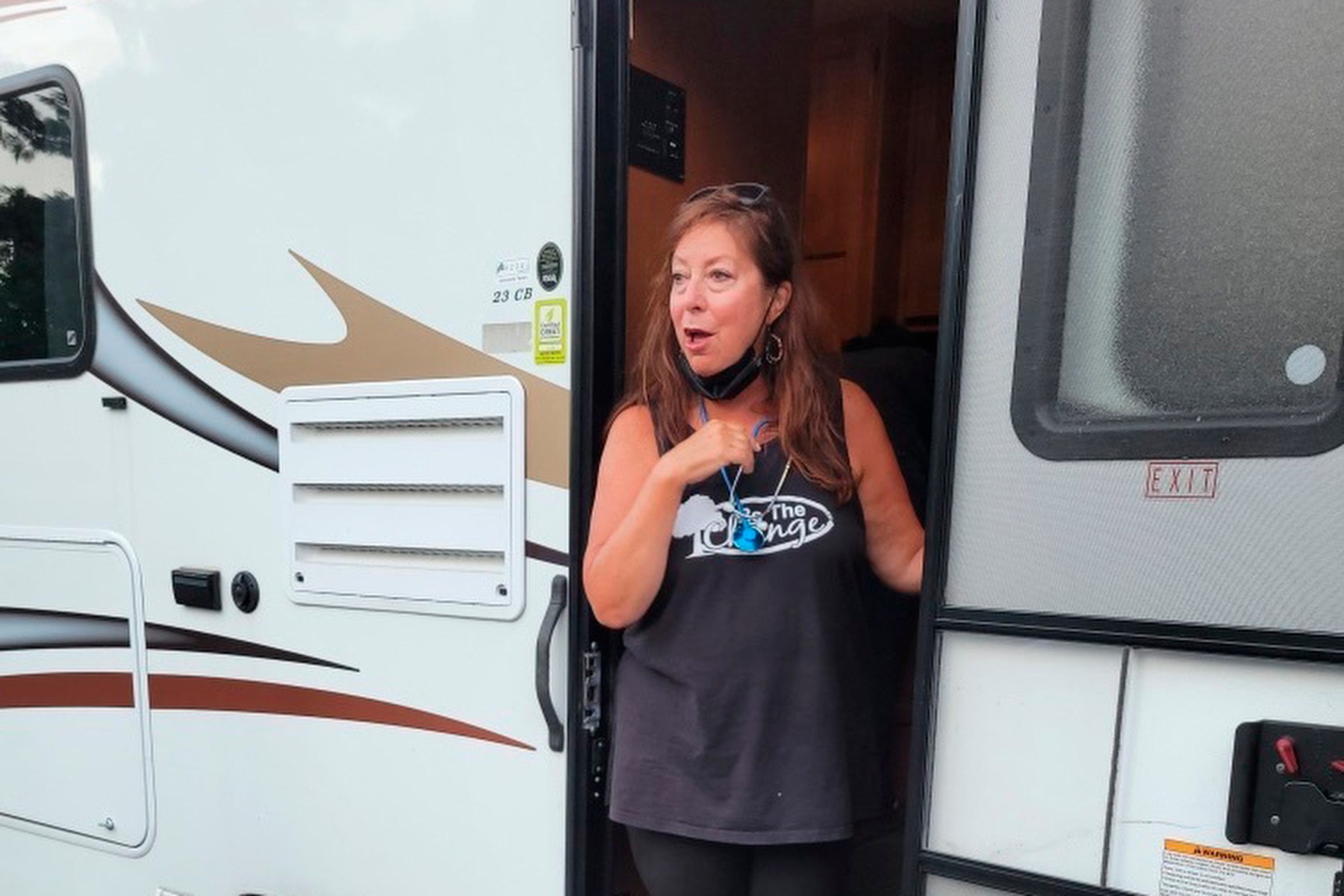

Norma Bowe looked at the scene unfolding before her: Immigration and Customs Enforcement (ICE) agents, dressed in their camo-colored tactical vests and black face coverings, pushing people with batons and yanking them into the street.
It was Memorial Day, and protesters had gathered outside Delaney Hall Detention Facility in Newark, New Jersey, as part of ongoing demonstrations demanding the release of immigrants in detention — more than 300 of whom were on a hunger and labor strike inside the facility.
Bowe is a registered nurse who has operated a mobile health clinic outside the detention center for more than a year. That Monday, as Bowe scanned the chaos, she said she could see from the corner of her eye ICE agents dragging a young woman across the asphalt. As the agents pulled her by the arms, her shirt snagged on the ground and came up and over her head, exposing her bra, Bowe told The 19th.
“Help me!” Bowe remembers the woman screaming while lying on the ground.
“I’m thinking in my head, I’ll just help her up,” she said. “ICE was so violently shoving people that I wasn’t sure if anybody was going to get to her.”
Bowe began to walk toward the woman. Then, Bowe said she went flying.
Videos of the scene captured from multiple angles appear to show Bowe landing face-first on the concrete sidewalk after being shoved by an officer. The result was a concussion, a fractured kneecap, medial meniscus tears and bruising to her left eye orbit, she said. In the nine weeks since, she has gone to the emergency room and received physical therapy and acupuncture. She’s visiting a neurologist next week for persistent headaches.
Her story is one in a string of alleged violent incidents between ICE agents and women throughout the United States. Over the last 18 months, online videos have shown women being tackled to the ground, pulled from a car, dragged out of a workplace and fatally shot. This week, Bowe has filed a claim against the federal government. It is one of 54 claims filed by affiliates of the American Civil Liberties Union (ACLU) in 17 states and Washington, D.C., against the federal government as a result of alleged harms by immigration authorities.
“They do whatever they want,” Bowe said, speaking about ICE. “They just harm whoever they want, whenever they want. And so, this is a step in making them accountable.”
On paper, federal law enforcement agents can be criminally prosecuted or sued in civil court for excessive violence while on the job. But in many instances, broader legal protections make it nearly impossible to win these cases.
On the civil end, a practice called qualified immunity shields government officials, including federal law enforcement, from civil lawsuits or lawsuits for money damages unless a previous court decision with similar circumstances resulted in other officials being held accountable.
A 1971 U.S. Supreme Court case established what’s called the Bivens doctrine, which has been one of the few legal avenues for people to sue a federal government official for violating their constitutional rights. But since 2017, the Supreme Court has issued rulings weakening Bivens to the point that it basically no longer exists.
That leaves the Federal Torts Claims Act, which allows individuals to sue the federal government for financial compensation as a result of harms from its employees while carrying out their official duties. In Bowe’s case, she is seeking $500,000 in money damages, according to her claim, viewed by The 19th.
Based on the law, the first step is to file administrative claims against the government, said Yasmin Cader, the ACLU’s Deputy Executive Director for Program, Strategy and Culture. The government then has six months to respond to the claim by settling with the people harmed or denying liability. If the government either ignores or denies the claim, the ACLU can elevate the claims to lawsuits.
The ACLU’s clients in these cases include a woman who was five months into a high-risk pregnancy while being held with her four children at a holding facility for approximately four weeks. “The family was held in a cell with limited access to clean running water and without any windows to the outside,” according to the ACLU press release.
“Almost half of the people are citizens,” Cader said of the ACLU’s clients. “The other half are people who are not citizens, but are nonetheless here in this country and deserving of their constitutional rights. We have racial profiling. We have abuses against people who are exercising their First Amendment rights. We have false and violent arrests. So, it is a wide array of examples of cases.”

Bowe is a grandmother who loves to stay active and kayak, and who has worked in nursing for more than 40 years. Five years ago, at the height of the COVID-19 pandemic, she teamed up with the Reformed Church in Highland Park, New Jersey, to set up a mobile health clinic in an RV to provide health
care services for people who lacked housing or adequate health insurance and immigrants who might be fearful of using traditional healthcare services.
“It started off, sort of, as a COVID initiative, and it very quickly became way more than that. It’s really a social justice initiative,” Bowe said. “We’re a medical street team. I always call us the gap between the street and the emergency room.”
With support from two community health workers, local medical students and volunteers, Bowe drives her RV clinic to communities in need. They provide blood pressure, diabetes and cancer screenings, and do stroke assessments, basic first aid care, and flu and COVID testing. And, increasingly, they serve as a mental health outlet for people under duress.
Over the last year and a half in particular, Bowe told The 19th that she has seen fear take hold in her community in response to the historic expansion of immigration enforcement.
She said she’s seen how women in particular can be left vulnerable when their husbands and partners are taken into ICE detention or deported, leaving them not only without their loved one, but without the household income they once had. As part of her route, she has stopped at the Delaney Hall detention center a couple times a month to support the loved ones of detainees.
“When people come get their blood pressure, it’s just a very simple thing. It’s an act of care. But then people will talk and cry, and will tell you the story of their loved one, and so we consider that mental health screening,” Bowe said.
She is hopeful that her injuries from Memorial Day will heal and that the ACLU’s legal action will help bring more attention to instances of violence by immigration authorities and some semblance of justice for victims. But at the time of the incident with ICE, she said she could not help but think of the others — both immigrants and U.S. citizens — who have faced violence or death at the hands of federal immigration agents.
“I thought about Alex Pretti because he was a nurse. He was helping someone up off the ground that had been shoved,” Bowe said. “I really could have died. So, that was that day.”
Two days later, she returned to Delaney Hall — scrapes on her face and body — to stare down the ICE agents and continue her work.