
Skip to content Site Search

Menu

Home

We’re an independent, nonprofit newsroom reporting on gender, politics, policy and power. Read our story.

Topics

  • Politics
  • LGBTQ+
  • Health
  • Justice
  • Caregiving
  • Education
  • Abortion
View all topics

Daily Newsletter

Your trusted source for contextualizing the latest election news.

Look for a confirmation sent to

Did you mean

The email didn't go through.

or Contact us for support
  • Latest Stories
  • Our Mission
  • Our Team
  • Strategic Plan
  • Support the 19th
  • Search
  • Contact
Donate

Republish This Story

* Please read before republishing *

We’re happy to make this story available to republish for free under an Attribution-NonCommercial-NoDerivatives Creative Commons license as long as you follow our republishing guidelines, which require that you credit The 19th and retain our pixel. See our full guidelines for more information.

To republish, simply copy the HTML at right, which includes our tracking pixel, all paragraph styles and hyperlinks, the author byline and credit to The 19th. Have questions? Please email partnerships@19thnews.org.

— The Editors

Loading...

Modal Gallery

/
Home

We’re an independent, nonprofit newsroom reporting on gender, politics, policy and power. Read our story.

Daily Newsletter

Your trusted source for contextualizing the latest election news.

Look for a confirmation sent to

Did you mean

The email didn't go through.

or Contact us for support

Become a member

We’re an independent, nonprofit newsroom reporting on gender, politics, policy and power. Read our story.

Two speech bubbles, one with an outlined border and one with a lilac fill.

Make sense of the midterms

Get through election week with our daily newsletter covering the women and queer people still fighting to be seen and heard in our democracy.

Subscribe Now

The 19th thanks our sponsors. Become one.

Abortion

Kansas voters reject another attempt to reshape the state’s abortion landscape

Reproductive rights supporters framed the ballot measure to elect state justices as an attempt to weaken abortion rights.

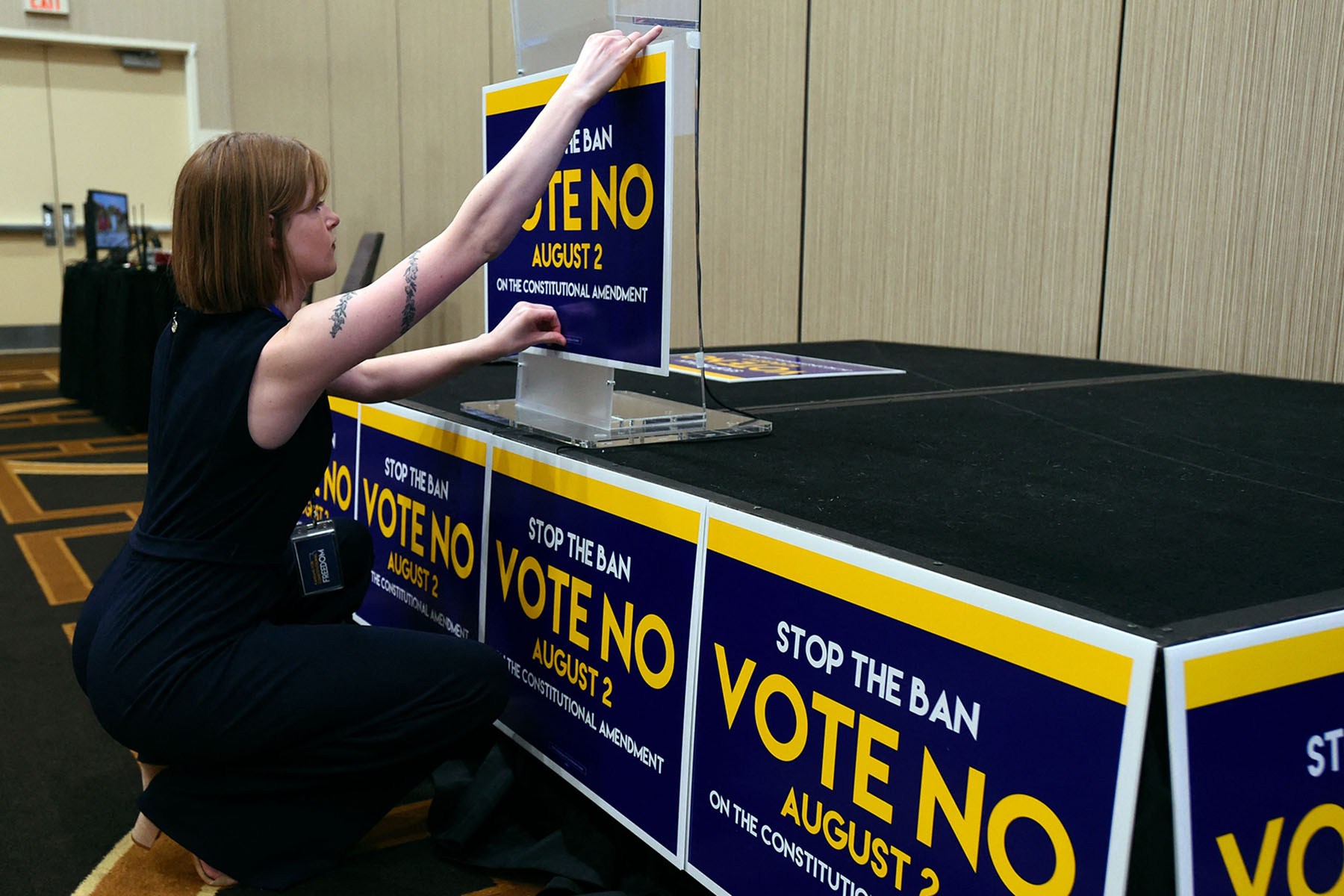
A woman crouches beside a stage, attaching a blue-and-yellow "Vote No" sign to a podium as matching signs cover the front of the stage.
A field organizer places "Vote No" signs before an election watch party in Overland Park, Kansas, on August 2, 2022, when voters rejected a constitutional amendment that would have eliminated state protections for abortion rights. (DAVE KAUP/AFP/Getty Images)

Shefali Luthra

Reproductive Health Reporter

Published

2026-08-04 20:15
8:15
August 4, 2026
pm
America/Chicago

Share

  • Bluesky
  • Facebook
  • Reddit
  • Email

Kansas voters rejected a ballot measure that would have made members of the state’s Supreme Court electable by popular vote — a seemingly technical issue that had become a proxy battle for the future of abortion rights in the state, Decision Desk HQ projects.

Conservatives in the state’s Republican-led legislature put forth the proposal in an effort to remake Kansas’ high court, which in 2019 issued a pivotal decision holding that the state constitution guaranteed the right to an abortion. Three years later, in 2022, Kansas voters rejected a measure that would have undone the court’s decision — securing the Sunflower State’s status as a destination for people seeking abortion from neighboring states such as Texas and Oklahoma, which have both banned the procedure.

State Attorney General Kris Kobach — then a candidate for the position — suggested in 2022 that abortion opponents should pivot to change the makeup of the state Supreme Court. A move to elect justices, he said, could enable lawmakers to “slowly and quietly” develop an anti-abortion judiciary that might ultimately overturn Kansas’ abortion rights protections.

The 19th thanks our sponsors. Become one.

The measure’s failure means that members of the Kansas court will continue to be appointed through a process in which the governor selects people from a list curated by a nine-member commission. The commission includes lawyers across the state who are elected by other Kansas attorneys, as well as non-lawyers selected by the governor.

Kansas Republicans argued the measure would impose needed transparency and accountability into the selection of court members. The measure’s opponents also argued that changing the court’s selection mechanism would empower billionaire donors to select justices, a point hammered in a TV ad  from a progressive coalition called Kansas United for Impartial Groups. 

Other states have indicated the potency of abortion in state court elections, and the massive levels of spending that can be funnelled in when voters directly elect members of their high courts.

In Wisconsin, where Supreme Court members are elected by popular vote, judicial elections in 2023 and 2025 — both races where liberal candidates emphasized their support of reproductive rights — shattered spending records, indicating “an era of rapidly intensifying state judicial politics,” wrote Douglas Keith, a deputy director at the Brennan Center for Justice, a nonpartisan civil rights group.

Opponents of the measure —  including the state’s chapter of the ACLU and Planned Parenthood Great Plains Votes, the healthcare provider’s advocacy arm — also framed the race as a contest about reproductive rights and an effort to relitigate the 2022 election. 

“Kansas is surrounded by states with abortion bans. We continue to see people coming from out of state for care here,” said Emily Wales, who heads Planned Parenthood Great Plains. “Abortion rights are clearly the focus of the legislature.”

In 2024, the most recent year for which state data is available, about three-quarters of all abortions in Kansas — around 15,000 out of just over 20,000 — were for people from other states, namely Texas, Oklahoma and Missouri. Since then, Missouri has passed ballot measures restoring state abortion rights. In Texas and Oklahoma, abortion remains almost entirely outlawed.


Share

  • Bluesky
  • Facebook
  • Reddit
  • Email

Recommended for you

  • Women yell while waving signs for reproductive rights in the streets of LA.
    How abortion became a stand-in for voters’ distrust of politicians
  • A protestor raises her fist while holding a sign for reproductive rights at a protest.
    The GOP candidates walking back some of their abortion stances
  • Sen. Roger Marshall in a navy suit and red tie applauds beside a smiling woman with long blonde hair at an indoor event. Two children are visible in the foreground.
    Roger Marshall closes campaign with men who compare abortion to human sacrifice and the Holocaust
  • Gina Hinojosa, wearing a navy blazer with a campaign button, smiles as she shakes hands with a woman at an indoor campaign event. A campaign sign is visible behind her.
    Could Texas reverse course on abortion? Democrats think there’s an opening

Daily Newsletter

Your trusted source for contextualizing the latest election news.

Look for a confirmation sent to

Did you mean

The email didn't go through.

or Contact us for support

Become a member

Explore more coverage from The 19th

  • Politics
  • LGBTQ+
  • Health
  • Justice
  • Caregiving
View all topics

Site Footer

Support representative journalism today.

Learn more about membership.

  • Give $19
  • Give $50
  • Give $100
  • Any amount

Transparency

  • About
  • Team
  • Contact
  • Privacy Policy
  • Community Guidelines
  • Gift Acceptance Policy
  • Financials

Newsroom

  • Latest Stories
  • Strategic Plan
  • 19th News Network
  • Events
  • Careers
  • Fellowships

Newsletters

  • Daily
  • The Amendment
  • Menopause
  • The Mom Guilt Economy
  • View all

Support

  • Ways to Give
  • Sponsorship
  • Republishing
  • Volunteer
  • Merch

The 19th is a reader-supported nonprofit news organization. Our stories are free to republish with these guidelines.