Skip to content Site Search

Republish This Story

* Please read before republishing *

We’re happy to make this story available to republish for free under an Attribution-NonCommercial-NoDerivatives Creative Commons license as long as you follow our republishing guidelines, which require that you credit The 19th and retain our pixel. See our full guidelines for more information.

To republish, simply copy the HTML at right, which includes our tracking pixel, all paragraph styles and hyperlinks, the author byline and credit to The 19th. Have questions? Please email partnerships@19thnews.org.

— The Editors

Loading...

Modal Gallery

/
Sign up for our newsletter

Menu

Home

We’re an independent, nonprofit newsroom reporting on gender, politics, policy and power. Read our story.

Topics

  • Politics
  • LGBTQ+
  • Health
  • Justice
  • Caregiving
  • Education
  • Abortion
View all topics

Daily Newsletter

A smart, relatable digest of our latest stories and top news affecting women and LGBTQ+ people.

Look for a confirmation sent to

Did you mean

The email didn't go through.

or Contact us for support
  • Latest Stories
  • Our Mission
  • Our Team
  • Strategic Plan
  • Support the 19th
  • Search
  • Contact
Donate
Home

We’re an independent, nonprofit newsroom reporting on gender, politics, policy and power. Read our story.

Daily Newsletter

A smart, relatable digest of our latest stories and top news affecting women and LGBTQ+ people.

Look for a confirmation sent to

Did you mean

The email didn't go through.

or Contact us for support

Become a member

Multi-color socks with

Our new merch store is now live!

Represent the newsroom that represents you. Every purchase directly supports our nonprofit newsroom.

Shop Now

The 19th thanks our sponsors. Become one.

LGBTQ+

Higher grades and belonging: Trans students thrive when their teachers support them

Actions as simple as asking for and affirming a student’s name and pronouns can make trans students feel substantially safer and more likely to succeed in the classroom, a new report shows.

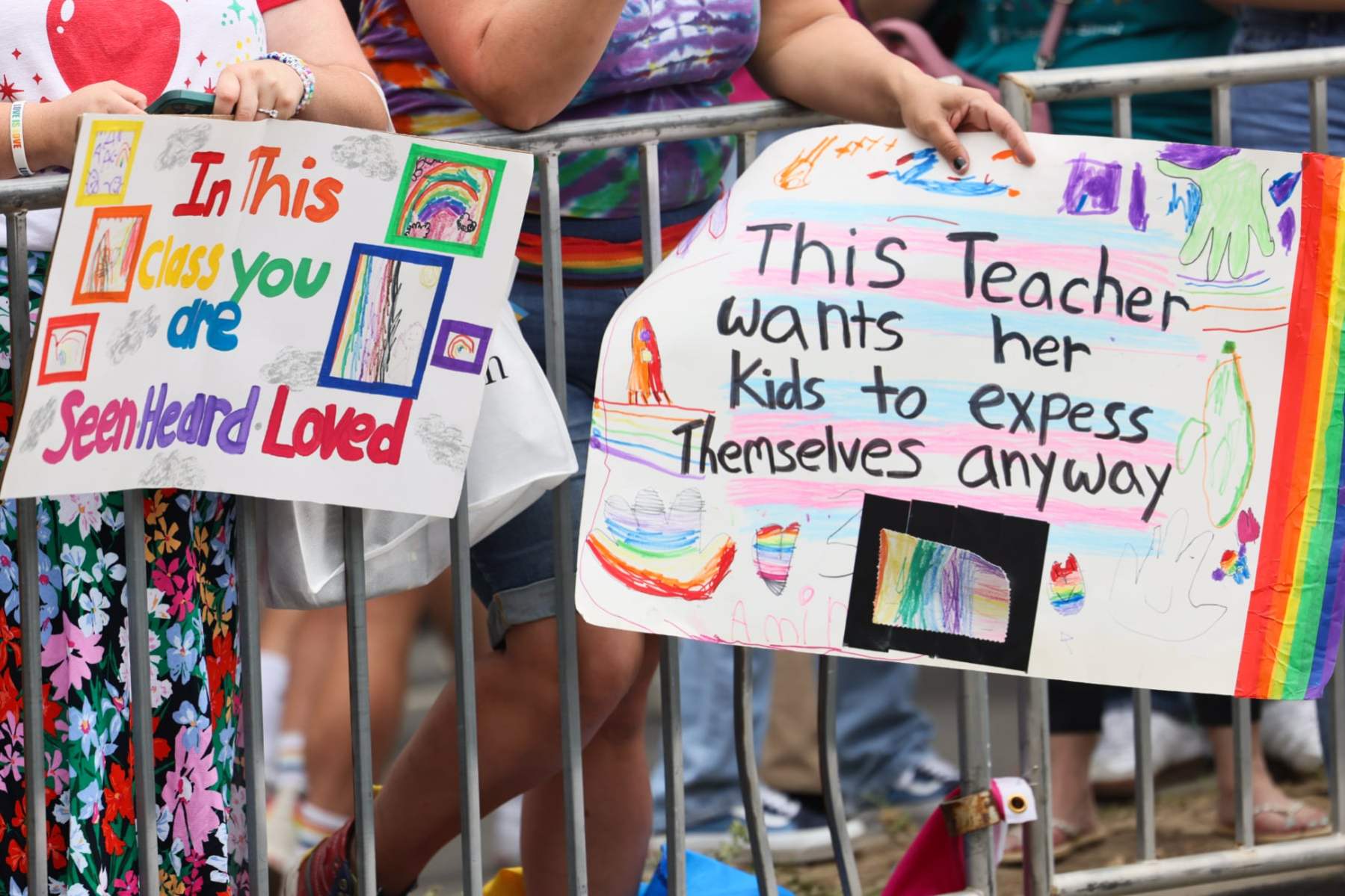
Signs that say "in this class you have seen heard loved" and "This teacher wants her kids to express themselves anyway" are held over a railing.
Students whose identities are affirmed at school report a greater sense of belonging and higher grades, research shows. (Rodin Eckenroth/Getty Images)

Brooke Migdon

Published

2026-08-18 14:03
2:03
August 18, 2026
pm
America/Chicago

Share

  • Bluesky
  • Facebook
  • Reddit
  • Email

Supportive teachers can make a world of difference for transgender students, influencing their sense of safety and academic engagement — often in the face of discrimination and bullying — according to new research from two national LGBTQ+ advocacy groups.

Students whose identities are affirmed at school report a greater sense of belonging and higher grades, and are more likely to participate fully in class, according to a report released Tuesday by GLISTEN and the Trevor Project. Students report similar outcomes when they are able to connect with LGBTQ+ peers at school, see positive representations of LGBTQ+ people in their classrooms and attend schools with inclusive policies, such as those that allow them to compete on sports teams or use facilities that best align with their gender identities.

“School environments can play a powerful role in determining whether transgender and nonbinary students thrive or struggle at school,” said Derrick Matthews, director of research science at the Trevor Project.

The 19th thanks our sponsors. Become one.

Policies affecting trans students vary broadly and encompass a range of state and federal laws and directives from local school districts. In recent years, Republican-led states and the federal government have increasingly restricted the rights of trans young people, especially at school.

The report noted that more than half of trans and nonbinary students said their school had implemented at least one policy or practice that was discriminatory toward LGBTQ+ students, and roughly 60 percent said they had experienced at least one negative event at school. Of that number, 49 percent reported verbal harassment related to their LGBTQ+ identity, and 27 percent said they were barred from dressing in accordance with their gender. 

More from The 19th

  • For college students, a school’s state politics can matter as much as its academics
    Two cyclists ride by a protest encampment with signage showing support for Palestine and a UCI sign on a light pole nearby.
  • The fight over teaching race and gender in college classrooms is escalating
  • Book bans and culture wars came for libraries. They’re still standing strong.

Twenty-five percent of students said they missed 16 or more days of school last year, and 9 percent said they were mistreated so badly that they left their school altogether.

The Trevor Project’s survey, conducted anonymously online between March and October of last year, included responses from more than 3,700 transgender, nonbinary and gender-expansive 13- to 24-year-olds. Nearly 2,000 trans middle and high school students responded to GLISTEN’s 2025 National School Climate Survey, administered between April and October 2024.

“Our findings illuminate a number of serious challenges these students face,” Matthews said. “However, these data also provide us with clear and impactful actions that teachers and school officials can take to set transgender and nonbinary students up for success.”

Asking about and affirming a student’s name and pronouns, teaching and talking about LGBTQ+ topics and supporting student-led LGBTQ+ groups like Gender and Sexuality Alliances can make trans students feel substantially safer at school, according to the report. But students also want their teachers to take greater action, said Shweta Moorthy, director of research and best practices at GLISTEN.

“There are many students in our survey saying that there’s sort of this, like, ‘negative neutrality’ type of thing happening, where while they aren’t hearing a lot of negative comments from educators, they aren’t hearing a lot of positive comments from educators either,” she said. “There is a clarion call in our research from students for their educators to show up in much more proactive and affirming ways. Safety isn’t just the absence of harm. It isn’t just the absence of bullying and the absence of discrimination.”

Share

  • Bluesky
  • Facebook
  • Reddit
  • Email

Recommended for you

  • Your guide to LGBTQ+ ballot measures in 2026
  • A collage with faces in profile, an American flag and numbers and graphing paper
    The State of Our Nation
  • Dr. Amy Acton, Ohio Democratic gubernatorial candidate, speaks to supporters during a rally.
    Democrats don’t agree on how to talk about trans athletes. Just look at Ohio.
  • Trans kids are vulnerable to eating disorders. This therapist knows what they’re going through.

Daily Newsletter

A smart, relatable digest of our latest stories and top news affecting women and LGBTQ+ people.

Look for a confirmation sent to

Did you mean

The email didn't go through.

or Contact us for support

Become a member

Explore more coverage from The 19th

  • Politics
  • LGBTQ+
  • Health
  • Justice
  • Caregiving
View all topics

Support representative journalism today.

Learn more about membership.

  • Give $19
  • Give $50
  • Give $100
  • Any amount
  • Transparency
    • About
    • Team
    • Contact
    • Privacy Policy
    • Community Guidelines
    • Gift Acceptance Policy
    • Financials
  • Newsroom
    • Latest Stories
    • Strategic Plan
    • 19th News Network
    • Events
    • Careers
    • Fellowships
  • Newsletters
    • Daily
    • The Amendment
    • Menopause
    • The Mom Guilt Economy
    • View all
  • Support
    • Ways to Give
    • Sponsorship
    • Republishing
    • Volunteer
    • Merch

The 19th is a reader-supported nonprofit news organization. Our stories are free to republish with these guidelines.