
This article was published in partnership with The Marshall Project, a nonprofit news organization covering the U.S. criminal justice system. Sign up for their newsletters, and follow them on Instagram, TikTok, Reddit and Facebook.
Suzanne Garcia looked down and away from the officer’s gaze as she went through the motions of a routine jail intake inspection: Remove all clothing, including underwear. Raise both arms. Lift each breast. Run fingers through hair. Show hands and feet. Turn 180 degrees. Bend over and squat. Separate butt cheeks. Cough.
Garcia had been arrested in 2020 and booked at the La Plata County Jail in Durango, Colorado, because of a years-old restraining order that was later dismissed. She remembers asking the female jail officer why she needed a strip search. The response: “This is just what we do in La Plata County,” Garcia recalled.
It all felt excessive, Garcia told The 19th, but she complied. She had no other choice. “It’s cold and it’s humiliating,” Garcia said. “You just feel like an ant under a microscope. It’s just, it’s terrible.”
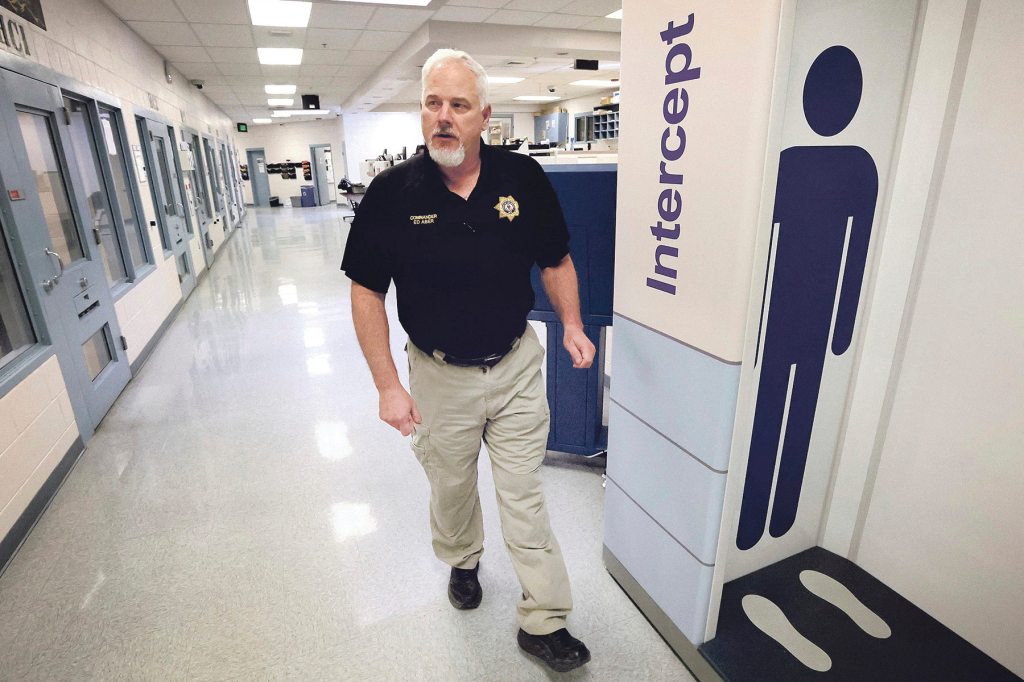
What Garcia did not know at the time was that her search was recorded by the officer’s body-worn camera. She was released from jail and moved on with her life. Then, last year, she received an unexpected phone call from a Durango Herald reporter with a shocking revelation: Her video was one of dozens of searches that had been improperly viewed by La Plata County Jail’s commander, Edward Aber.
Over the course of five years, Aber allegedly logged into the county’s evidence database more than 3,000 times and viewed strip search videos of 117 incarcerated women, according to county and state officials. In criminal charges filed last year, authorities said the viewings sometimes happened from hotel rooms and residential addresses.
Aber, who has pleaded not guilty, has not spoken publicly about the allegations. His attorney did not respond to an email request for comment.
Garcia felt sick when she learned of the allegations, not only because of what victims characterize as an abuse of power, but also because Durango — with less than 20,000 people — is a relatively small community. She knew Aber’s family. “His grandson took my daughter to homecoming,” Garcia said.
As a former chairwoman for the county’s Democratic Party who had previously run for public office, Garcia said she sprang into action. She went to the district attorney’s office and started asking what the DA planned to do. When that did not yield satisfactory answers, she reached out to her state representative’s office, which connected her with the Colorado Coalition Against Sexual Assault.
From there, Garcia worked with the coalition’s advocates and other alleged victims of Aber to draft a bill to ensure this would not happen again. In May, Colorado Gov. Jared Polis signed the legislation, which limits how jails in the state can conduct strip searches and when staff can access any recordings. Advocates working in sexual violence prevention told The 19th that the new law is the result of survivors coming together to demand legislative change. They also hope it will be a model for other states — an effort to reconsider the pervasive use of strip searches in the criminal legal system.
Strip searches have become standard practice in correctional facilities throughout the United States.
Omny Miranda Martone, founder and CEO of the Sexual Violence Prevention Association (SVPA), said strip searches are “being performed way more often than anybody realizes, often hundreds of times a year for people who are incarcerated.” The national organization assisted with advocating for Colorado’s strip-search law.
While much of the public understands that incarcerated people are strip-searched when they enter jail or prison, Martone said, “it’s also often done whenever somebody moves between the facility, between maybe one building and another,” as well as “before and after somebody visits with their loved ones, which often incentivizes them not to see their loved ones.” Strip searches, Martone argues, are a form of state-sanctioned sexual violence, and they can become the catalyst for additional sexual violence.
Comprehensive data that tracks strip searches does not exist. In Connecticut last year, state lawmakers called for funds to switch to body scanners after finding that the state performed an estimated 355,000 strip searches on incarcerated people in 2024. Supporters of the legislation called the searches “dehumanizing.”
Corrections officials argue that strip searches help to promote safety inside facilities by stopping contraband — like illicit drugs or potential weapons — or prohibited items like cash or uncanceled postage stamps.
There is also little data showing that visual or physical strip searches are the most effective method for finding contraband. A 2019 study by the Washington State Department of Corrections found that during a pilot program using body scanners as an alternative to strip searches, contraband detection increased from an average of two discoveries per month to 10 per month.
In La Plata County, where officers are required to use body-worn cameras during strip searches, these inspections can also be recorded. Until the new strip-search law, incarcerated people did not receive notice of the recordings.
Katrina Lile received a letter from the district attorney’s office for La Plata County in July 2025, four years after her release from county jail, informing her that she was one of the women whose videos Aber allegedly viewed.
“All I could do was just cry and cry, because I cannot believe this is happening to me,” Lile said. In the days that followed, she said, her anger grew. She would get into arguments with her husband or lose patience with her young son. “I was taking my hurt and my anger out on my family,” she said.
Like Garcia, Lile called the office of Rep. Katie Stewart, a Colorado Democrat, who asked if Lile wanted to be involved with the effort to write the new bill.
Stewart was six months into her first term in the Colorado House when news of Aber’s accusations broke in her district and she started receiving calls from constituents. She consulted more experienced lawmakers before working with the survivors, advocates against sexual assault, attorneys and local law enforcement to craft a possible bill.
“There was a broad coalition,” Stewart said. “It was a bit of an arm wrestling match to thread the needle to get a meaningful policy put in place to ensure that this didn’t happen again.”
Survivors and advocates were especially eager to address video recordings of strip searches. Rather than banning them altogether, survivors said that the recordings offered a layer of accountability and evidence in case of any misconduct during a strip search, said Elizabeth Newman, director of public policy for the Colorado Coalition Against Sexual Assault.
Lile suggested that the law requires officers to inform incarcerated people that they are being recorded. It also requires that jail staff obtain written approval to access strip-search video and log the reason for accessing the video.
To better regulate the use of strip searches in Colorado jails, the law established clearer parameters for when incarcerated people can be strip-searched: during the intake process, if staff have a reasonable belief that an incarcerated person is concealing contraband, or if a particular scenario has a history of producing contraband, for example, if there is an overdose in the facility.
The law also included whistleblower protections to prevent retaliation against jail staff who voice concerns about potential misconduct, Newman said. She added that the new law is limited to jails in the state, and doesn’t include prisons, because of budget constraints and limited federal oversight. She said her organization plans to monitor implementation of the law and review the data collected by jails to inform potential legislation for state prisons.
Stewart and Rep. Javier Mabrey, a Democrat, introduced the bill to the Colorado House in February, and it was passed and signed by May. The new law is the first of what national advocates hope to be a nationwide campaign to pass similar legislation in other states, according to Martone of the Sexual Violence Prevention Association.
Martone has studied the success of other public safety initiatives, including nationwide campaigns to end drunk driving as well as “End the Backlog,” aimed at addressing untested rape kits. Their group uses four pillars — research, policy, coalition building and public education — in its work.
Part of the work of taking on strip searches is getting the public and lawmakers to be more empathetic to incarcerated people and the circumstances that can lead to incarceration, Martone said.
For survivors in Colorado, the new law is the first step in a longer journey to justice. In July 2025, Aber was arrested and charged with 117 counts of invasion of privacy for sexual gratification and one count of first degree official misconduct for inappropriately viewing the sensitive footage. His criminal trial was initially scheduled to begin Aug. 10 but was pushed to November due to scheduling conflicts.
“We passed a bill faster than we got justice,” Lile said. “We kind of feel like we got justice with this bill — almost.”
“Everybody worked together, and put their heads together,” she said. “Our main concern was protecting other incarcerated people, so this didn’t happen to anybody again.”