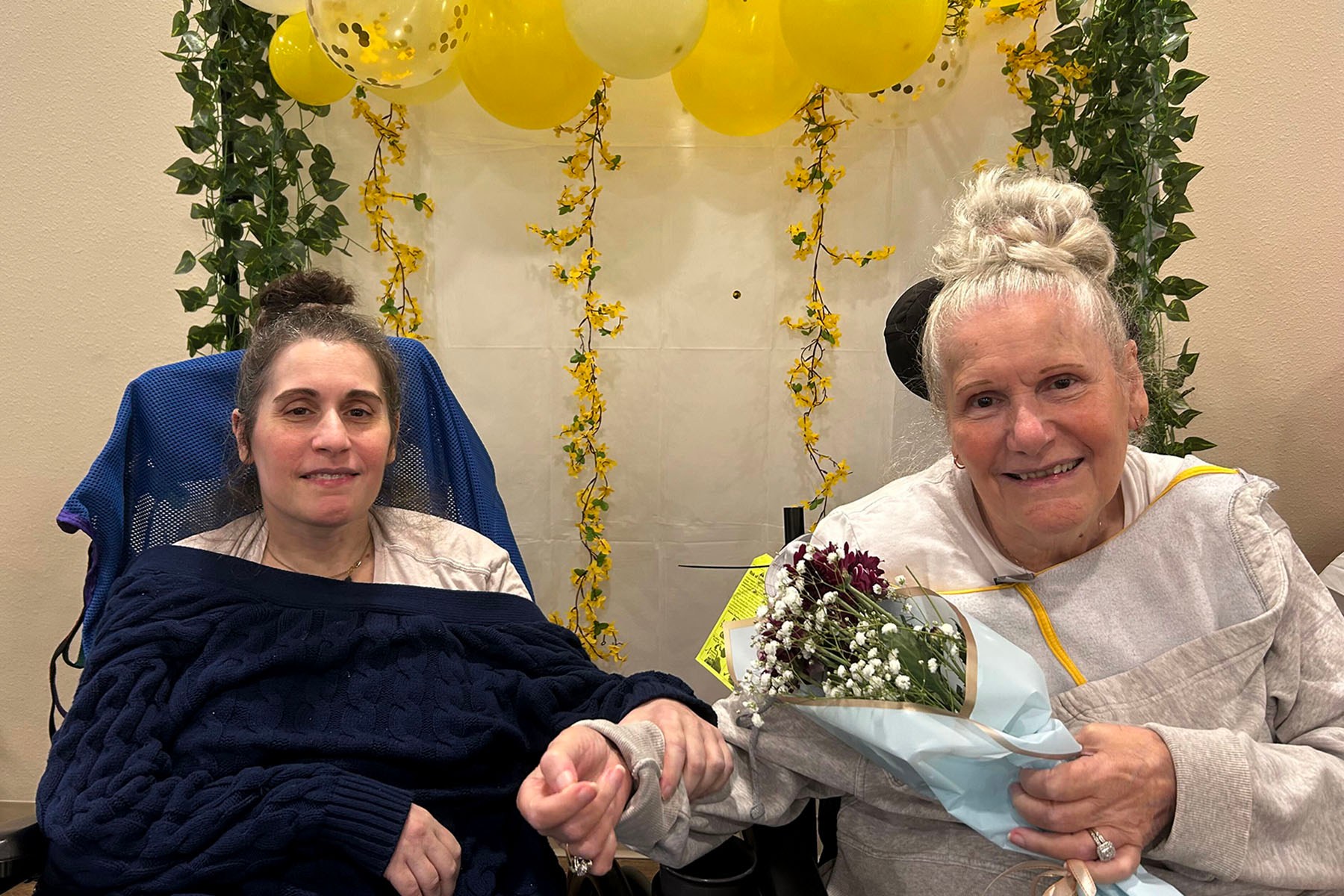

Cindy Napolitan and her daughter Melissa have multiple sclerosis, a degenerative condition in which the immune system attacks the brain, spinal cord and nerves. They have lived together at a nursing home in Mesquite, Texas, for nine years. In previous elections, Cindy and Melissa Napolitan voted by mail, but this year they took an unusual step: They voted in person. They worried their mail-in ballots — and even their in-person votes — may not be counted.
“I’ve never worried like this before. I’ve never worried that I don’t have the proper ID. I’ve never worried that somebody is going to intimidate me. Will I encounter somebody that’s going to threaten me or make me feel less than? So yeah, I’m very worried, and I shouldn’t be,” Cindy Napolitan said. “I shouldn’t have to be worried about stuff like that. This is the 19th Amendment. I’m allowed to vote.”
Nursing home residents are guaranteed the right to vote. Around two-thirds of all nursing home residents in the United States are women, making aging and long-term care gendered issues.
There is no data on how many nursing home residents exercise that right. Cindy, 70, and Melissa Napolitan, 48, at least, feel like they’ve had good experiences with voting at their facility. Cindy Napolitan, in particular, has worked with the activities coordinator to organize rides to the polls for her, her daughter and other interested residents.
“We are scheduled to go on the first day of early voting. So in case there are any issues that we come across, we still have time to rectify the situation and be allowed to vote,” Cindy Napolitan said.
Cindy and Melissa Napolitan are more concerned this year than in previous years about government interference and voter suppression. Their fears are not unfounded: Experts and advocates for the rights of nursing home residents, older adults and people with disabilities are worried too.
In July, the Centers for Medicare and Medicaid Services rescinded previous guidance affirming that nursing home residents have the right to vote.
“The memo does not alter the underlying law. Nursing homes are governed by the Nursing Home Reform Act of 1987 and its implementing regulations,” said Nina Kohn, a professor at Syracuse University and expert on elder law. “That law still requires facilities to support their residents in exercising their rights as Americans.”
The memo also emphasized voter fraud in nursing homes, specifically around mail-in ballots. For years, President Trump has disparaged mail-in ballots, insisting without evidence that fraudulent votes by mail had a role in his loss during the 2020 presidential election. His comments have led to some states restricting who can use a mail-in ballot and in what contexts.
According to experts, including Kohn, there is no evidence that voter fraud is a serious or widespread problem in nursing homes. Instead, Kohn is concerned about the chilling effect that it may have on residents’ rights.
“The language in the memo itself is intimidating, and it may understandably make staff think that they could face criminal prosecution or be in some other form of legal trouble if they help residents vote,” Kohn said.
Cindy and Melissa Napolitan do everything together — and on Monday, they voted together. They are also roommates at the facility; most people living in nursing homes are assigned roommates who are strangers.
“Unlike other people that have roommates that don’t get along, I’m very lucky and fortunate that I have somebody that loves me and I love her,” Cindy Napolitan said.
This is the second time Cindy and Melissa Napolitan have voted in person since entering a nursing home. The first time was during the 2024 presidential election.
“I’ve been checking my status weekly to make sure that I haven’t been dropped off the voter rolls, making sure my daughter and I don’t have some sort of issue that says that we can’t vote,” Cindy Napolitan said.
People living in nursing homes and other long-term care facilities face specific barriers. Some residents may need assistance filling out their ballots because they lack the movement or dexterity to hold a pen or press buttons on a computer screen. People with dexterity or coordination issues may also be unable to produce the same signature twice.
“With some forms of voting, some states will use your ID to verify your signature. If your signature looks different than the one on your ID, your ballot might get thrown out. Or there is a ballot hearing process, so you could be notified of that and able to fix it, but it is a bunch of extra steps that impact disabled voters at higher rates,” said Alexia Kemerling, director of Accessible Democracy for the nonpartisan American Association of People with Disabilities.
An increasing number of states now require voters to show some form of photo identification. This can also be a problem for many nursing home residents because they may no longer have a driver’s license. They also may no longer have passports because they aren’t traveling internationally. States have other forms of identification, but getting them can involve complex paperwork and multiple trips.
Some states will accommodate voters in nursing homes and other facilities so they can acquire state identification that isn’t a driver’s license.
“My license expired, and so I had to apply for an identification card. I had to coordinate with them to come here instead of going to the DMV because I wasn’t about to do that. I didn’t know how long I would have to sit there. I didn’t have a ride,” Melissa Napolitan said. “They came and took our pictures, and filled out all the forms for us.”
Kemerling objects to the idea that this somehow renders nursing home residents and other people with disabilities incapable of making an independent choice.
“In the disability community, we don’t necessarily mean that independence means doing something alone. Independence is having control over how something is done,” Kemerling said. “Just because you need someone to assist you as part of the voting process does not mean that you are giving up your choice.”
There are steps nursing home residents and their families can take to advocate for their rights. Lori Smetanka is the executive director of the National Consumer Voice for Quality Long Term Care, which advocates on behalf of people living in nursing homes and assisted living facilities. Her organization produces a fact sheet for nursing home residents enumerating their rights and how they can advocate for themselves.
“For the generation of people that are living in long-term care facilities, it’s largely an older population of people,” Smetanka said. “It’s very important to them to exercise their right to vote. When we talk with residents, it is very important to them. Some of them have really advocated very heavily for themselves in order to be able to do that.”
Smetanka emphasized that it is not only up to residents and their families to advocate for their rights.
“If the resident has the ability to raise the questions about it, they certainly should be doing that, Smetanka said. “Families should be asking, but staff should be asking too — ‘What can we do to help you vote this year? Who is interested in voting? How can we get the requirements in place so you can cast your ballots?’” At some facilities, voting may not be on staff’s radar, despite the legal requirements.
Cindy Napolitan has been active in advocating for her right to vote, as well as the rights of her fellow residents, and she encourages others who are able to do the same.
“I’m very vocal and very into advocating for our residents here and making sure that they’re all able to vote,” Cindy Napolitan said. “I’m the one that will start telling our activity director that there’s a deadline for filing to become a registered voter. There’s a deadline to file for a mail-in ballot, and I’m usually the one that makes sure that those things get done.”
When asked what she wants people to understand most about voting in nursing homes, Melissa Napolitan pushed back against the insinuation that nursing homes are hotbeds of voter fraud and that she and her peers don’t have their own opinions.
“I think that people maybe don’t take the time to realize that people in nursing homes aren’t just here waiting to die,” Melissa Napolitan said.
To check your voter registration status or to get more information about how to vote and what’s on your ballot, visit vote.org.