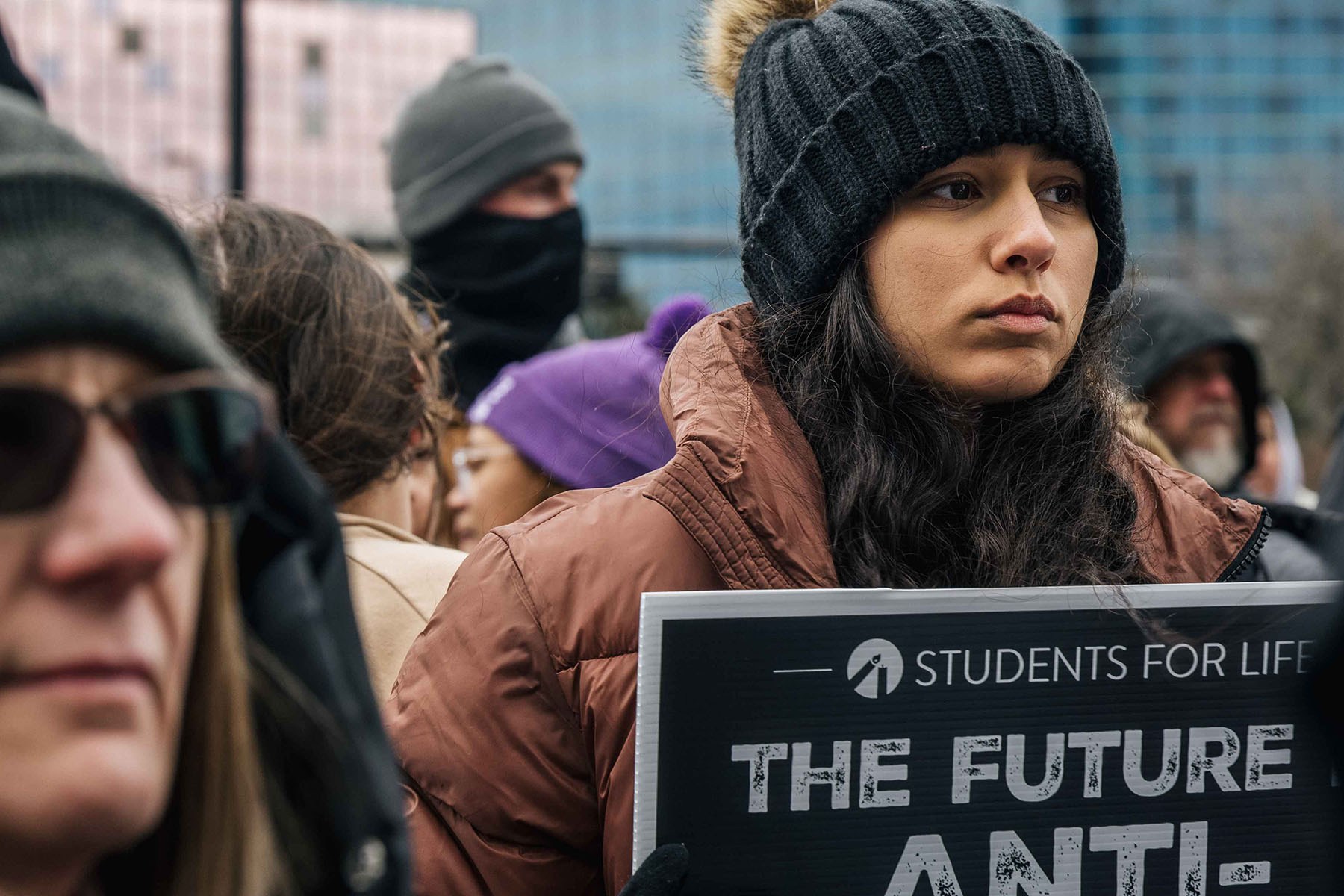

When Texas lawmakers enacted House Bill 7 — a sweeping law that allows private citizens to sue anyone who helps distribute abortion medication in the state — Students for Life cheered the measure.
Now, that anti-abortion group is being sued under the law they championed, in a case that experts say could ultimately weaken the very tool organizations hoped would stop people from getting abortions in Texas. Abortion opponents are also planning to file their own lawsuits that could also define HB 7.
“The genius of the suit is that it shows if HB 7 is as broad as it seems, it can be used against anyone, including people who share a judge’s perspective on abortion,” said Mary Ziegler, a law professor at the University of California, Davis. “It’s obviously precedent-setting.”
The suit targets four people associated with Students for Life for allegedly ordering abortion medications into Texas without intending to use them personally. In a March social media post, the named defendants claimed to be ordering the pills “undercover” to illustrate that they are still available to people in the state. HB 7 does not prevent people from ordering abortion medication, but it does prohibit transporting them or providing them to others.
The suit was filed last week on behalf of a Texas-based woman who, because of the state’s abortion ban, is now a mother of two. The plaintiff seeks just under a half million dollars — enough, the suit says, to raise two children in Texas. The suit was filed by lawyers at Amplify Legal, a nonpartisan practice that supports abortion rights.
Students for Life has condemned the lawsuit while defending HB 7. In a statement, Kristi Hamrick, a spokesperson for the organization, said it “appreciates the backhanded compliment that because of our legislative work, babies’ lives are being saved.”
Critics have called HB 7 a “bounty hunter law” because it allows private lawsuits, with financial awards attached, to be brought by people unrelated to the incident. The law has hardly been used since it took effect in December. One lawsuit, filed in Texas against a California-based physician who allegedly mailed abortion medications to a woman in Texas, lists HB 7 among the laws ostensibly violated. That case remains in its early stages.
Some experts say it’s unclear what activities can be prosecuted under the law, including whether it targets people who intend to help someone procure an abortion, regardless as to whether they succeed. Others have suggested it could threaten free speech protected by the First Amendment by targeting people who say they intend to distribute pills for the purpose of abortion, or that it could represent an effort by Texas to regulate commerce conducted across state lines — something only the federal government can do. (The text of the law says it would not apply to constitutionally protected speech.)
This new suit may test those very questions.
“The purpose of this suit is really to show how frankly ridiculous the law is and how vague it is,” said Rachel Rebouché, a law professor at the University of Texas at Austin.
If the suit is dismissed, it could add new standards and definitions around when HB 7 might actually apply — including who is an appropriate plaintiff or what kind of behavior actually can serve as the basis for a lawsuit. Those, Rebouché said, would ultimately narrow the scope of the far-reaching law.
“It’s an interesting and innovative strategy to ask courts to weigh in on laws that are difficult to apply, very hard to enforce, very open-ended language, have jurisdiction and standing problems and where the intent of the law is to try to intimidate people out of state,” she added. “There are lots of issues for a court to grapple with.”
This case could take months or longer to unfold. But abortion opponents in Texas say they are preparing their own suits that could illustrate or test HB 7’s scope.
John Seago, the head of the influential anti-abortion group Texas Right to Life, said his organization is working to bring forward what he called “more serious lawsuits” targeting the medical providers and support networks that are helping Texans obtain abortions. It’s not clear when those suits might be filed.
“We want to be strategic, especially on these first cases, because it is a unique law and it’s a new law, and there could be a lot of misunderstanding about how courts should handle it,” Seago told The 19th. “We’ve been very careful on bringing the lawsuits to make sure they were the right relators, the right defendants, the right fact pattern.”
HB 7 is part of a multipronged effort by abortion opponents to halt the flow of abortion medications — mifepristone and misoprostol — into the state. Though Texas has banned abortion in virtually all circumstances, people have continued to order medications online from medical providers in other states who are protected by their own state laws.
And anti-abortion groups are pressing for the federal government to institute its own restrictions on abortion medications, which could ultimately make laws like HB 7 redundant.
They have called on the Justice Department to revive a long-dormant law from the 19th century called the Comstock Act, which they believe could ban the drugs from being mailed. Some have also pressed the Food and Drug Administration to impose new restrictions on mifepristone so that it can be prescribed and provided only in person.
But the federal government has taken little action in that direction, recently indicating in court filings that the soonest any new federal review of mifepristone’s approval — the first step toward new restrictions — likely would not be completed until March.
“The elephant in the room is whether there will be federal limits. This case fits into the fragmented landscape where states are trying to battle other states,” Ziegler said. “If the federal government steps in and says there are new limits on pills — whether through the Comstock Act or FDA or some other federal suit — that would take precedence over what’s happening here.”