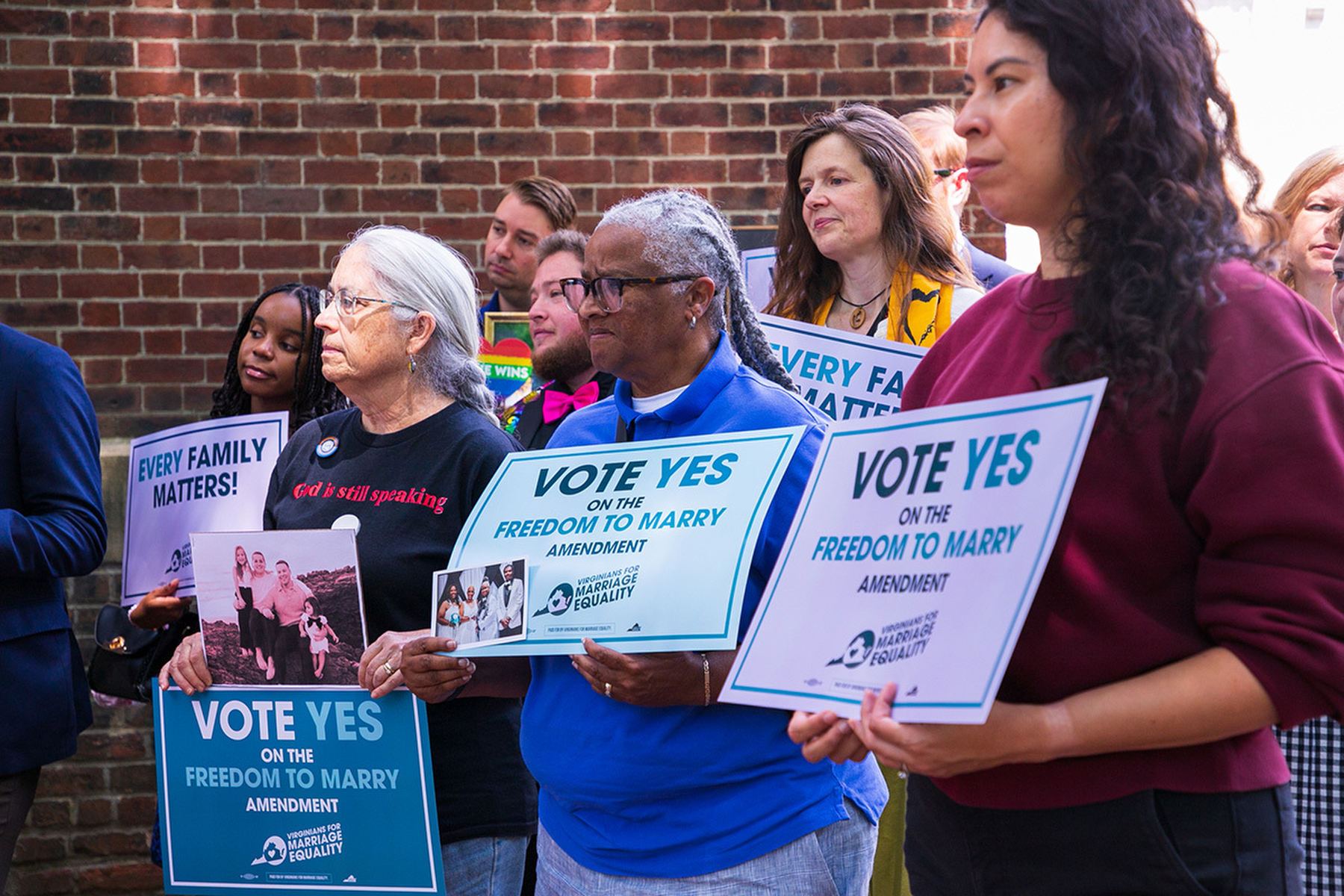
Virginia voters on Tuesday approved a constitutional amendment officially repealing the state’s ban on same-sex marriage, nearly 20 years to the day after it was adopted in 2006.
With more than 95 percent of the vote in, Virginia’s Question 2 passed with 57 percent of the vote, according to Decision Desk HQ. The 2006 measure, which legally defined marriage as a union between “one man and one woman,” also passed that year with 57 percent of the vote.
The initiative’s success is a substantial victory for Virginia’s marriage equality advocates, who spent years lobbying the legislature to put the proposal before voters. Virginia joins a growing coalition of states in striking language against same-sex marriage from its constitution. Nevada, California, Colorado and Hawaii have also repealed their bans in recent years.
In Virginia, proposed amendments to the constitution must be approved by the state House and Senate twice before they can go before voters. Just eight Republicans in the 140-seat legislature voted for the amendment when it came up for final passage in January.
Virginia’s ban on gay marriage, like those in 24 other states, has not been enforceable since 2015, when the Supreme Court issued its landmark ruling in Obergefell v. Hodges that established a federal right to marry for same-sex couples. But state LGBTQ+ rights groups have argued that recent decisions and public statements by the court’s conservative majority put that right in jeopardy.
The Supreme Court declined to take up a case challenging its same-sex marriage ruling last year, despite criticisms levied against it by two of its own justices, Clarence Thomas and Samuel Alito. In 2022, after the court overturned Roe v. Wade, the landmark 1973 decision that established the federal right to abortion, Thomas suggested the court “should reconsider” some of its other rulings, including Obergefell. In a recently published collection of speeches, Alito called the court’s Obergefell decision the “decisive point in our nation’s turn against religious liberty.”
Nationally, support for marriage equality remains high, with 65 percent of Americans registering support in a June Gallup poll. Falling support among Republicans has driven an overall decline since 2022, when support for same-sex marriage reached an all-time high of 71 percent. In a 2024 survey, 68 percent of Virginians said same-sex couples should be able to marry legally.
Republicans opposed to repealing the language in Virginia’s constitution had argued that the measure to do so was “radical and deceptive,” and tried to connect it to more politically divisive issues. One conservative Virginia nonprofit claimed without evidence that the initiative would “enshrine gender ideology into our state constitution.”
Former Lt. Gov. Winsome Earle-Sears, a Republican who lost her bid for governor last year, embarked on a statewide bus tour this summer imploring voters to “protect the lives of babies and traditional marriage” by rejecting the ballot initiative and another to establish reproductive rights.
“Tonight’s victory belongs to generations of Virginians who organized, advocated and fought for equality, often without knowing whether they would live to see this day,” said Narissa Ramen, executive director of Equality Virginia and campaign manager for Virginians for Marriage Equality, the two primary organizations backing the proposal.
Kelley Robinson, president of the Human Rights Campaign, the nation’s largest LGBTQ+ rights group, called the ballot measure’s passage “a big and important win.”
“We must work to carry this momentum across the country to ensure our marriages are protected in every state in the nation,” she said.