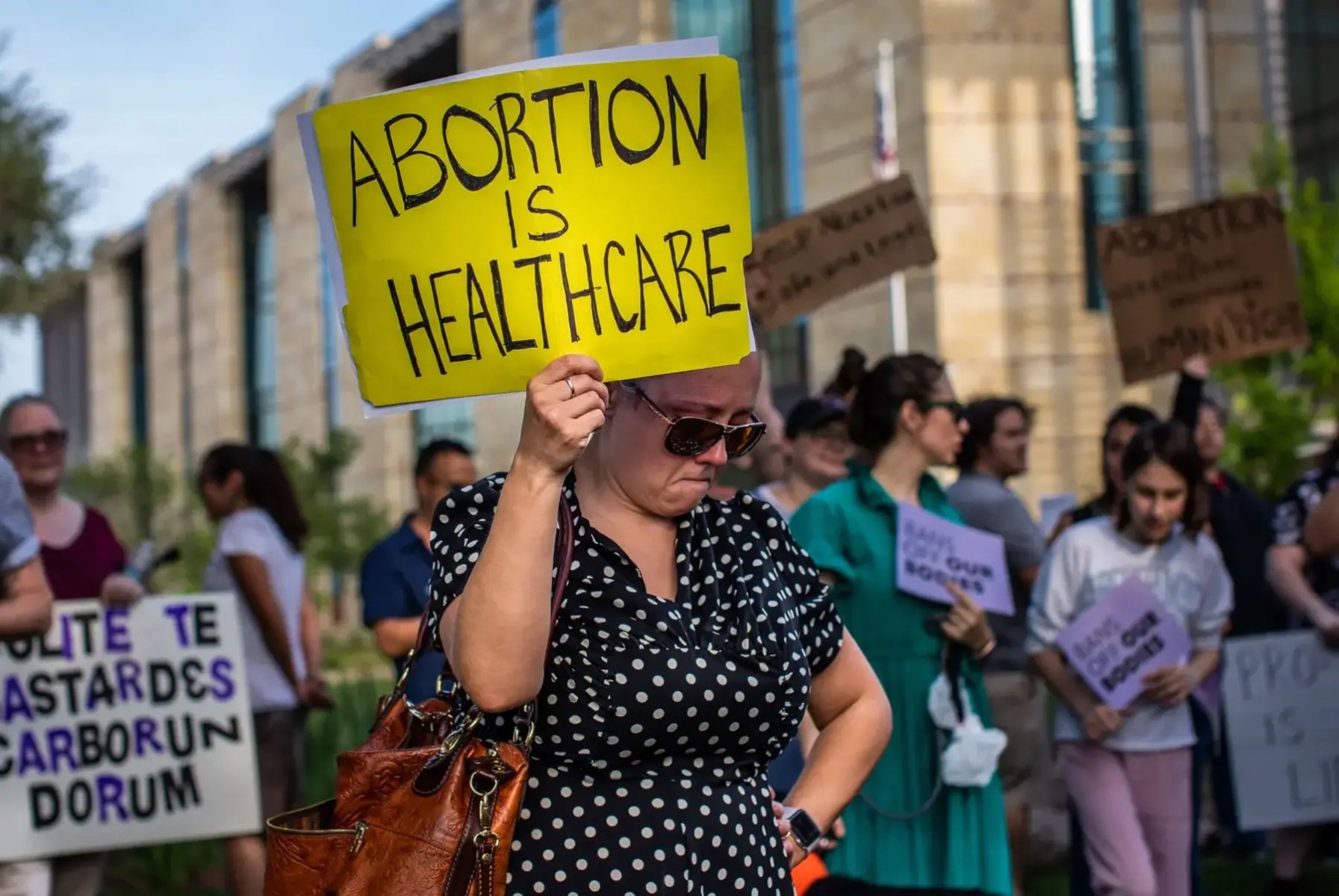
A Texas woman has filed an emergency lawsuit, asking a Travis County judge to allow her to terminate her pregnancy.
This is the first time since before Roe v. Wade was decided in 1973 that an adult woman has asked a court to intervene to allow her to terminate a pregnancy, and the first lawsuit of its kind since Texas banned almost all abortions in 2022.
Kate Cox, a 31-year-old Dallas woman, learned last week that her fetus was diagnosed with full trisomy 18, a chromosomal anomaly that is almost always fatal before or soon after birth. The fetus is developing with an umbilical hernia, a twisted spine, a club foot and an irregular skull and heart, according to the lawsuit.
Cox, who already has two children, both delivered by Cesarean section, also has elevated glucose and underlying health conditions. The lawsuit alleges she is at increased risk of gestational hypertension and diabetes and complications from anesthesia and cesarean section, if she were to carry the pregnancy to term.
“Ms. Cox’s physicians also explained that a C-section at full term would make subsequent pregnancies higher risk and make it less likely she would be able to carry a third child in the future,” the lawsuit says.
“I’m trying to do what is best for my baby and myself, but the state of Texas is making us both suffer,” Cox said in a press release. “I need to end my pregnancy now so that I have the best chance for my health and a future pregnancy.”

Cox received this diagnosis on Nov. 28, the same day the Texas Supreme Court heard arguments in Zurawski v. Texas, a landmark lawsuit in which 20 women and two doctors are challenging Texas’ abortion laws with regards to complicated pregnancies.
The Texas Supreme Court is currently considering that case, which asks whether the state’s abortion bans apply to women carrying non-viable pregnancies like Cox’s. A Travis County judge previously ruled that the laws should not apply to patients with medical complications that could become life-threatening or those who have received lethal fetal diagnoses. The Texas attorney general’s office appealed that ruling, putting it on hold. The state has argued that the law is clear — and clearly does not allow abortions in cases where the fetus is unlikely to survive after birth.
The high court heard arguments in the case Nov. 28, including the state’s claim that the plaintiffs do not have the legal right to sue, since none of the 20 are currently seeking abortions.
Texas Supreme Court Justice Jeff Boyd asked Assistant Attorney General Beth Klusmann if there was ever a circumstance in which a woman would be able to bring a lawsuit seeking to clarify the law. Klusmann replied that a woman actively seeking an abortion for a lethal fetal anomaly would arguably have standing to sue the attorney general for her specific case.
“And then the defense would be whether or not they intended to enforce it in that circumstance or not, so through the ultra vires, sovereign immunity process, we’d probably hash out some of the merits,” she said. While Klusmann acknowledged that it was likely “impractical” for a woman to file a lawsuit while dealing with a complicated pregnancy, “we don’t bend the rules of standing for practicality.”
As those arguments were happening in Austin, Cox was in the Dallas area, learning her much-wanted pregnancy was unlikely to result in a live baby. In researching her options, she learned about the lawsuit and reached out the Center for Reproductive Rights, which filed both suits. Tuesday’s lawsuit follows the model Klusmann laid out before the justices last week, bringing an ultra vires challenge to the state’s abortion law as it applies to her specific lethal fetal diagnosis.
The lawsuit says that Cox cannot wait for the Supreme Court to rule and asks the judge to grant a temporary restraining order, prohibiting enforcement of Texas’ abortion bans against Cox and her husband, as well as Dr. Damla Karsan, an OB/GYN who has agreed to perform the abortion, and her employees. Karsan is a plaintiff in Zurawski v. Texas as well. Cox’s lawsuit also asks for a declaratory judgement that finds the state’s abortion bans do not apply to patients with emergent medical conditions.
Molly Duane, senior staff attorney for the Center for Reproductive Rights, agreed with Klusmann that most people experiencing a pregnancy complication won’t be able to file a lawsuit. And with such a novel litigation strategy, she said it was unclear whether the courts would act quickly enough to actually get Cox the relief she seeks in a timely manner.

“This is not a normal or reasonable or feasible way for health care to be practiced in this country,” Duane said.
If a judge grants a temporary restraining order, the Office of the Attorney General cannot directly appeal or block that order, as it has with the injunction in the Zurawski case. But the state could ask a higher court to intervene through a writ of mandamus filing, which would delay and possibly deny Cox’s request for an abortion. And a temporary restraining order would not likely extend beyond Cox’s case, meaning other patient seeking an abortion on similar grounds would need to go to court themselves.
“It would be persuasive, but it’s not a binding precedent,” said Charles “Rocky” Rhodes, a law professor at South Texas College of Law.
One outstanding question would be whether Cox’s husband and doctor might be vulnerable to lawsuits if any injunction was later overturned on appeal. Texas’ novel ban on abortions after about six weeks of pregnancy, which is enforced entirely through private lawsuits, contains a provision that indicates people could face lawsuits for aiding or abetting abortions that occurred while an injunction was in place, if that injunction was later overturned. That provision has never been tested in court, and Rhodes said it’s unclear whether it would hold up.
“There’s a lot of novel stuff colliding in this case,” he said. “We knew these questions were coming, just maybe not so soon.”
The attorney general’s office did not immediately respond to a request for comment.
This article originally appeared in The Texas Tribune.
The Texas Tribune is a member-supported, nonpartisan newsroom informing and engaging Texans on state politics and policy. Learn more at texastribune.org.


