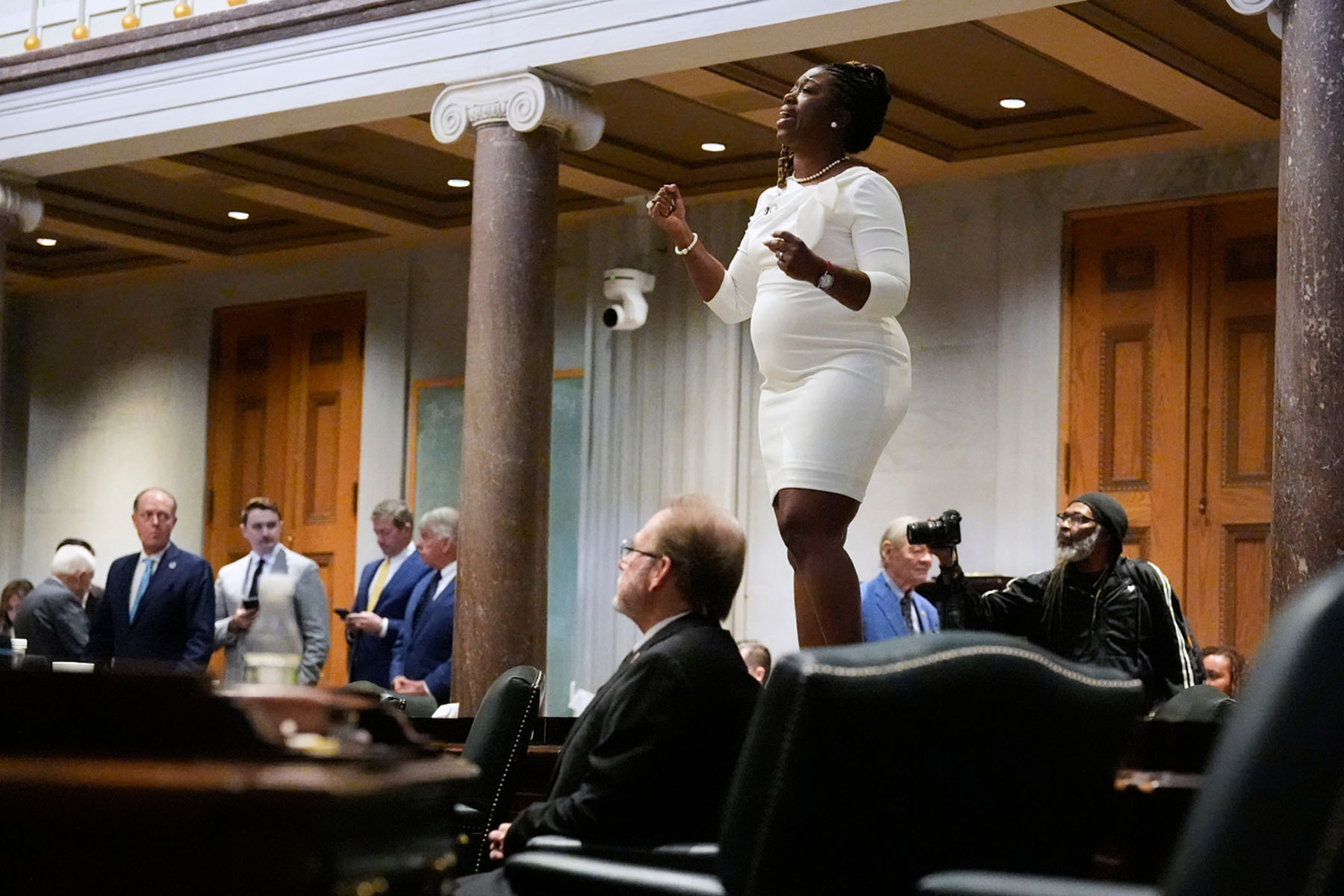

As the Tennessee legislature held a special session this week to redraw its congressional map to break up a majority-Black district in Memphis, state Sen. Charlane Oliver did everything she could to broadcast that what was happening was not normal.
The longtime voting rights advocate disrupted proceedings. She forced votes on routine matters. She told her colleagues about her great-great-uncle Elijah Bryant, who fought for the Union in the U.S. Civil War. She shared a photo of her grandfather, who served in the Navy during World War II. She said he was a member of its “last Negro infantry.”
But nothing she did seemed to reach the Republican lawmakers pushing to redraw the state’s map at President Donald Trump’s urging after a Supreme Court ruling last week that completed its gutting of the Voting Rights Act of 1965. Some avoided her in the hallways; others called her disrespectful.
So, in the final moments before the Republican-controlled legislature approved a map on Thursday that aimed to eliminate the last Democrat-held U.S. House seat in Tennessee, Oliver climbed onto her desk in the chamber and unfurled a white sheet. It had “Jim Crow 2.0” and “Stop the TN Steal” spray-painted in black.
Dressed in suffragist white, she began to sing:
Sing a song full of the faith that the dark past has taught us,
Sing a song full of the hope that the present has brought us.
Facing the rising sun of our new day begun,
Let us march on ‘til victory is won …
“Lift Every Voice and Sing” is a hymn written by NAACP leader James Weldon in 1900 to honor President Abraham Lincoln’s birthday. The civil rights organization then adopted it as the “Black National Anthem,” and it rose to prominence during the civil rights movement in the 1960s as Black Americans fought for the right to vote in the Jim Crow era.
“The words in the Black National Anthem pierce right to this moment because we have not stopped fighting, we have not stopped journeying towards freedom since we came across the ocean. I needed to signify the magnitude of the moment with that song,” Oliver told The 19th in an interview on Friday.
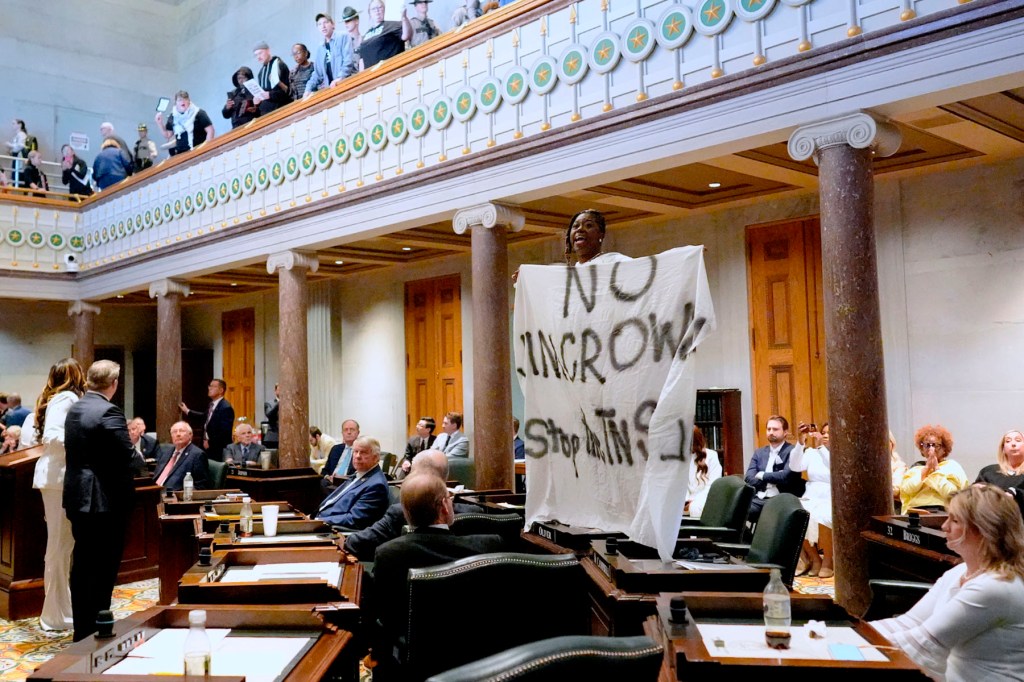
State Senate Speaker Randy McNally tried to silence her by cutting her microphone. State Senate Chief Clerk Russell Humphrey tore the banner from her hands. Both are White Republican men. McNally issued a statement that called Oliver’s conduct “disgraceful” and said that she “disrespected her colleagues, her constituents and this state.”
“What was disrespectful was the special session,” Oliver said.
McNally blocked Oliver from casting her vote against the map.
The map passed 25-to-5, with all remaining Democrats in opposition. An estimated 1.4 million Tennesseans were drawn into a new district. There are only about 70 days until early voting begins in the state; absentee ballots are already in the mail.
Oliver noted that the state had a 1972 law on the books that prohibited mid-decade redistricting between censuses. The GOP supermajority in the legislature and Republican Gov. Bill Lee reversed that law this week so they could push through the map, cracking the state’s only Democratic congressional district.
“They made a mockery of our legislature,” Oliver said. “People didn’t send us here to draw racist maps. They sent us here to figure out how to fix the roads, and get out of traffic, and lower our grocery prices, and figure out why our job growth is zero.”
“The process was disrespectful, let’s call out the real culprits,” she added.
Tennessee is one of a handful of southern states pushing to redraw their congressional maps after the Supreme Court’s ruling in Louisiana v. Callais. It took just a day for U.S. House Speaker Mike Johnson, a Republican from Louisiana, to urge such a push. His state halted its midterm primary elections with voting already underway. In Alabama, a special legislative session to redraw its maps was disrupted by protests.
When Mississippi lawmakers convene later this month to redraw maps, it will be in the same building where the state voted in 1861 to secede from the Union rather than stop enslaving Black Americans. (The current legislative building is undergoing renovations.)
Matia Powell, with the nonprofit organizing group CivicTN, noted in a call with reporters on Friday that the city of Memphis, which is in the district that was redrawn, is one of the largest majority-Black cities in the country and home to some 400,000 Black people. It is “now cracked into three separate districts,” she said.
“It wasn’t drawn to be a Black district. It was because Memphis is a Black population,” Powell added.
Before the Supreme Court’s Callais ruling, maps could have the specific aim of giving voters of color a better chance to elect their preferred representatives. Voters could also challenge maps that had the impact of diluting their voting power, even if it was unintentional. After the ruling, maps drawn based on race are prohibited. Voters will have to prove that maps were drawn based on race to intentionally disenfranchise them, something that voting-rights experts predict will be an impossibly high bar to clear in courts. They also say that those in elected office who could be hardest hit are Black women, who have made historic gains since a key provision of the Voting Rights Act was updated in the 1980s.
Anneshia Hardy, the executive director of Alabama Values, said on the same call that the Callais decision “does not just threaten the future of representation. It potentially destabilizes the gains that we have already fought for and secured.”
Oliver believes that now that the Tennessee legislature has redrawn congressional districts, state legislative districts will be next. She represents Tennessee’s 19th Senate District, the only one in the Nashville area that is majority Black — and one that was drawn with that intention after the passage of the Voting Rights Act. In the decades since, it became a stronghold of Black political power in the state.
Tennessee was also the last state to ratify the 19th Amendment to the U.S. Constitution, which extended voting rights to women, though women of color remained functionally disenfranchised for several more decades.
“This has historic significance, so they’ll try to draw me out,” she said.


