
The Supreme Court has kept a key abortion drug available for now. Still, Democrats will highlight the consequences of abortion bans as a midterms campaign theme, elevating what could be another weakness for Republicans, who are already underwater on a host of other issues, including cost-of-living concerns, skyrocketing healthcare costs and the ongoing war in Iran.
The high court on Thursday blocked a decision from the U.S. Court of Appeals for the 5th Circuit that would have prevented healthcare providers from mailing mifepristone, one of two drugs used in most abortions. The court’s decision — which sparked livid dissents from its two most conservative members and fierce criticism from abortion opponents — will stay in effect while a challenge filed by the state of Louisiana makes its way through the courts.
Democrats haven’t yet spent much time talking about abortion on the campaign trail. But lawmakers and candidates have made their stances clear: Ahead of this week’s decision, every Democrat in Congress filed an amicus brief to the Supreme Court arguing that access to mifepristone should remain unchanged. On Thursday, every Democratic U.S. senator signed onto a non-binding resolution endorsing the safety and efficacy of the medication. Most Republicans in Congress filed their own brief pushing for new national restrictions on mifepristone.
Sen. Bill Cassidy, a Louisiana Republican facing a primary challenger backed by President Donald Trump on Saturday, led congressional Republicans’ amicus brief.
“I will always defend life and will continue to support Louisiana’s case as it progresses,” Cassidy said in a Thursday statement. “Despite this outcome, FDA can and must immediately reinstate the in-person dispensing requirement to protect mothers from abuse and coercion.”
With Trump’s approval ratings plummeting, Democrats are hoping to gain control of the House of Representatives, where Republicans currently hold a three-seat majority, and possibly find a path to winning the U.S. Senate, which would require gaining four seats. Reproductive rights groups are already working to launch a new midterm push, tying abortion to individual Republicans seeking election.
“It’s not probably what Republican candidates want to be talking about in really close elections, — that’s for sure,” said Ashley Kirzinger, a pollster at KFF, a nonpartisan health policy research, polling and journalism organization. “This is not where they’re going to be seen as the party voters trust.”
Even without a ruling restricting abortion rights, Democrats — particularly those in tight races — are likely to highlight the consequences of bans as the midterm elections pick up steam, said Molly Murphy, a pollster at Impact Research, a Democrat-aligned firm.
But the messaging won’t be as prominent as it was two years ago, when abortion became a marquee issue for Vice President Kamala Harris, then the Democratic nominee for president.
“I think we’ll hear it in campaign advertising,” Murphy said. “I don’t know that it will be headline in these races as the defining issue between these candidates, but I do think it’s, in this environment, a powerful proof point when Democrats are making the case about a larger loss of rights, a larger loss of agency.”
Public opinion research suggests that voters are particularly concerned about the economy, with polls finding large shares voicing concerns about inflation, the cost of healthcare and gas prices, which have shot up since Trump launched the conflict in Iran. Recent polling from KFF suggests that Democrats have an advantage for voters worried about healthcare prices.
The substance of possible mifepristone restrictions and the court’s role in enforcing or blocking them can be too technical for many voters to link to specific candidates, Murphy said. But Democrats are fitting abortion rights more broadly into their larger campaign messages.
“Because [restrictions] didn’t take effect, the argument is that it is threatened, and that is important to raise for people,” she said. Murphy pointed to gubernatorial elections last fall in Virginia and New Jersey, races where Democratic candidates highlighted their support for abortion rights protections among other issues.
Already, some Democrats had made abortion a focus of their election campaigns — notably in state Supreme Court races and some primaries.
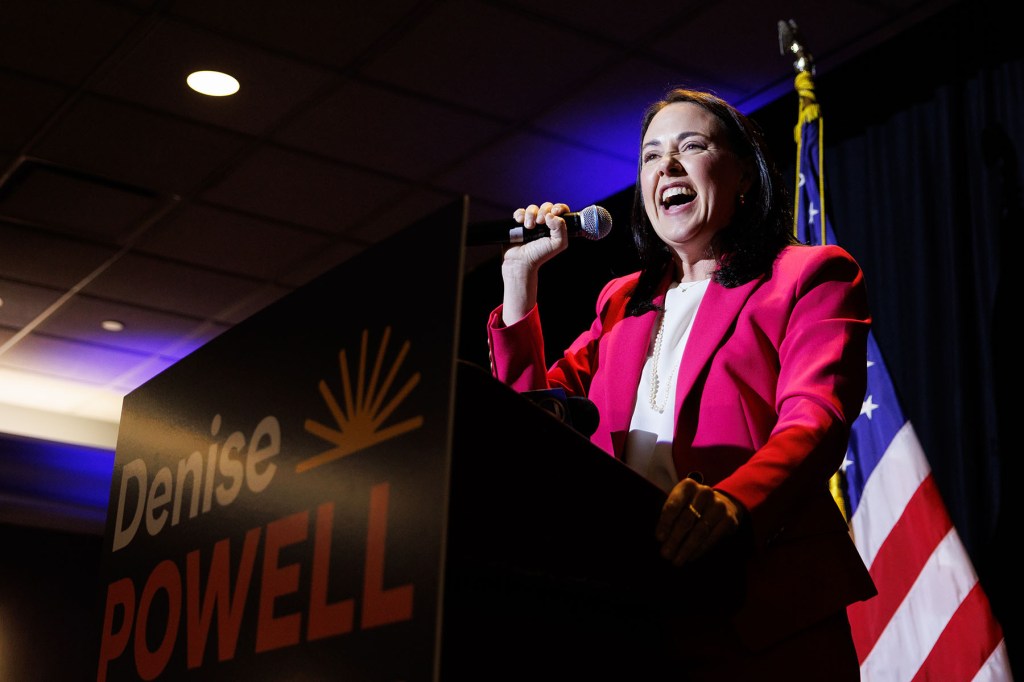
On Tuesday, Democrat Denise Powell won a contested primary for Nebraska’s 2nd Congressional District after she and several outside groups supporting her made abortion a central issue in the race; the Omaha-based seat is set to be one of the most competitive in the nation in November.
One factor remains key, Kirzinger said: Candidates need to feel comfortable talking about abortion.
“It has to be a unique environment with a competitive race,” she said. “And you need candidates willing and able and comfortable talking about abortion access in a way that feels authentic.”
Take Maine, where Republican Sen. Susan Collins is expected to face a challenge from Democratic businessman Graham Platner. Lisa Margulies, a spokesperson for Planned Parenthood’s local political arm, called Collins a “rubber stamp” for anti-abortion policies, pointing to her votes to confirm Supreme Court justices and federal judges who have supported abortion restrictions, including in the Louisiana appeals court that supported limitations on mifepristone.
“Susan Collins is a threat to abortion access in Maine and across the country,” Margulies said.
Before the mifepristone ruling, Platner’s campaign manager, Ben Chin, said he expected abortion to be “absolutely huge” and a vulnerability for Collins following her vote to confirm Justice Brett Kavanaugh in 2018, one of the justices who voted to overturn the Roe v. Wade decision, which guaranteed federal abortion rights, in 2022. Collins was last up for election in 2020, two years before that decision.
“This is the first time that the material facts on the ground have changed that Collins has been up for reelection, and we do expect that to be a major reckoning for her,” Chin said on an April 30 call with reporters.
But Platner has spent little time talking about abortion since May 4, when the Supreme Court took up the mifepristone case. A one-minute ad released that week referenced the overturn of Roe v. Wade about halfway through. Platner does not appear to have put out any statements specifically addressing medication abortion or the case before the Supreme Court. Data from the Society for Family Planning shows that almost a third of Mainers in 2024 who got abortions did so through telehealth.
Democratic Sen. Jon Ossoff, who signed onto congressional Democrats’ amicus brief and is running for reelection in Georgia, has not put out any public statements on abortion since May 4, but has talked about the issue in a broader context, highlighting a pattern of restrictions on reproductive healthcare.
His campaign directed The 19th to a speech he made in March that referenced women “bleeding out in Georgia labor wards because they didn’t get prenatal care” and the state’s six-week abortion ban. In Georgia, at least two women have died because of medical complications after they could not receive abortions. Ossoff attended a vigil this past August in honor of those women.

When asked about the role of the mifepristone case in the upcoming election, a spokesperson for former North Carolina Gov. Roy Cooper, a Democrat running in another closely watched Senate race, highlighted Cooper’s veto of an abortion ban as governor. Cooper’s most recent statement about abortion, from January, highlighted his work as governor to protect a “constitutional right to reproductive healthcare.”
Some Democratic women lawmakers said the legal seesawing over mifepristone and other efforts by the Trump administration to undercut reproductive healthcare, like cuts to Planned Parenthood and Title X family planning funds, underscores access to healthcare as a top election issue.
“This isn’t just about abortion, now this is about contraception as well,” said Rep. Pramila Jayapal, also of Washington, a prominent progressive voice who is widely expected to win reelection this fall. “We can see exactly what it is they’re trying to do. And Republican voters care about this. Democratic voters care about it. Independent voters care about it. So, yeah, I do think it’s going to be an issue.”
Rep. Angie Craig, who is running for Senate in Minnesota, and a few women Democrats in competitive House races, including Lauren Babb Tomlinson, a regional Planned Parenthood leader running for Congress in California; Lindsay James, who is running in Iowa; and Shannon Bird, running in Colorado, have posted on social media about the case, with some calling on Congress to codify Roe v. Wade.
None of the speakers at a May 6 fundraising gala for Emily’s List, an organization that backs Democratic women supportive of abortion rights, mentioned medication abortion or the mifepristone lawsuit that was then before the Supreme Court. Rep. Sharice Davids of Kansas, who voted to protect abortion access in 2022, did reference what she said were nationwide attacks on the procedure. Davids announced five days later her plan to run for reelection.
“I don’t have rose colored glasses on. I’m not Pollyanna about this,” she said. “These extreme politicians have not stopped. They haven’t stopped in Kansas, and they’re not stopping across the country. So we all know that we can’t afford to sit back.”