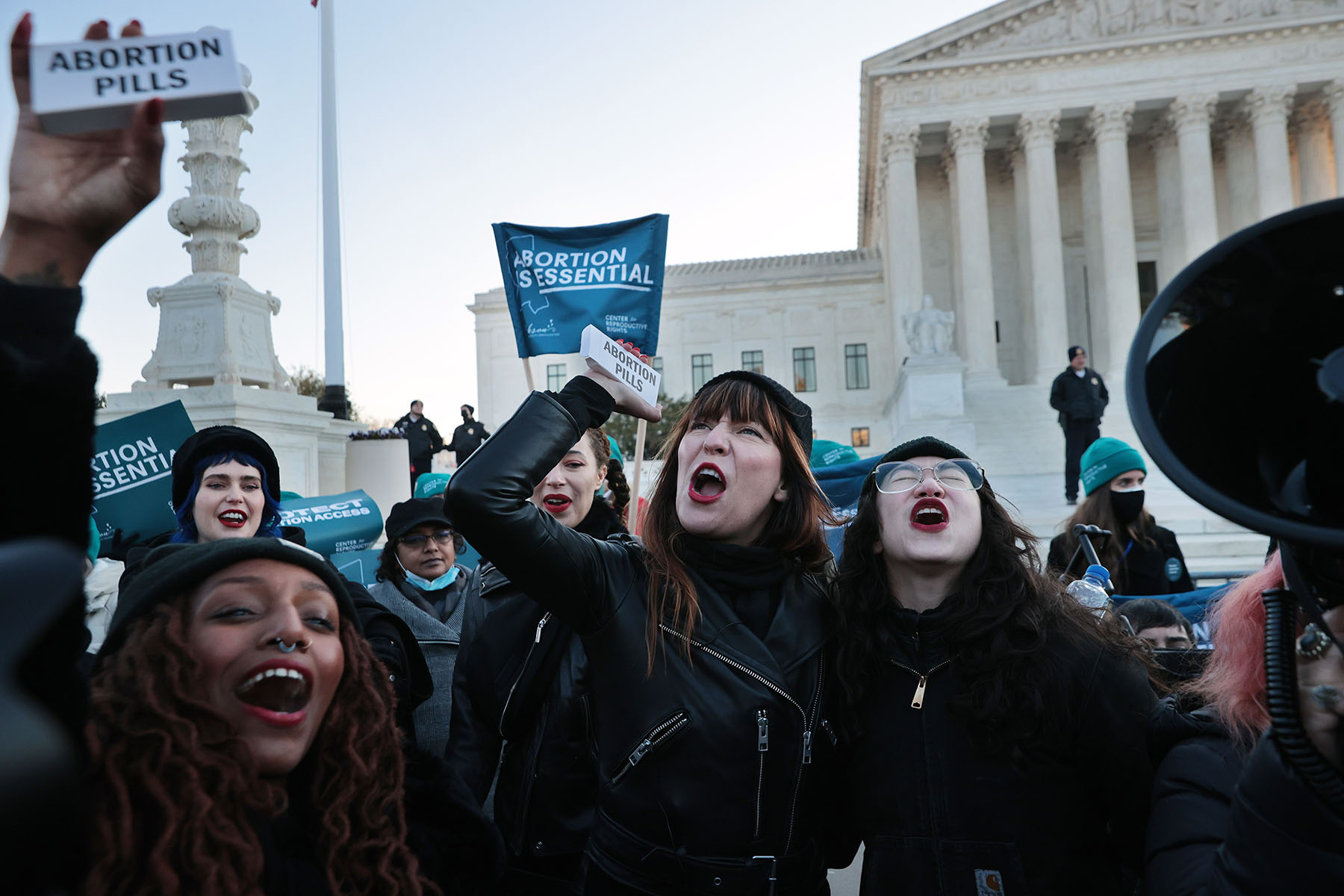

Abortion pill access by mail will continue uninterrupted as a key drug’s approval for use ricochets through the nation’s highest courts.
On May 4, the U.S. Supreme Court temporarily halted an appeals court’s decision that would have barred prescribing mifepristone — one of two drugs used in most medication abortions — through telehealth, despite medical research supporting the Food and Drug Administration’s 2023 decision to allow virtual care.
The Supreme Court’s decision extends until 5 p.m. ET May 11, and is meant to give the high court time to weigh in on a contentious issue that was last before the court only two years ago.
The case could substantially reshape the availability of abortion, less than four years after the overturn of Roe v. Wade. That decision, which allowed states to ban abortion, ultimately fueled the emergence of telehealth-focused practices. Medical providers practicing in states with specific abortion protections prescribe and mail two abortion medications — mifepristone and misoprostol — to people seeking care in states with bans. Even in states without abortion restrictions, patients are increasingly turning to telehealth, which can be more convenient than going to a clinic.
Data from the Society of Family Planning suggests that as many as 1 in 4 abortions are now done through telehealth. About half of those are for people in states with abortion bans or heavy restrictions.
Here is the latest on what you need to know about mifepristone’s availability and what to expect next.
Are telehealth abortions available?
Yes. The Supreme Court’s intervention means medical providers can continue offering mifepristone through telehealth, and they intend to do so.
But even before the high court intervened, abortion providers across the country had made contingency plans that would allow them to continue offering telehealth abortions without mifepristone: prescribing and mailing higher doses of misoprostol, the other drug often involved in abortion.
The misoprostol-only regimen is largely safe and effective in terminating pregnancies and is used in countries where mifepristone is not available because of cost or legal barriers. But it is less effective than taking both drugs.
Research published in 2023 found that misoprostol alone ended pregnancies 88 percent of the time. Mifepristone and misoprostol together successfully resulted in abortion between 95 and 99 percent of the time. Misoprostol alone can also have more intense side effects than mifepristone and misoprostol, including increased bleeding that can lead more patients to seek emergency room follow-up care.
The National Abortion Federation, a professional association of abortion providers, encouraged members to offer misoprostol-only abortions for patients seeking telehealth if mifepristone was not available.
Multiple Planned Parenthood affiliates confirmed that they are prepared to offer misoprostol-only abortions for telehealth patients while continuing to offer the combination regimen to in-person patients.
The Massachusetts Medication Abortion Project, a telehealth practice that relies on state-specific protections known as shield laws to offer medication abortions by mail to people living in states with bans, has also planned to shift to just misoprostol if medical providers could not legally mail mifepristone to patients.
Why is mifepristone being targeted?
Mifepristone has been approved in the United States since 2000, and its safety and efficacy is supported by decades of rigorous research. In 2021, the FDA began allowing medical providers to offer the drug through telehealth, citing the COVID-19 pandemic. In 2023, the FDA officially approved mifepristone for telehealth distribution.
But telehealth’s increasing prevalence — particularly in states with abortion bans — has made it a top target for abortion opponents, who point out that virtual care is a key reason why abortions have increased since Roe v. Wade’s fall.
Under the Trump administration, the FDA has agreed to review mifepristone’s approval. But abortion opponents have argued the administration is slow-walking that process, pressing for quick action and producing papers that question the drug’s safety. Mainstream scientists have criticized those papers, with some calling them “junk.”
As of May 4, President Donald Trump has not weighed in on the case now before the Supreme Court. In hearings thus far, the FDA has said that Louisiana does not have legal standing to challenge the federal approval of mifepristone but has not weighed in explicitly on Louisiana’s arguments challenging drug’s safety.
Louisiana has also argued that a long-dormant anti-obscenity law called the Comstock Act outlaws the mailing of all drugs used to induce abortions — an argument that would cut off access to mifepristone and misoprostol. The appeals court did not consider that argument when blocking telehealth; it’s not clear if the Supreme Court will. In hearings so far, the Trump administration also has not responded to Louisiana’s arguments about the Comstock Act.
Hasn’t this happened before?
The case now before the Supreme Court is only the latest effort to use the legal system to restrict mifepristone. This case was brought by Louisiana in October, but in 2023, a coalition of anti-abortion doctors initiated a similar legal challenge in Texas. In that case, the Supreme Court ultimately found that those doctors had not experienced direct legal harm and did not have standing to challenge the FDA.
It’s unclear if the court will rule similarly now. While the previous case was spearheaded by healthcare providers, this case was brought by Louisiana Attorney General Liz Murrill on behalf of a woman who says she was forced against her will to take abortion medications acquired through telehealth. That has become a key talking point for abortion opponents, and now, multiple cases challenging telehealth abortions include allegations that a woman was forced to terminate her pregnancy with pills acquired in the mail. In fact, research shows that most people who experience coercion with abortions are actually forced to keep their pregnancies.
Meanwhile, states with anti-abortion leaders are lining up other efforts to challenge mifepristone, including in Texas, where a state law has enabled massive civil lawsuits against anyone who helps people in the state get abortion pills by mail. Abortion opponents are testing that law’s effectiveness with civil suits pending in federal court.
The timing of this particular case could thrust abortion policy back into the political spotlight in an election year. Polling shows most voters support abortion protections and oppose restrictions.
What’s next?
The Supreme Court will weigh by 5 p.m. ET on May 11. It could issue a ruling through its “shadow docket,” which allows the justices to make a quicker, often-unsigned but still legally enforceable decision without hearing arguments first. That ruling could either preserve mifepristone’s availability by telehealth or allow the lower court’s decision to stand.
The Supreme Court could also agree to take up the case, scheduling oral arguments before the current term ends in June, or for its next term, which starts in the fall. If it did so, any ruling issued now would last only until the court formally heard and decided on the case.


