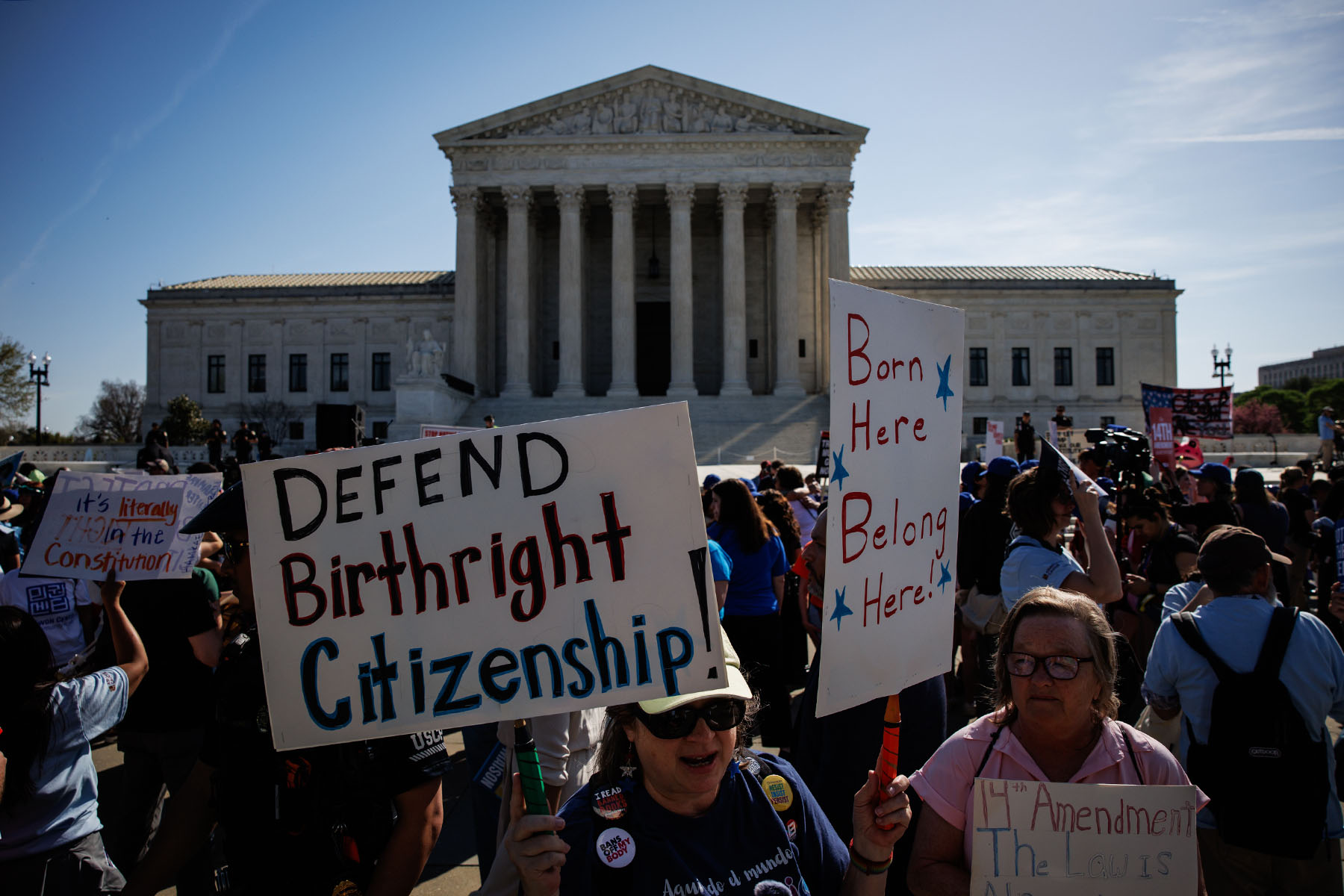

The U.S Supreme Court upheld more than 100 years of legal precedent on Tuesday that affirmed the 14th Amendment’s guarantee of birthright citizenship to children born to immigrants lacking permanent status.
The court voted 6-3 to reject the Trump administration’s reinterpretation of the citizenship clause of the 14th Amendment, which reads in part: “All persons born or naturalized in the United States, and subject to the jurisdiction thereof, are citizens of the United States and of the State wherein they reside.”
In oral arguments on April 1, the Trump administration questioned whether noncitizen or temporary status immigrants have an allegiance to the United States, and argued that citizenship should depend on families establishing a “permanent domicile and residence” in the country. In its challenge to the administration, Cecillia Wang, national legal director for the American Civil Liberties Union (ACLU), argued that establishing a permanent domicile was not the focus of the citizenship clause of the 14th Amendment.
Chief Justice John Roberts wrote for the majority, joined by all four women on the court — Justices Sonia Sotomayor, Elena Kagan, Amy Coney Barrett and Ketanji Brown Jackson. The majority rejected the administration’s argument, writing that there is “scant evidence for this dramatically revisionist view.”
“Citizenship, then and now, was the right to have rights— to freely participate in our political community. The Framers of the Fourteenth Amendment extended that promise to ‘every free-born person in this land,’” Roberts wrote. “We keep that promise today.”
The majority also repeatedly referred to the precedent set by the landmark 1898 Supreme Court case, U.S. v. Wong Kim Ark, which ruled in favor of a man born in California to Chinese parents. In the 128 years since, the court has repeatedly “understood the rule of Wong Kim Ark to guarantee citizenship to all children born in the United States and subject to its power,” the majority wrote.
Justices Clarence Thomas and Samuel Alito each authored dissenting opinions. Alito warned that the court majority has made “a serious mistake” in “one of the most important decisions in the history of the Court,” and argued that the 14th Amendment’s citizenship clause requires allegiance only to the United States. He also wrote that the majority’s interpretation opens the door to citizenship for “virtually everyone who happens to be born in this country, including the children of ‘birth tourists,’ women who come here solely for the purpose of giving birth to a child and then promptly return home.” The nonpartisan Migration Policy Institute has described birth tourism as a “rare practice.”
For 158 years, birthright citizenship has been granted to most children born in the country, except for those born to foreign diplomats, hostile military members and on foreign public vessels. Native American children were excluded from birthright citizenship until the Indian Citizenship Act of 1924 established that right.
Thirty years after the ratification of the 14th Amendment, the Supreme Court extended birthright citizenship to the children of immigrant parents with it’s ruling in the Wong Kim Ark case.
Through the decades, birthright citizenship has been considered by many scholars, immigrant rights advocates and everyday Americans to be one of the nation’s foundational promises. But on the first day of Donald Trump’s second term, he signed an executive order challenging these protections for children born to parents without citizenship or permanent legal status. In response, the ACLU and other organizations filed a class-action lawsuit on behalf of a group of parents and children who would be affected by Trump’s order.
“It’s pretty hard to overstate the turmoil that it placed expecting parents in,” said Grace Choi, an attorney with the ACLU who worked on the birthright case. “Pregnancy and expecting a child is supposed to be a happy, joyous time. Instead, because of the order — and because of all of Trump’s policies for folks who are immigrants, non-citizens — it was just absolute chaos.”
Choi recalled one client who was about seven months pregnant and trying to figure out if she needed to move to another state to give birth and asking her doctor if inducing labor was an option in order to meet the deadline set by Trump’s executive order. An estimated 250,000 babies are born on U.S. soil to immigrant parents without authorization each year. Narrowing the scope of birthright citizenship would have threatened to expand the number of people living in the country without authorization for generations. According to projections published by the Migration Policy Institute and Penn State, an additional 2.7 million people would be unauthorized by 2045, and 5.4 million additional people by 2075.
The Supreme Court opinion upholding birthright citizenship, Choi noted, reflected her team’s focus on precedent and the intent of the law in its argument.
“One of the clients mentioned that the news just gave her goosebumps,” Choi added.
“She said really poignantly that this Fourth of July will feel even more special as a result of this decision.”


