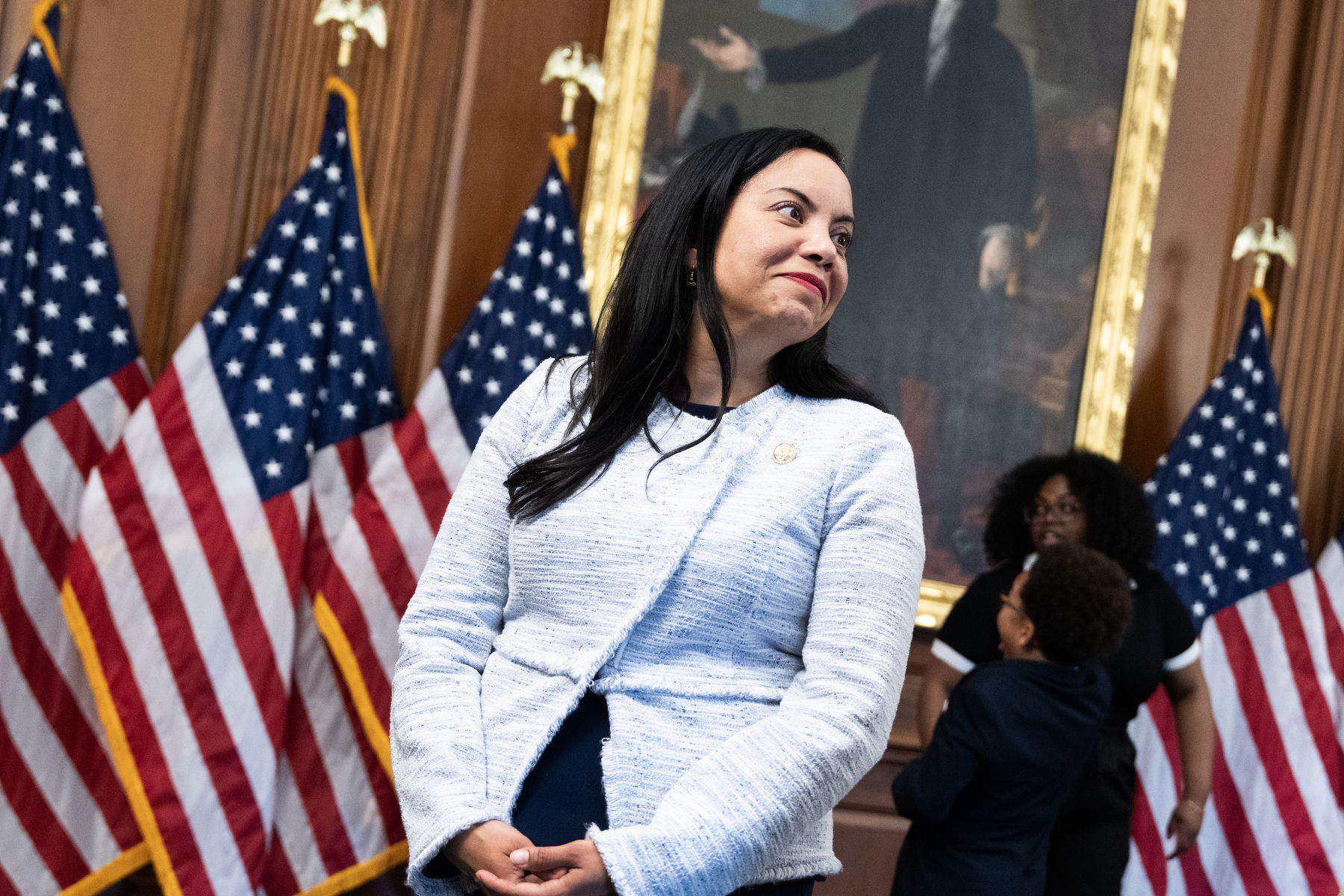

Rep. Analilia Mejia knew when she joined Congress in April that she wanted to use her post to highlight what she believes is an existential threat to everyday freedoms: attempts to erode and redefine the 14th Amendment.
Before winning her New Jersey special election, Mejia had authored articles about how the Reconstruction-era amendment underpins everything from the right to vote to birthright citizenship. She campaigned on protecting it as a way to safeguard reproductive rights and bar insurrectionists from holding elected office. In her first House floor speech, immediately after being sworn in, Mejia noted that the 14th Amendment was “designed to protect the civil and political rights of individuals” and its ratification after the Civil War was achieved through “blood, sweat and tears.”
On Thursday, the 158th anniversary of the ratification of the 14th Amendment, House Democrats are launching a task force to help Americans connect the dots between the 14th Amendment and Republican efforts to limit birthright citizenship, curtail reproductive rights and make it more difficult for some voters to cast ballots.
“I approached leadership with this idea that this administration has an open campaign, has a sustained campaign, to weaken and undermine the rights and freedoms of everyday Americans,” Mejia, a task force co-chair, told The 19th in an exclusive interview. “So what can we do, in this moment, that will deepen the American people’s understanding of why this is important, so that we can counter this campaign with an informed populace?”
Mejia said the task force will convene constitutional and civil rights experts and create educational materials to make it easier for community leaders, state-level elected officials and rank-and-file voters to “better understand the rights that are afforded to us, how they’re under attack, and what we can do to hold the line for generations to come.”
The Democrats will use the task force to coordinate legislation, oversight and public education as they respond to Trump administration attempts to weaken the 14th Amendment’s protections. They are considering activities like field hearings and the creation of know-your-rights materials.
“There are far too few Americans who truly understand what is at stake,” Mejia said. “You cannot have American democracy without equality, and you cannot have equality under the law without adhering to and upholding the 14th Amendment.”
Mejia’s fellow task force co-chairs are Reps. Emanuel Cleaver of Missouri, Emily Randall of Washington, Lateefah Simon of California and Suhas Subramanyam of Virginia.
The 14th Amendment is the second in a trio of updates to the U.S. Constitution ratified in the years after the Civil War. The 13th Amendment officially abolished slavery. The 14th Amendment established birthright citizenship; prohibited state and local governments from depriving any individual of life, liberty or property without due process; and mandated that all individuals have equal protection under the law. The 15th Amendment established that the government cannot deny a citizen the right to vote based on their race or ethnicity.
The 14th Amendment’s due process clause, long interpreted as establishing a right to privacy as a form of liberty, underpinned the constitutional right to abortion for nearly 50 years until the Supreme Court overturned Roe v. Wade in 2022.
In April, the Supreme Court’s conservative majority finished gutting the 1965 Voting Rights Act by finding that the creation of a second majority-Black district in Louisiana violated the 14th Amendment’s equal protection clause — a constitutional interpretation called “peculiar” by Kareem Crayton of the Brennan Center for Justice, a civil rights organization. Then, in a 6-3 decision last month, the court found that state bans on trans athletes competing on women’s and girls’ sports teams did not violate the same clause, which has historically been used to protect the rights of LGBTQ+ people.
One of the first moves made by President Donald Trump after his reelection was to sign an executive order limiting birthright citizenship, which requires redefining the 14th Amendment. When the Supreme Court rejected Trump’s attempt to limit birthright citizenship in another 6-3 decision last month, much of the civil rights community was shocked by how narrowly the case was decided, given the 14th Amendment’s longstanding precedent.
“I was disturbed about how close it was,” Mejia said.
Mejia is the first Afro-Latina to serve in Congress. Her parents emigrated from Colombia and the Dominican Republic. She said they instilled in her and her sister a “deep love for democracy,” and her push to educate the populace about the 14th Amendment is a personal one.
“If it wasn’t for birthright citizenship, I wouldn’t be a citizen. My mother wasn’t a citizen when I was born — birthright citizenship is near and dear to my heart, as it is to many, many Americans whose parents immigrated,” Mejia said.
“I love the fact that in the United States we all are born free, but that can be undermined if we do not uphold the protections that were hard-fought and well-deserved that are contained within, again, the 14th Amendment,” she added.


