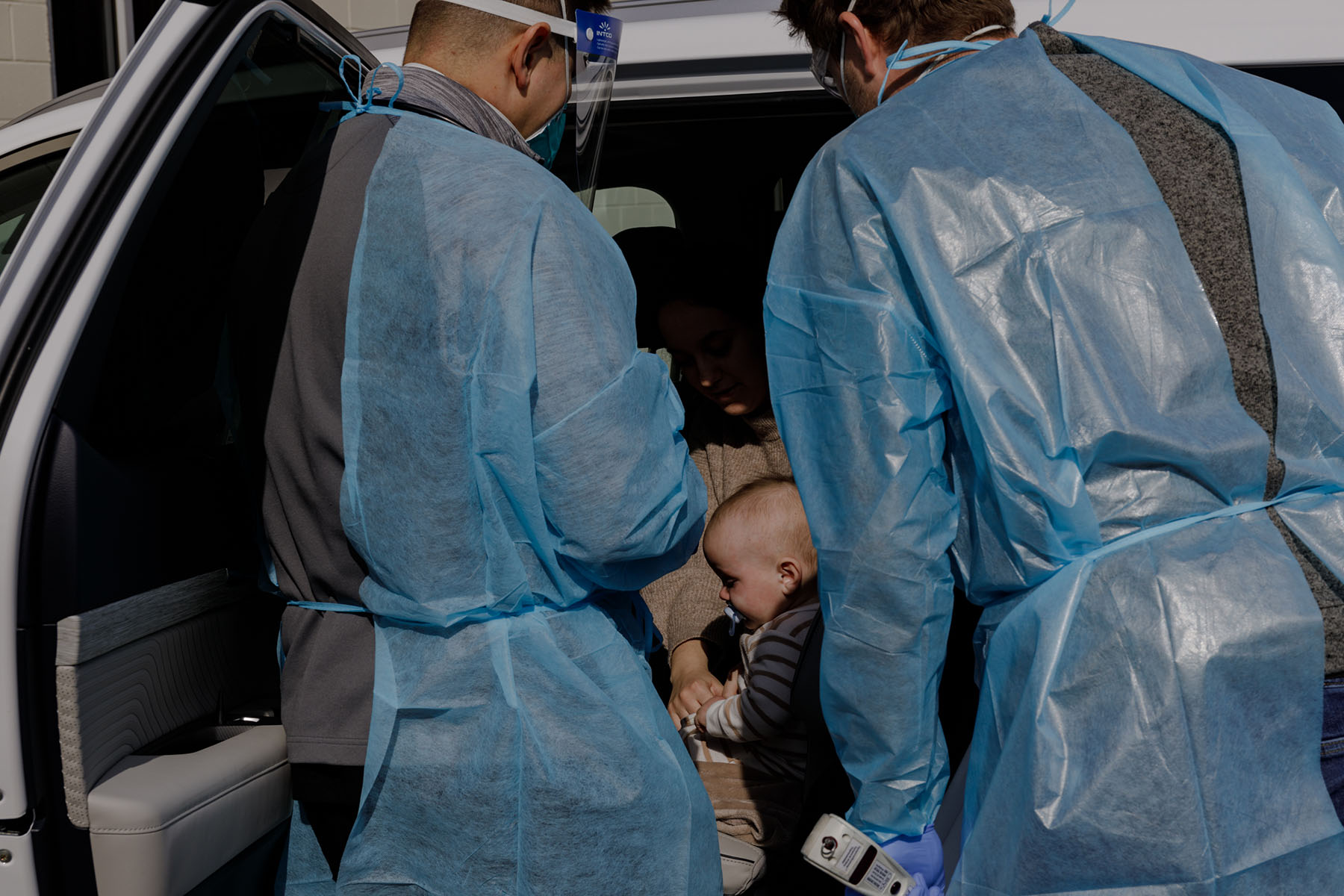

The number of measles cases reported in the United States so far this year has surpassed the total recorded in all of 2025, a mid-year milestone that shows the difficulty of containing the highly contagious disease amid increasing vaccine hesitancy and misinformation.
Johns Hopkins University released data that shows 2,295 cases have been reported as of Tuesday. There were 2,288 cases confirmed in 2025.
The current epicenter is in Utah, where more than 500 cases have been reported and officials are still tracking new ones. An outbreak in South Carolina that started in 2025 and totaled nearly 1,000 cases ended a few months ago.
Dr. Paul Offit, director of the Vaccine Education Center at the Children’s Hospital of Philadelphia, said the official tally just accounts for confirmed cases of measles — some people with measles never seek formal care or report their symptoms.
“Those are just the cases that were confirmed,” he said. “It could be two or three times that actual number.”
The bulk of measles cases across the United States this year are among young people under 20 years old. Since January 2025, 18 percent of measles cases have been among children under 5 years old and 47 percent have been among children 5-17. More than 90 percent of all cases are among people who either did not receive the measles-mumps-rubella (MMR) vaccine or whose vaccination status is unknown.
A measles vaccine became available to the general public in the early 1960s. After it became a two-dose series in the early 1990s, reported cases of measles in the United States plummeted.
“Vaccines are a victim of their own success. We not only eliminated the disease, we eliminated the memory of this virus, and that’s where we’re suffering,” said Offit.
Young children are among the most vulnerable to measles since the first MMR shot is not typically administered until a child turns 1. The second shot in the series is usually given between ages 4 and 6, though some parents have opted to give the shot sooner.
The data on unvaccinated people reflects a nationwide trend that began amid the pandemic: Routine vaccination rates for U.S. kindergarten children continue to decline. New polling from KFF, a nonpartisan health policy research and news organization, shows people without a trusted healthcare provider are more likely to endorse vaccine myths. That also holds true for people who often use social media or artificial intelligence-based chatbots for health information.
Gallup polling shows one in four Americans use AI tools to gather health information, and an estimated 14 million use it to replace a doctor’s visit because of cost or other barriers to care access.
Other KFF polling also shows that some myths about vaccines — including the false claim that the MMR vaccine causes autism — are not believed across the board. Only a minority of respondents (1 percent) believed four common vaccine myths were true, while 29 percent said all those myths were false. Three in 10 adults were in a mixed middle of certainty on vaccine myths — a sign that robust health communication strategy could help.
As cases surge — last year’s measles total was the most cases in 30 years — Offit worries about long-term effects like brain swelling that can emerge years after a measles infection.
“The child recovers from measles, but the virus is continuing to reproduce itself in the brain. So that five years later, seven years later, the child comes back in with a deterioration in handwriting skills, deterioration in personality, and ultimately descends into a vegetative state from which there is no escape and death is invariable. I mean, look at those cases. When you see that, it’s heartbreaking, and there’s nothing you can do about it other than having not gotten measles infection in the first place.”
This measles milestone also comes during a shift in public messaging from the federal government on vaccines, including around routine childhood vaccines. Health and Human Services Secretary Robert F. Kennedy Jr., a longtime anti-vaccine activist, has tried to revamp the recommended vaccines for children. A judge has placed those recommendation changes on hold amid a lawsuit filed by the American Academy of Pediatrics and other groups.
In a statement, Kayla Hancock, director of the Public Health Project at the nonprofit Protect Our Care, blamed Kennedy for using “every bureaucratic tool at his disposal to stoke anti-vax skepticism without proof,” allowing for measles to “roar back after decades of dormancy, with other preventable diseases right behind it.”
Hancock added that Kennedy “has made virtually no effort on behalf of the federal government to combat the growing measles crisis, leaving states and doctors to scramble for resources and guidance.”
Emily G. Hilliard, senior press secretary for HHS, said in an email that Kennedy “has been clear” that vaccination is most effective at preventing measles. She also said the department under Kennedy has mounted “an aggressive outbreak response” by giving funding to states and local partners, offering more technical assistance and providing additional Centers for Disease Control and Prevention personnel and resources.
“HHS focused its response where it can have the greatest impact: rapidly supporting affected communities, strengthening state and local response efforts, and communicating the ways in which measles transmission can be slowed, including through MMR vaccination, and ways that measles can be treated,” she said.
Earlier this year, Kennedy defended his agency’s handling of measles cases in response to a series of questions by Democrats on the House Ways and Means Committee. “We’ve done better at preventing measles than any other country,” he told lawmakers, noting that measles cases are surging globally.
Still, the scope of measles spread in the United States — there were just 285 total cases in 2024 — has public health officials predicting that the country will lose its coveted measles elimination status, earned in 2000, which indicates no continuous transmission of the disease for 12 months or more. An international health body has pushed its formal review of the country’s status from April to November.
“Whether we lose it or not is irrelevant,” Offit said. “We’ve lost it. Measles is circulating in this country.”