
Skip to content Site Search

Republish This Story

* Please read before republishing *

We’re happy to make this story available to republish for free under an Attribution-NonCommercial-NoDerivatives Creative Commons license as long as you follow our republishing guidelines, which require that you credit The 19th and retain our pixel. See our full guidelines for more information.

To republish, simply copy the HTML at right, which includes our tracking pixel, all paragraph styles and hyperlinks, the author byline and credit to The 19th. Have questions? Please email partnerships@19thnews.org.

— The Editors

Loading...

Modal Gallery

/
Sign up for our newsletter

Menu

Home

We’re an independent, nonprofit newsroom reporting on gender, politics, policy and power. Read our story.

Topics

  • Politics
  • LGBTQ+
  • Health
  • Justice
  • Caregiving
  • Education
  • Abortion
View all topics

Daily Newsletter

A smart, relatable digest of our latest stories and top news affecting women and LGBTQ+ people.

Look for a confirmation sent to

Did you mean

The email didn't go through.

or Contact us for support
  • Latest Stories
  • Our Mission
  • Our Team
  • Strategic Plan
  • Support the 19th
  • Search
  • Contact
Donate
Home

We’re an independent, nonprofit newsroom reporting on gender, politics, policy and power. Read our story.

Daily Newsletter

A smart, relatable digest of our latest stories and top news affecting women and LGBTQ+ people.

Look for a confirmation sent to

Did you mean

The email didn't go through.

or Contact us for support

Become a member

Multi-color socks with

Our new merch store is now live!

Represent the newsroom that represents you. Every purchase directly supports our nonprofit newsroom.

Shop Now

The 19th thanks our sponsors. Become one.

Justice

California’s new law aims to close a housing gap for domestic violence survivors

Fleeing a violent home means finding a new place to live. Cities and counties in the state are now required to plan for that.

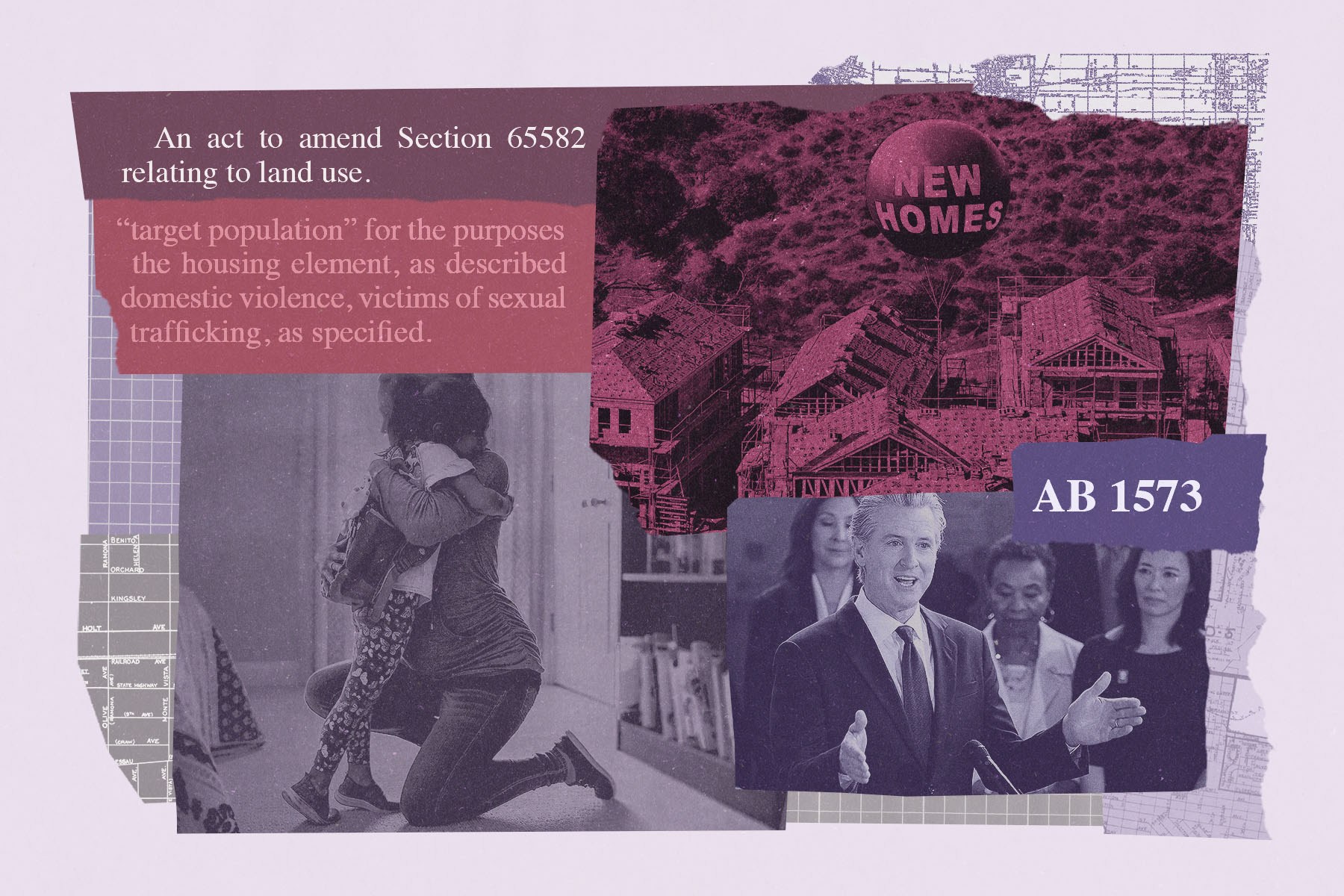
Collage illustration about California housing legislation, combining a photo of a woman embracing a child, new homes under construction, and Gavin Newsom speaking at a podium. Text excerpts from the bill appear alongside a "NEW HOMES" balloon and a label reading "AB 1573," overlaid on maps and architectural plans.
(Emily Scherer for The 19th; Getty Images)

Jasmine Mithani

Technology Reporter

Published

2026-10-01 07:00
7:00
October 1, 2026
am
America/Chicago

Share

  • Bluesky
  • Facebook
  • Reddit
  • Email

Domestic violence survivors often struggle to find housing, and California’s “Unseen and Unheard Housing Act” will help make more housing available to meet their specific needs.

California Gov. Gavin Newsom signed the bill Sunday requiring cities and counties to factor in domestic violence survivors when planning for future housing.

The state’s 540 local governments are required to submit a plan for land use every five to eight years, depending on population size. The plan analyzes and proposes ways to meet community needs around climate change, health, economics and equitable opportunities. Within that is an assessment of housing supply and demand, which is required by law to include overviews of housing for seniors, people with disabilities, farmworkers, women-led households, households with five or more members and the unhoused.

The 19th thanks our sponsors. Become one.

Now cities and counties will have to account for the needs of domestic violence survivors, too.

More from The 19th

  • Violence against women and trans people is worse than previously thought, new research finds
    Collage featuring a blurred silhouette of a couple alongside excerpts from data tables about intimate partner violence, including statistics on harassment, controlling behavior and other forms of abuse.
  • Federal funds for domestic violence services are falling short. California survivors are pushing for a fix.
  • This domestic violence shelter was told it no longer aligns with the Trump administration’s priorities

“Our hope is that this bill will significantly increase the supply of permanent housing for survivors, and will bring funding, attention, and action to address the invisible crisis of domestic violence survivors falling into homelessness when they leave their domestic violence situations,” said Jennifer Willover, housing policy analyst at the California Partnership to End Domestic Violence, which coordinates domestic violence advocacy and response across the state.

Domestic violence and housing go hand in hand. Some victims choose to stay in a home with abuse in order to keep them — or their kids — housed, while others find there is no place to go when they need to escape violence. 

Domestic violence is often a precursor to homelessness: 17 percent of unhoused cisgender women experienced intimate partner violence — most often physical — in the six months prior to homelessness, according to a 2024 report.

Among unhoused survivors of recent domestic violence, 40 percent said the abuse was a factor in leaving their prior housing. Twenty percent said it was the main reason.

According to DomesticShelters.org, at least 70 percent of California’s 165 domestic violence services organizations provide emergency housing. But those stays are typically only one to three months; longer-term support is much more difficult for survivors to find — and funding for it is drying up.

Stable housing in the months and years after fleeing abuse is hard to come by. Cost is an enormous barrier, and survivors don’t always have income or money of their own. According to the National Network to End Domestic Violence, many abusive partners exert financial control over victims, such as by forbidding them from working, refusing to put assets in their name or not allowing access to bank accounts.

The Bureau of Economic Analysis ranks California as one of the highest cost-of-living states, and rent in the most populous cities can be thousands of dollars a month. Credit checks can also make it harder to find a place to stay if an abusive partner coerced a victim into taking out loans or opened credit cards in their name.

This new law doesn’t provide any solutions, but it elevates the needs of domestic violence survivors who make up a large share of the population. Recent research from Tulane University showed 61 percent of women, 45 percent of men and 84 percent of gender-nonconforming people reported experiencing intimate partner violence across their lifetimes.


Share

  • Bluesky
  • Facebook
  • Reddit
  • Email

Recommended for you

  • A woman wearing glasses and a denim jacket smiles down at a young girl wih braided hair adorned with blue bow barrettes, alson in a matching denim jacket, as the two share a close moment together indoors.
    Keshia said it was self defense. She goes on trial for murder next week.
  • Collage featuring a blurred silhouette of a couple alongside excerpts from data tables about intimate partner violence, including statistics on harassment, controlling behavior and other forms of abuse.
    Violence against women and trans people is worse than previously thought, new research finds
  • Collage featuring the White House, the seal of the Office of Management and Budget, U.S. currency and enlarged text from federal regulations on terminating or suspending grants.
    Domestic violence groups fear survivor services could disappear without warning
  • A woman is reflected in silhouette against a window background, maintaining her visual anonymity.
    This domestic violence shelter was told it no longer aligns with the Trump administration’s priorities

Daily Newsletter

A smart, relatable digest of our latest stories and top news affecting women and LGBTQ+ people.

Look for a confirmation sent to

Did you mean

The email didn't go through.

or Contact us for support

Become a member

Explore more coverage from The 19th

  • Politics
  • LGBTQ+
  • Health
  • Justice
  • Caregiving
View all topics

Support representative journalism today.

Learn more about membership.

  • Give $19
  • Give $50
  • Give $100
  • Any amount
  • Transparency
    • About
    • Team
    • Contact
    • Privacy Policy
    • Community Guidelines
    • Gift Acceptance Policy
    • Financials
  • Newsroom
    • Latest Stories
    • Strategic Plan
    • 19th News Network
    • Events
    • Careers
    • Fellowships
  • Newsletters
    • Daily
    • The Amendment
    • Menopause
    • The Mom Guilt Economy
    • View all
  • Support
    • Ways to Give
    • Sponsorship
    • Republishing
    • Volunteer
    • Merch

The 19th is a reader-supported nonprofit news organization. Our stories are free to republish with these guidelines.