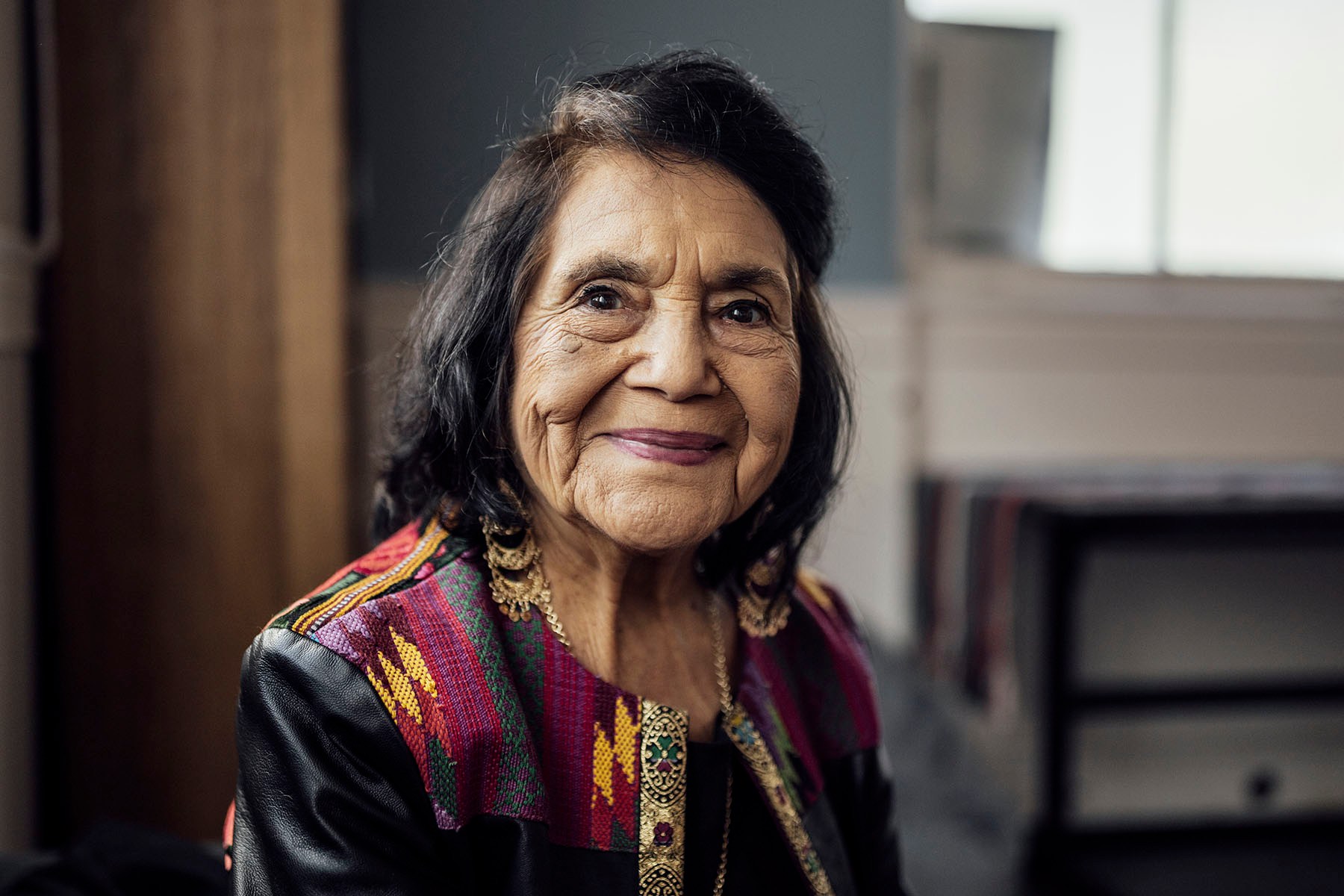

Dolores Huerta, who rose to national prominence as the co-founder of the National Farm Workers Association and was known for her advocacy for women farmworkers, died on Wednesday. She was 96.
Long recognized for her lifelong dedication to farmworkers, Huerta’s fight against injustice — and the sacrifices she made in that fight – reemerged in the wider public consciousness this year when she spoke of being sexually assaulted and raped by César Chávez, the farmworker movement’s most visible leader. Her revelation was just one more act of speaking out in a life dedicated to justice.
Huerta was born in New Mexico but spent most of her life in California’s Central Valley, an agricultural hub where a quarter of the country’s food is grown.
After graduating college, she became an elementary school teacher. A majority of her students were the children of migrant farmworkers. She left teaching when she realized that she could better use her talents to help their parents fight issues like wage theft and poor working and living conditions. She is widely quoted as saying: “I couldn’t tolerate seeing kids come to class hungry and needing shoes. I thought I could do more by organizing farmworkers than by trying to teach their hungry children.”
She left the school to work at the Community Service Organization, a Latino civil rights group. In 1955 she helped start the Stockton chapter of the organization, which is where she met Chávez, a rising Chicano leader. The two went on to create the National Farm Workers Association (NFWA).
One of the first major actions she undertook was helping organize the Delano Grape Strike in 1965, a five-year strike that was started by Filipino workers who were fighting for higher wages. About a week into the strike, NFWA joined the movement with 1,200 Mexican laborers. The two groups representing the strikers eventually merged to become the United Farm Workers (UFW), a labor union.
As part of the UFW’s work to fight for better working conditions and union contracts, Huerta went to New York to organize a national boycott against table grapes. There she met the feminist leader Gloria Steinem, who in 1968 flew out to California to march with the striking farmworkers.
While Huerta was the lead negotiator for the grape worker contracts that resulted from the organizing, her contributions and leadership during the strikes and subsequent boycotts were often overshadowed by Chávez. It was Huerta who coined the ¡Sí Se Puede! chant, which means “yes, it can be done” and came to define the farmworker movement – but the phrase has been erroneously credited to him over the years. The phrase continues to be a rallying cry of activists across the country, and more recently has been used by politicians like Rep. Alexandria Ocasio-Cortez and former President Barack Obama.
Over the years, Huerta began to focus more on the women farmworkers in the movement, and in 1974 she helped found the Coalition of Labor Union Women. She worked to raise awareness about the specific dangers they faced in the fields, including an epidemic of sexual assault. In a 2013 interview with “Frontline” she talked about how farmworker women were often subject to threats and assault in the fields and were scared to speak up due to their immigration status or threats to their employment. She worked to elevate these and other women’s issues, including access to child care, through UFW, where she served as vice-president from its founding until 1999.
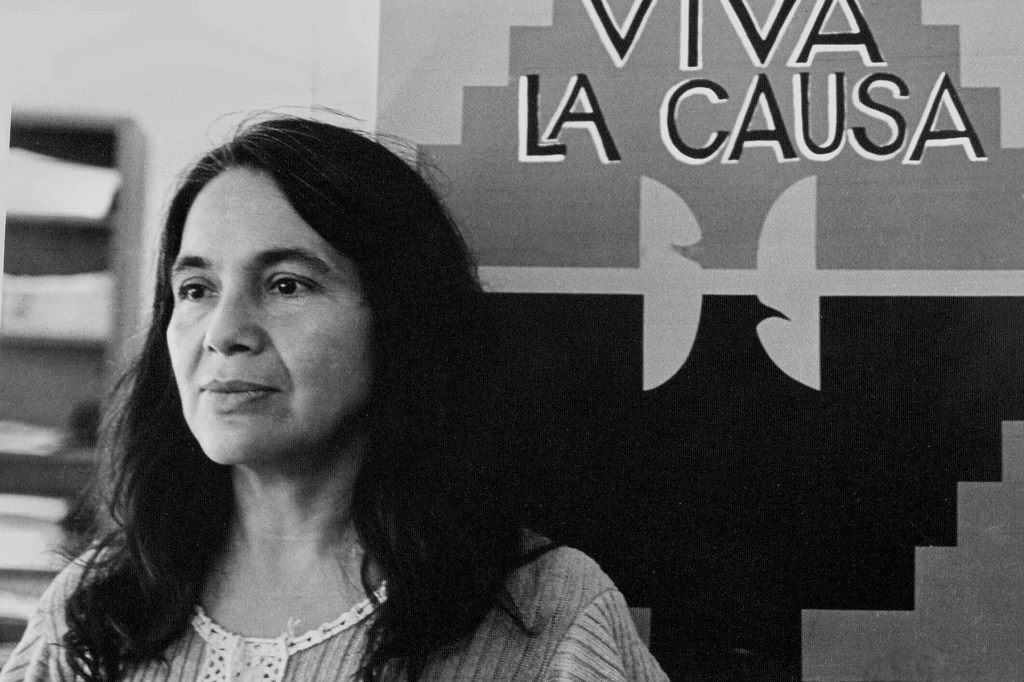
In March 2026, Huerta revealed to the New York Times that she herself was a victim of sexual assault, detailing two encounters with Chávez, one of which she says was rape. The bombshell revelation came as part of an investigation conducted by the Times that revealed a pattern of sexual assault by Chávez against women and girls in the movement.
Huerta said she kept the assaults she endured secret to protect the work they were doing. “I never talked about it to anybody and the reason I didn’t is because I just didn’t want to hurt the movement.”
Huerta also worked to change the culture within the union itself. In the same “Frontline” interview, she describes how she would take note of every time someone made a sexist comment in board meetings. The first time she did this, she noted 58 sexist remarks. “They were all shocked, and then the next meeting, I got them down to 30, then 20, then eventually two and pretty soon zero,” she said.
“I believe that’s why it’s so important to have women involved,” she said. “In the farmworkers’ union, we had a lot of women on the front lines, we had a lot of women in our departments. The best way to curb this type of macho sexist culture is to make sure that women are involved.”
In her later years, she became involved in the broader women’s rights movement, working for the Feminist Majority Foundation on its Feminization of Power campaign, where she advocated for more Latinas to run for office.
While in her early labor organizing years she was outspoken against abortion, she would later change her view on the issue. In an interview published in 2018 by Signs, a feminist journal based at the University of Chicago, she described how her stance was rooted in her Catholic upbringing and shifted as she learned from feminist leaders like Steinem and Eleanor Smeal, cofounder of the Feminist Majority Foundation.
“I’m glad I went through that because it helps me to be able to transfer that transition to other women, especially to Latina women, to make them understand that this is a basic right that women need to have. And access to abortion is a human right that women need to have because if you cannot have control over your body, it’s very hard to control anything else,” she said at the time.
Huerta herself had 11 children, whom she raised mostly as a single mother.

Throughout her life she received numerous accolades, including the Presidential Medal of Freedom from then-President Barack Obama in 2012 and the Eleanor Roosevelt Human Rights Award in 1998. She also was the first Latina inducted into the National Women’s Hall of Fame.
Her legacy continues through the Dolores Huerta Foundation, which she cofounded with her daughter Camila Chavez in 2003 to promote grassroots organizing for social justice; her daughter continues to serve as its executive director.
Several schools around the country, including four elementary schools in California, have been named in her honor. Three states — California, Washington and Nevada — celebrate Dolores Huerta Day.