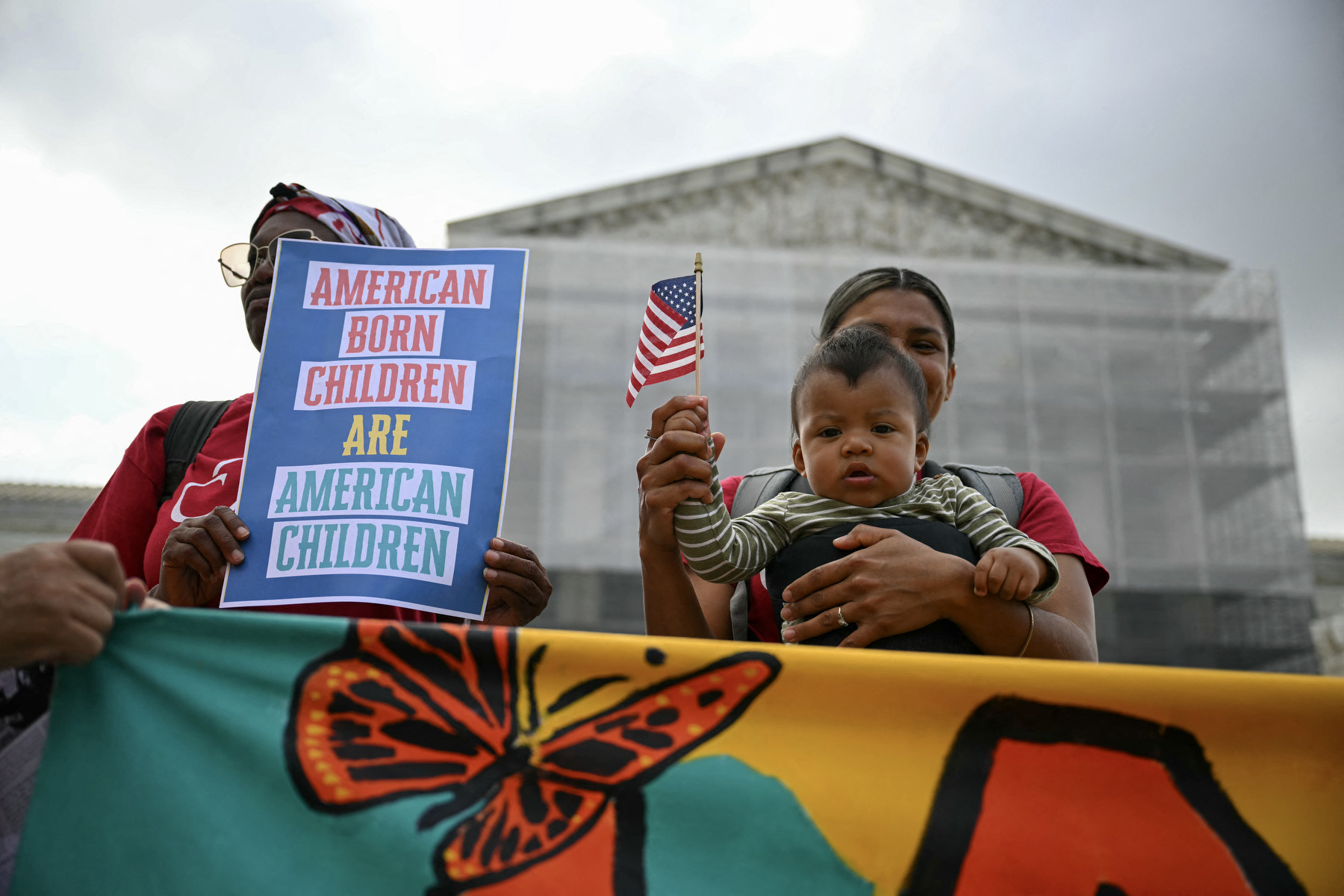

In the wake of a Supreme Court decision this week upholding the constitutional right to birthright citizenship, the Trump administration and fellow Republican immigration hardliners are exploring alternative routes to limit citizenship rights for children born within the United States to foreign tourists.
Markwayne Mullin, the head of President Donald Trump’s Department of Homeland Security, suggested on “Fox & Friends” Wednesday morning that this effort could include banning pregnant foreigners from traveling to the United States.
“There are tourist visas that they get to come into the United States or into our territories just simply to give birth; they’ll come in the eighth month, maybe one, two, three weeks left, give birth here,” Mullin said. He did not offer any evidence that the practice is widespread.
They “have a child who may move back to China, raise the person in a communist regime — even though they’re a citizen of the United States — and they come back over here, and in some cases, they go to universities, stealing intellectual property. It’s absolutely been a national security issue,” Mullin continued.
Mullin added that there was a “long conversation at the White House” on Tuesday after the Supreme Court ruled in the birthright citizenship case. He met with Trump; Stephen Miller, a top adviser to the president and the architect of many of his far-right immigration policies; and Tom Homan, the president’s “border czar.”
Miller, when asked by Fox News later that day about whether the administration should ban travel by pregnant foreigners, said that the country needed to think “very carefully” about who is allowed to deliver a baby here.
Here’s what to know about birth-related tourism in the United States, how the Trump administration has moved to limit it and what they are talking about doing next.
This story will be updated.
Is birth-related tourism common?
The federal government does not keep an official tally of how many foreign tourists traveled to the United States to give birth so their babies could be U.S. citizens. The Center for Immigration Studies, which advocates for significantly reducing immigration, estimated that in 2020 there were between 20,000 and 26,000 possible instances of babies born in the United States to foreign tourists. There were 3.6 million babies born in the country that year; the potential cases the conservative advocacy group identified account for less than 1 percent of overall births. The nonpartisan Migration Policy Institute has described birth tourism as a “rare practice.”
Has the Trump administration tried to crack down on what it calls “birth tourism” before?
The State Department announced earlier this month that the U.S. Embassy in West Africa had “uncovered a sophisticated birth tourism network of more than 100 foreign nationals using fraudulent documents and visa ‘fixers’ to get themselves visas to get U.S. citizenship for their children.”
“Under President Trump, the State Department is defending the integrity of U.S. citizenship by ending illegal birth tourism schemes,” the agency said.
The State Department had, in the early months of Trump’s second term, issued a travel-related announcement that U.S. consular officers would deny the tourist visas of any traveler determined to be coming to the United States for the primary purpose of giving birth so their child would gain citizenship.
In April, shortly after the Supreme Court heard oral arguments in the birthright citizenship case — and the justices seemed skeptical that Trump had the authority to issue an executive order ending the practice — the news agency Reuters reported that Immigration and Customs Enforcement (ICE) ordered its investigators to also focus on a new “Birth Tourism Initiative.”
Traveling to the United States on a temporary tourist visa for the primary purpose of giving birth is currently prohibited. Though customs officers are limited in how they can question visa applicants about pregnancy, federal immigration enforcement agencies have wide latitude to determine how policies are implemented.
In late 2014, for example, the United States and China entered into a decade-long reciprocal visa agreement. Based on this agreement, consular officers were directed not to deny visa applicants from China, even if their primary purpose for travel was to give birth and obtain U.S. citizenship for their child — they were to be treated like any other applicant for a medical visa.
In early 2020, the State Department amended its policies to “establish that travel to the United States with the primary purpose of obtaining U.S. citizenship for a child by giving birth in the United States is an impermissible basis for the issuance of a B nonimmigrant visa.” It also heightened the standards to qualify for a medical visa, including demonstrating the means to pay for treatment.
How did birth-related tourism factor into the birthright citizenship case before the Supreme Court?
Limiting the ability of tourists and other immigrants to obtain U.S. citizenship for their children has been a longtime priority of the Republican Party’s conservative flank — and it factored into the legal arguments the Trump administration made in Trump v. Barbara, the birthright citizenship case.
Solicitor General D. John Sauer told the justices that birthright citizenship has “spawned a sprawling industry of birth tourism” and that tourists from “hostile nations have flocked to give birth in the United States.” Chief Justice John Roberts, a conservative who is often a swing vote on the divided court, asked Sauer for more information about the prevalence of birth-related tourism. Sauer responded: “No one knows for sure.”
Roberts wrote the opinion for the 6-3 majority that upheld the constitutional right to birthright citizenship. Fellow conservative Justice Amy Coney Barrett joined him with the court’s three liberal justices: Justices Sonia Sotomayor, Elena Kagan and Ketanji Brown Jackson. Conservative Justice Brett Kavanaugh agreed with the outcome of the case but on different legal grounds.
Justice Samuel Alito wrote about alleged “birth tourists” in his dissenting opinion, describing them as “women who come here solely for the purpose of giving birth to a child and then promptly return home.”
How might the Trump administration enforce further restrictions on the travel of pregnant foreign tourists?
It is not yet clear how the Trump administration might further direct immigration enforcement agencies to crack down on pregnant foreign tourists entering the country.
Thus far, much of the public discussion from members of the administration has focused on limiting the travel of pregnant foreign nationals who are visibly in the later stages of pregnancy. Mullin said on Fox & Friends that traveling late during a pregnancy “can also cause a health issue for the mother.” (It can also be dangerous at earlier stages.) He did not offer any evidence that the administration’s immigration-related investigations showed that birth-related tourism was happening in the final weeks of pregnancy.
Correction: An earlier version of this story misstated the justice who agreed in part with the decision.


