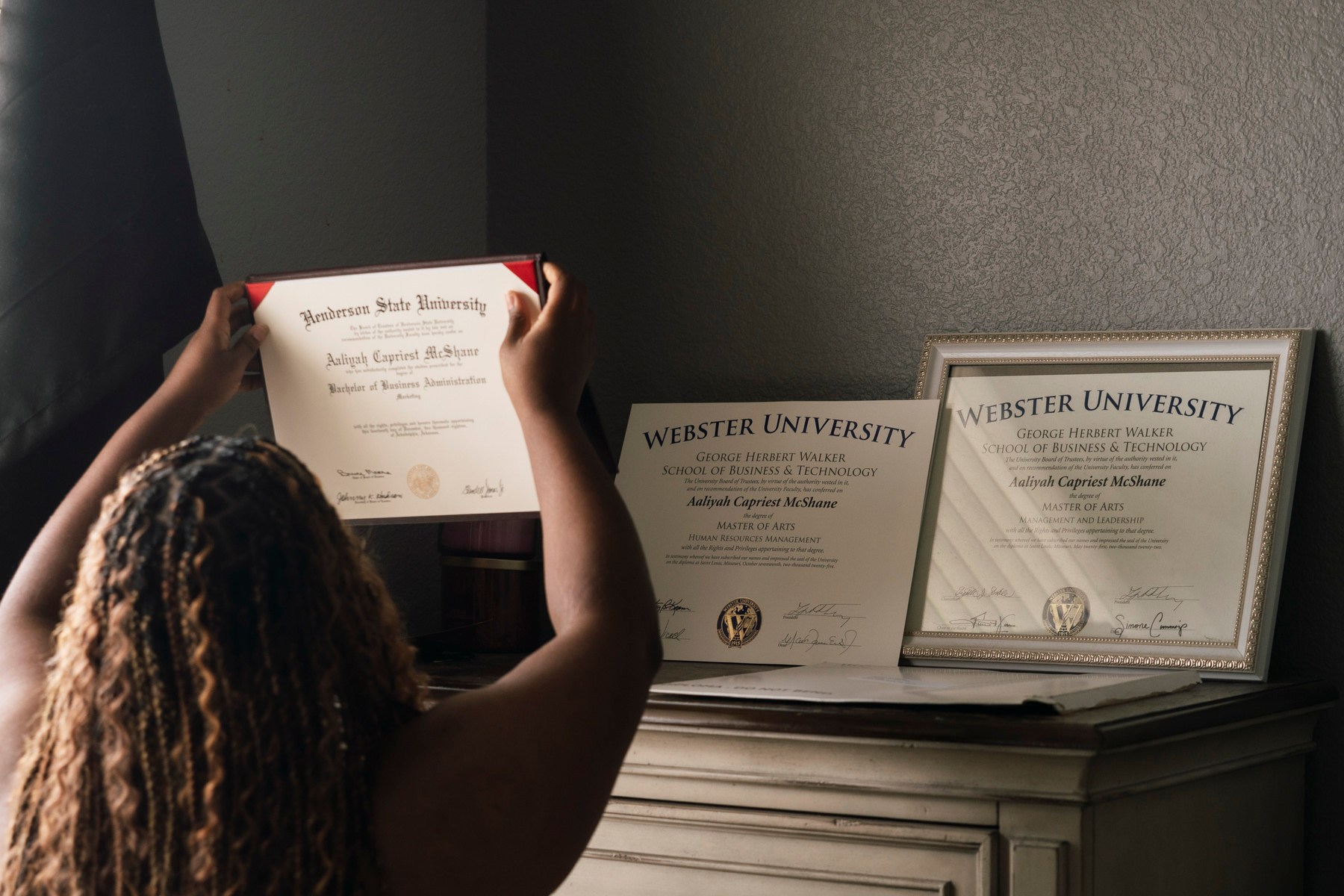
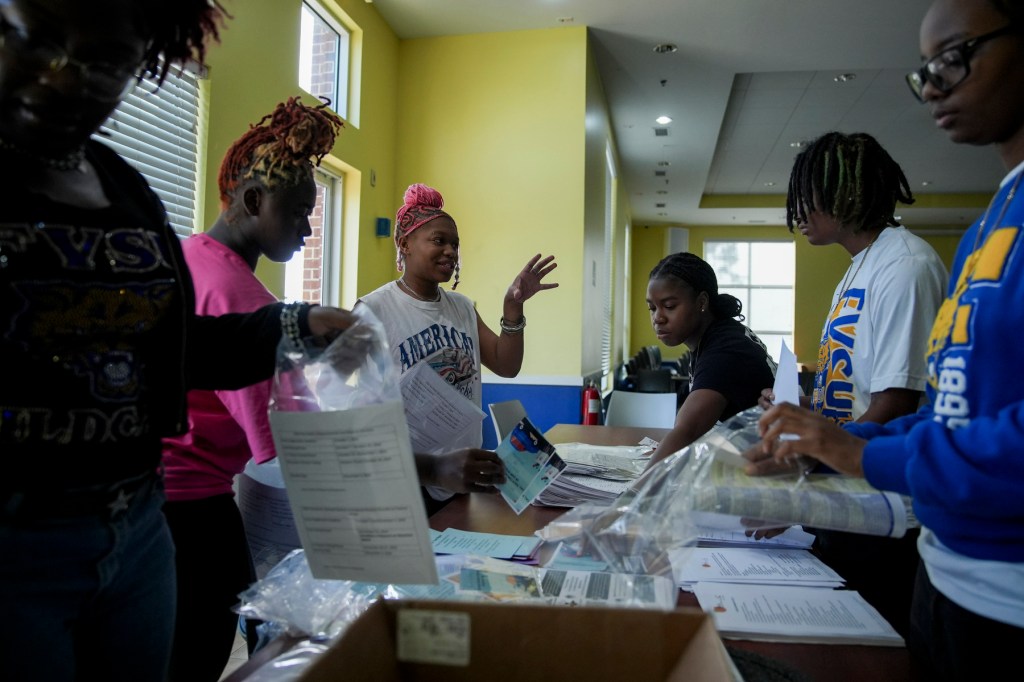
Leila Kuguru has big dreams of attending law school to become a federal prosecutor or public defender. On campus, Kuguru, a senior political science major at Clark Atlanta University, serves as the chair of CAU Votes, a student-led civic engagement organization. In the lead-up to the midterms, Kuguru led a campaign to help register students at her HBCU to vote and get them prepared for the upcoming election.
Kuguru cares about voting. And as she heads to the polls this year, she has one topic top of mind: affordability. As a Black woman, she’s wondering, “What happens when you do everything you’re told to do and still struggle to afford everything?”
Black women in college are headed into a volatile postgrad environment. The unemployment rate for Black women rose sharply from 5.6 percent in August to 6.8 percent in September. White women’s unemployment rate held steady, hitting just below 3 percent in September. And as of June 2026, the unemployment rate for recent college graduates was 5.7 percent according to the New York Federal Reserve. The unemployment rate for the general population was 4.1 percent.
Black women’s participation in the labor force has been on a decline. According to data from the Economy Policy Institute, Black women suffered from the largest employment loss last year, the unemployment rate jumping almost an entire percentage point from 2024, in large part due to cuts to the federal workforce made by the so-called Department of Government Efficiency. Black women with bachelor’s degrees were among the hardest hit. The employment rate for Black women with bachelor’s degrees fell by 3.5 percentage points over the past year — a larger decline than any other education attainment level.
“We can’t talk about the economy without talking about the almost 300,000 Black women that lost their jobs, or the families struggling to afford food and housing, or the students that are graduating without knowing whether they’ll be able to support themselves post-grad. Even if we want to get a post-grad education, how are we going to pay for it?” Kuguru said. “Affordability is definitely a big issue on my mind as a senior preparing to graduate.”
The 19th spoke to Black women near college graduation about the midterm elections. They said affordability, finding work and funding their post-baccalaureate education were among their top concerns.
Federal cuts
President Donald Trump has enacted sweeping changes to higher education that could have a major impact on Black women, who rely on student loans more than any other demographic. In July, the Education Department banned federal student loans for college programs whose median salaries earn less than people with only a high school diploma. The rule also limits how much students can borrow. Programs designated as non-professional graduate programs faced a loan cap of $100,000, while professional degrees, like medicine and law, were capped at $200,000. Only 11 programs qualified as professional degrees, with career fields traditionally dominated by women, like teaching and nursing, left off the list.
As a senior, Kuguru is concerned with how she will afford law school. The average cost of law school in 2026 is $198,788, with elite law schools charging over $80,000 a year for tuition and fees.
“It’s a little nerve-wracking because … the occupant of 1600 Pennsylvania Avenue right now thinks that there is a categorization of what jobs are considered professional degrees and not professional,” Kuguru said.
Aisosa Onaghise is a first-year master’s student at San Diego State University, where she studies English and comparative literature. She graduated from the University of California, Los Angeles in 2025 after transferring from a community college. After graduating, Onaghise struggled but found work as a substitute teacher.
Onaghise said she felt targeted by the new rules. She graduated from UCLA debt free but planned to take out loans for her second year of her master’s degree.
“You already have to do so much to justify your degree in the humanities. People saying, ‘Oh, it doesn’t have a strong return, like STEM or engineering.’ So for the federal government to say, ‘Yeah, there’s no return. So you’re not going to get federal loans from us to pursue this.’ It [feels] like daggers,” Onaghise said.
But no candidates have stood out to her regarding affordability and her other concerns.
“They’re [saying] vote blue no matter what, blue wave, [but] what is that supposed to signal? Are we hoping that they’re gonna push for more job openings, maybe put regulation around AI so maybe more jobs can actually open up, you know? So I’m not hearing any of that,” Onaghise said.
Onaghise is supported by her parents but feels guilty about it. “They’re in their 60s. They should be prepping and saving more for their retirement, but I feel like I’m still pulling so much from them, because everything is so expensive, and I’m unable to actually lock down a stable entry-level job,” she said.
Niambi Carter, an associate professor at the School of Public Policy at the University of Maryland, said that, between cuts to the federal workforce and the student loan caps, Black women have been targeted.
“I don’t think this many Black women end up unemployed by happenstance. I think part of the targeting of these positions going after, and not just in terms of DOGE, but even going after the professions where we find a lot of women and a lot of Black women in particular, nursing, social work, etc., and declassifying them as professions, even suggesting that they are not worthy of student loan financing because they are not lucrative enough, is a direct shot across the bow at Black women,” Carter said.
Managing expenses
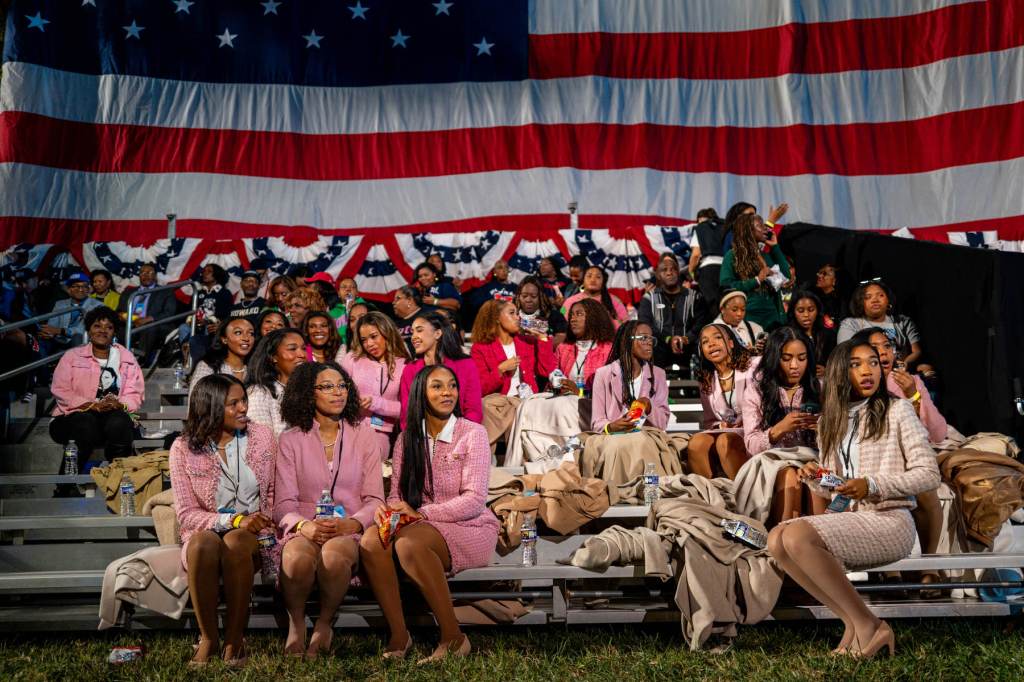
Morgan, who asked for her last name to be withheld to protect her privacy as a scholarship recipient, is a senior at the Georgia Institute of Technology. She says that affordability is “practically nonexistent” when it comes to housing, education and food. With a part-time job in addition to her studies and campus activities, Morgan struggles to find affordable groceries.
“I have to drive further out of Atlanta to get to a more affordable place to buy my groceries because there’s not anywhere that really has reasonable prices for a college student with a part-time job’” she said. “I feel like I can’t hold on to money no matter what I do.”
Morgan hopes that candidates can help alleviate these pressures and make everyday living costs more affordable.
“It just feels like things are getting worse and worse. And I want to see legislation and proactive politicians that are seeking to actually make things more affordable; not just say that they’ll be more affordable and then sell out to the next buyer,” she said.
At the polls, Gen Z tends to vote for issues they are concerned about rather than sticking to a party. Twenty-nine percent of people ages 18 to 29 identify as independents rather than Democrats or Republicans. And in the 2024 election, 46 percent of young people who voted said they did to support action on issues they cared about.
Still, Black voters overwhelmingly go for Democratic candidates — especially Black women. Carter feels that the Democratic Party has failed to meet this moment for young Black women. Black women are one of the strongest Democratic voting blocks, with 92 percent voting for Kamala Harris in 2024.
“[It] speaks to a Democratic Party that feels like they’ve captured Black voters,” Carter said. “Like there is no place for Black voters to go, and that is kind of true, right? But I think the national Democratic Party, because of the moment we’re in, have backed off talking about Black ideas, Black people, Black politics.”
This matches Kuguru’s experience: Though she is excited to vote, she expresses frustration with Black women voters being expected to save democracy. “Black women in particular are often expected to organize, mobilize and show up for everyone else,” she said.
There are 77 Black women on the ballots this midterm election, including Georgia gubernatorial candidate Keisha Lance Bottoms. Kuguru expressed her support for Bottoms’ goal of raising Georgia’s minimum wage to $15 an hour, stating, “That tangible action is really what we need from this election.”
Kuguru finds Black women dominating the midterms exciting as it offers her a sense of comfort. She finds that some of the politicians who don’t look like her do not consider her best interests. Living in Georgia, it hits especially close to home: A 2018 APM Reports investigation revealed that then-Georgia Republican Secretary of State Brian Kemp, now the state’s governor, led the purge of over a half a million voters in 2017, with an overwhelming number of them being Black.
Kuguru said that Black women running offers her a “sense of security.” She points to moves like the removal of hundreds of thousands of voters from the rolls in 2017, something the secretary of state has power over.
This year Penny Brown Reynolds is running for secretary of state of Georgia, her win would make her the first Black woman to hold that position in the state. “On November the 3rd, I know I’ve done everything that I’m supposed to do,” Brown Reynolds told The 19th.” I have worked harder on this than anything I’ve ever done in my life. Over 450 days I’ve been at this, but now the question becomes: Who are you in this moment?”
Remaining optimistic
Both Kuguru and Onaghise show that losing hope is not an option.
“I can’t even think of the ‘what if‘ right now. I can’t because the reality is thick. So if we’re voting with reality in mind, it’s going to be a clear win,” Kuguru said.
Onaghise hopes to become an adjunct professor or a communications professional but feels scared about options for her future.
“I want to feel hopeful. I want to feel optimistic, but I feel like everybody is struggling so much, whether it’s finding a job, being able to budget and actually afford essentials,” she said. “I feel like it’s a very pessimistic time for a lot of people going into the midterms. I feel like there is so much distrust in the government. I feel there’s so much infighting. So I’m wondering, are politicians actually going to do the work to actually address affordability?”

Onaghise says she doesn’t take voting for granted and that Republican efforts to restrict voting show that it’s important.
“I haven’t talked to my friends too much about voting because everybody’s so busy. But I feel like there’s a greater sense of responsibility among Gen Z women, especially voting more progressively, when it comes to [things like] the economy and reproductive rights,” Onaghise said.
Jennifer Gerson contributed to this reporting. To check your voter registration status or to get more information about how to vote and what’s on your ballot, visit vote.org.