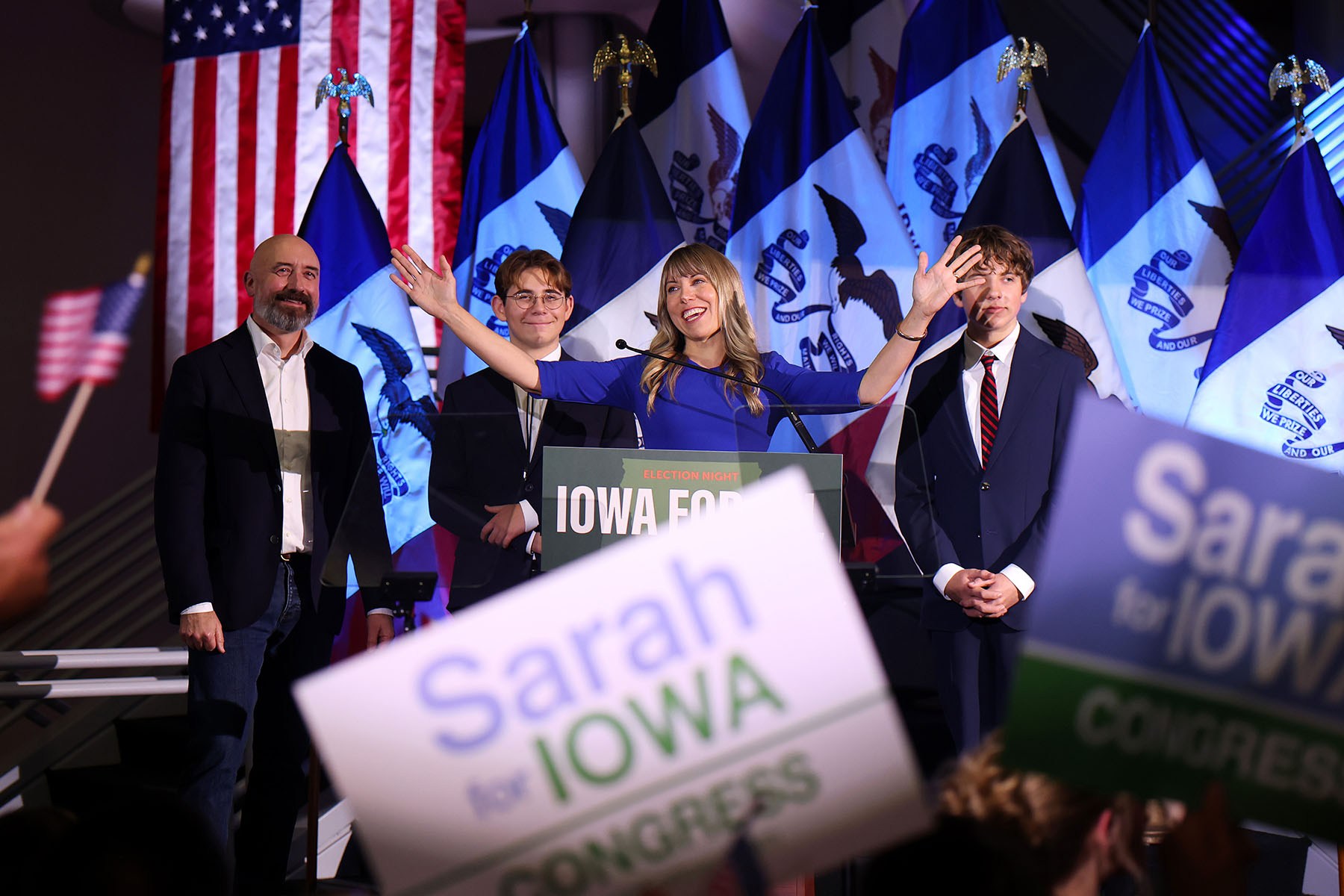
Republican women in Iowa, who once enjoyed gender parity in congressional representation, will have no seats when the next Congress is sworn in, losses that reflect a bigger trend on an election night where Democrats across the country flipped enough seats to take control of the House and Senate.
Before Election Day, GOP women held a Senate seat and two of Iowa’s four congressional seats. After Tuesday, they will have no representation in either chamber, according to projections from Decision Desk HQ.
GOP Sen. Joni Ernst had decided to not seek reelection, and Iowa’s Ashley Hinson lost the race for her seat to Democrat Josh Turek. It wasn’t just in Iowa where Republican women lost: The longest-serving Republican woman senator, Maine’s Susan Collins, fell to Democrat Troy Jackson.
More women were on state and federal ballots this cycle, with a record number running for the U.S. House — but Republican women are increasingly lagging their Democratic counterparts in congressional representation nationwide. Among nominees for U.S. House seats, 203 are Democrats, versus 76 Republicans, according to the Center for American Women and Politics (CAWP). And those who are in Congress also experience the gender disparity: 42 percent of Democrats in the 119th Congress are women, compared with only 15 percent of Republicans, according to CAWP data.
Experts say that at every stage of the process — from recruitment to fundraising to campaigning to governing — Republican women face unique challenges, roadblocks and obstacles. They are running in a party that says it doesn’t care about gender identity and attempting to attract voters who are less likely to see women as viable leaders.

There are far fewer training programs and organizations geared explicitly toward preparing Republican women to run for election. That means fewer run for state and local office — and hence fewer have the experience, networks and qualifications to run for higher federal office.
Still, there were a few bright spots for Republican women on Tuesday. Marsha Blackburn, who made history in 2018 when she became the first woman elected to the Senate from Tennessee, made history again by becoming the state’s first woman governor. Florida Sen. Ashley Moody won reelection, defeating Angie Nixon, a democratic socialist.
The losses in Iowa are also a referendum on President Donald Trump, who won the state every time he’s been on the ballot and held a rally in Dubuque over the weekend. They come as Republican presidential hopefuls prepare to swarm the first-in-the-nation caucus state in the lead-up to 2028.
Hinson’s Senate bid opened up her seat representing the state’s 2nd District, where Democratic state Rep. Lindsay James defeated Republican state Rep. Joe Mitchell.
In Iowa’s 3rd District, which includes Des Moines, Democratic state Sen. Sarah Trone Garriott defeated incumbent Republican Rep. Zach Nunn, who had been seeking a third term in one of the most competitive districts in the nation.
Former state Rep. Christina Bohannan defeated Rep. Mariannette Miller-Meeks in Iowa’s 1st District, another purple district. The race marked the third matchup between the two women. In 2022, Miller-Meeks won the seat by seven percentage points. In 2024, she won reelection by fewer than 800 votes.
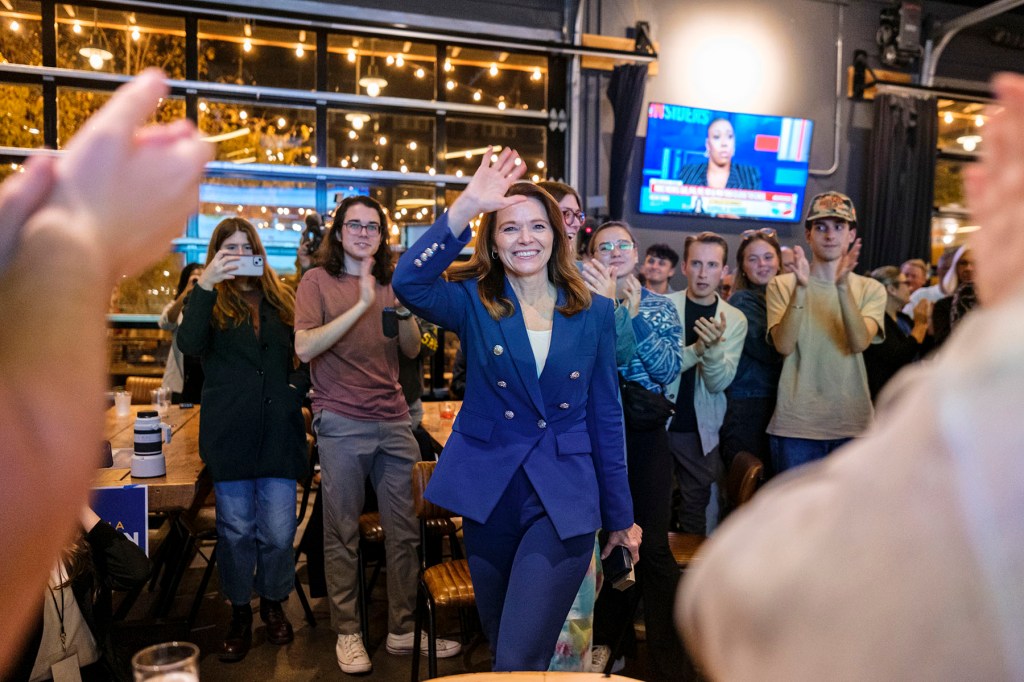
A Republican is projected to win Iowa’s 4th District, a conservative pocket of the state. No women had been running for the seat.
Republican women also lost representation in major statewide offices. Gov. Kim Reynolds was not seeking another term, and only male candidates were on the ballot to replace her.
Polling shows that women in both parties face the double bind of needing to show competence and likeability. But Republican women face additional money problems, lack of party support and more complicated electability requirements.

The Democratic Party has large, centralized political action committees (PACs) like EMILY’s List dedicated to funding women through primaries. There’s no equivalent on the Republican side. And in terms of messaging, the Republican Party isn’t interested in explicitly talking about why it’s important to elect women.
Republicans are also more likely to hold beliefs about traditional gender roles, in which men are breadwinners and protectors and women rear children at home and follow their husbands.
About 84 percent of Republicans believe that society would benefit from a return to traditional gender roles, compared with 34 percent of Democrats, according to a recent 19th/YouGov poll.