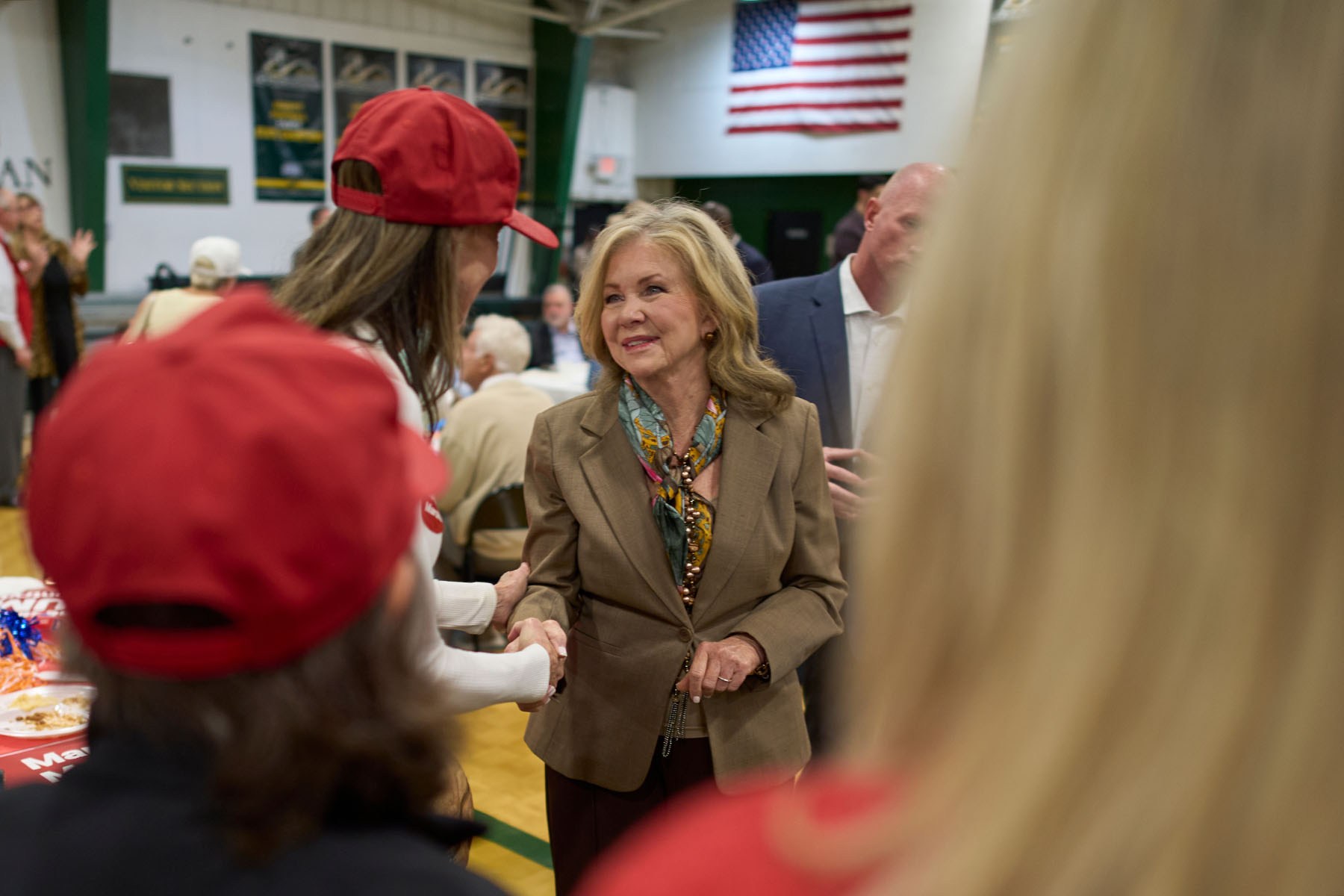

Marsha Blackburn made history in 2018 when she became the first woman elected to the U.S. Senate from Tennessee. Now, she’s poised to make history again and become the state’s first woman governor in its 230-year history.
Blackburn’s anticipated victory is a bright spot for the Republican Party amid predictions of a blue wave on Tuesday. Her candidacy comes as women continue to make strides in representation: More women were on state and federal ballots this cycle, with a record number running for the U.S. House of Representatives, according to the Center for American Women and Politics (CAWP).
But while 19 Democratic women are their party’s gubernatorial nominees, Republicans have just seven. Among nominees for U.S. House seats, 203 are Democrats, versus 76 Republicans, according to CAWP.
And those who are in Congress also experience the gender disparity: 42 percent of Democrats in the 119th Congress are women, compared with only 15 percent of Republicans, according to the CAWP data.
So why are there fewer Republican women in office? Experts say that at every stage of the process — from recruitment to fundraising to campaigning to governing — these women face unique challenges, roadblocks and obstacles. They are running in a party that says it doesn’t care about gender identity and attempting to attract voters who are less likely to see women as viable leaders.
Jennifer Lim, co-founder and executive director of Republican Women for Progress, said she’s been working to develop a pipeline for Republican women who want to run for office. In the past decade, Lim said, the grassroots policy organization has helped thousands of women at the local, state and federal level through one-on-one assistance and an annual one-day training.
“Republican women are in the predicament they’re in because they’re in a party that assumes the best candidate is going to win, but of course this doesn’t work because there are structural issues that are specific to Republican women,” Lim said.
Lim said her organization has helped women across the Republican spectrum — from those who considered themselves moderates and opted to vote for Hillary Clinton in the 2016 election to some who worked at the White House during President Donald Trump’s first administration.
But, she said, there are far fewer training programs and organizations geared explicitly toward preparing Republican women to run for election. That means fewer run for state and local office — and hence fewer have the experience, networks and qualifications to run for higher federal office.
Amanda Hunter, the former executive director of the Barbara Lee Family Foundation who oversaw research on women running for office, said voters often have a stubborn “imagination barrier” when it comes to picturing a woman in an elected position that a woman has never held before.
“We’ve seen that women are expected to hit the ground running on day one. And if they don’t, they’re judged,” Hunter said. “Men are sort of given permission to grow into a job, while women are questioned going into the job.”
Women in both parties also face the double bind of needing to show competence and likeability.
“The research repeatedly found that voters say they won’t vote for a woman if they don’t like her, but they will vote for a man they don’t like — assuming that both are qualified,” said Hunter, who is now an adjunct professor at the Women in Politics Institute at American University. “A woman has to show that she is strong enough, but she can’t seem too tough or too mean because then she won’t be likeable.”
Money problems
The Democratic Party has large, centralized political action committees (PACs) like EMILY’s List dedicated to funding women through primaries. There’s no equivalent on the Republican side.
EMILY’s List was founded in 1985 after Democratic women recognized that the traditional party establishment, which was largely controlled by men, was not doing enough to recruit, fund or elect women. Now, EMILY’s List is one of the largest PACs in the country, supporting Democratic women who back abortion rights. In the 2026 election cycle, it raised more than $46 million, according to Federal Election Commission data,
Maggie’s List, a Republican PAC founded in 2010 to raise awareness and funds to elect conservative women, raised around $400,000 in the same time period, according to federal data.
“There are a lot more Democratic women donors that give to Democratic women — there’s buckets just for them,” Lim said. “There are so few Republican women and Republican donors that give specifically to Republican women’s organizations. And so oftentimes, Republican women and Republican men are competing for the same money.”
Lim said Republican donors don’t typically give to Republican women’s organizations because they don’t see a point when voters aren’t explicitly demanding more women run.
And the few GOP organizations that do give to women are usually connected to the party — which Lim said is a “real problem.”
“Whatever messaging you’re putting out has to be party messaging,” Lim said. “And for right now, these organizations are not going to support anybody who isn’t falling into the MAGA universe. There’s not really any room to be your own type of Republican woman here. I think there’s a lot more flexibility on the Democratic women’s side.”
Lack of party support
After addressing pipeline and money issues, Lim said the party needs to send a different message about women, noting that for so long Republican women have been caught in “this cage of identity politics,” where the party isn’t interested in talking about why this demographic group is important to elect.
“They have to start talking about the value that Republican women add to the party and add as lawmakers,” Lim said. “The party could have any sort of messaging to voters that it’s OK to vote for Republican women, that you should vote for Republican women.”
In addition, Lim said women right now are concerned about their safety and the safety of their families as the political climate gets more divisive and violent. They are mindful that under this administration, they could face backlash from within their own party if they step out of line.
“If you’re a woman working in Republican politics right now and you’re not quite in the place where the administration has taken the party, then you’re afraid of repercussions,” Lim said.
The question of electability
It’s not just about the party — it’s about voters.
Sarah Kornfield, a communications professor and the director of women’s and gender studies at Hope College, said Republicans are more likely to hold beliefs about traditional gender roles, in which men are breadwinners and protectors and women rear children at home and follow their husbands.
“For people who identify this way, to vote for a woman is in many ways contrary to their beliefs about what it means to be a man and what it means to be a woman,” Kornfield said. “It’s especially hard for the men to vote for a woman because there’s a concern about being emasculated.”
About 84 percent of Republicans believe that society would benefit from a return to traditional gender roles, compared with 34 percent of Democrats, according to a recent 19th/YouGov poll.
Kornfield also pointed to research that used the metaphor of a country as a family unit. In his 1996 book, “Moral Politics: How Liberals and Conservatives Think,” George Lakoff found that Republicans tend to view their political leaders as a “stern father” who sets strict rules, teaches discipline and protects the family from a dangerous external world. Democrats, on the other hand, view elected officials as nurturing parents who focus on empathy, open communication and shared social responsibility.
Paired with the belief in traditional values, Kornfield said it is doubly difficult for women to embody a “strict father” persona while maintaining the accepted traditional role of a woman. She pointed to former Alaska Gov. Sarah Palin, who was on the GOP presidential ticket in 2008, as a successful example. Palin famously referred to herself as “Mama Grizzly.”
“She was feminine enough as a former beauty queen, but she was also tough,” Kornfield said. “Sarah Palin really walked this tightrope and framed herself as a particular type of frontier mother, a woman who gets the job done without being emasculating.”
When asked if a woman presidential candidate would make the Republican Party more or less likely to win, about 32 percent of Republicans said it would make them less likely or much less likely to win, according to The 19th/YouGov poll.

Still, there are some prominent Republican women on the ballot this year. Gov. Sarah Huckabee Sanders is cruising toward reelection in Arkansas’ gubernatorial race. Rep. Maria Elvira Salazar, the Florida incumbent who recently broke with Trump on his immigration agenda, still holds an advantage in a tight House race. Sen. Ashley Moody, who was appointed to replace Secretary of State Marco Rubio, is generally favored in her race against Florida state Rep. Angie Nixon, a democratic socialist who has gained significant momentum and national attention even in the deep-red state. Rep. Ashley Hinson, widely seen as a rising star in GOP politics, is running in Iowa for the open Senate seat vacated by Sen. Joni Ernst after her retirement. The House Republican caucus’ top-ranked woman, Rep. Lisa McClain, is running for reelection in Michigan.
Alysse Baker, an assistant professor of communication at Roanoke College, said studies found that Republicans are also more likely to believe that if people are in status positions or higher social hierarchies, — it’s because they’re more deserving or inherently better than other groups.
“If you believe that different groups have different power because that’s just the way the world works, then at least in the United States that means supporting a patriarchal structure that benefits men who are White,” Baker said. “That also translates to not being able to see women in leadership positions because leadership positions are traditionally held by men.”
To check your voter registration status or to get more information about how to vote and what’s on your ballot, visit vote.org.